

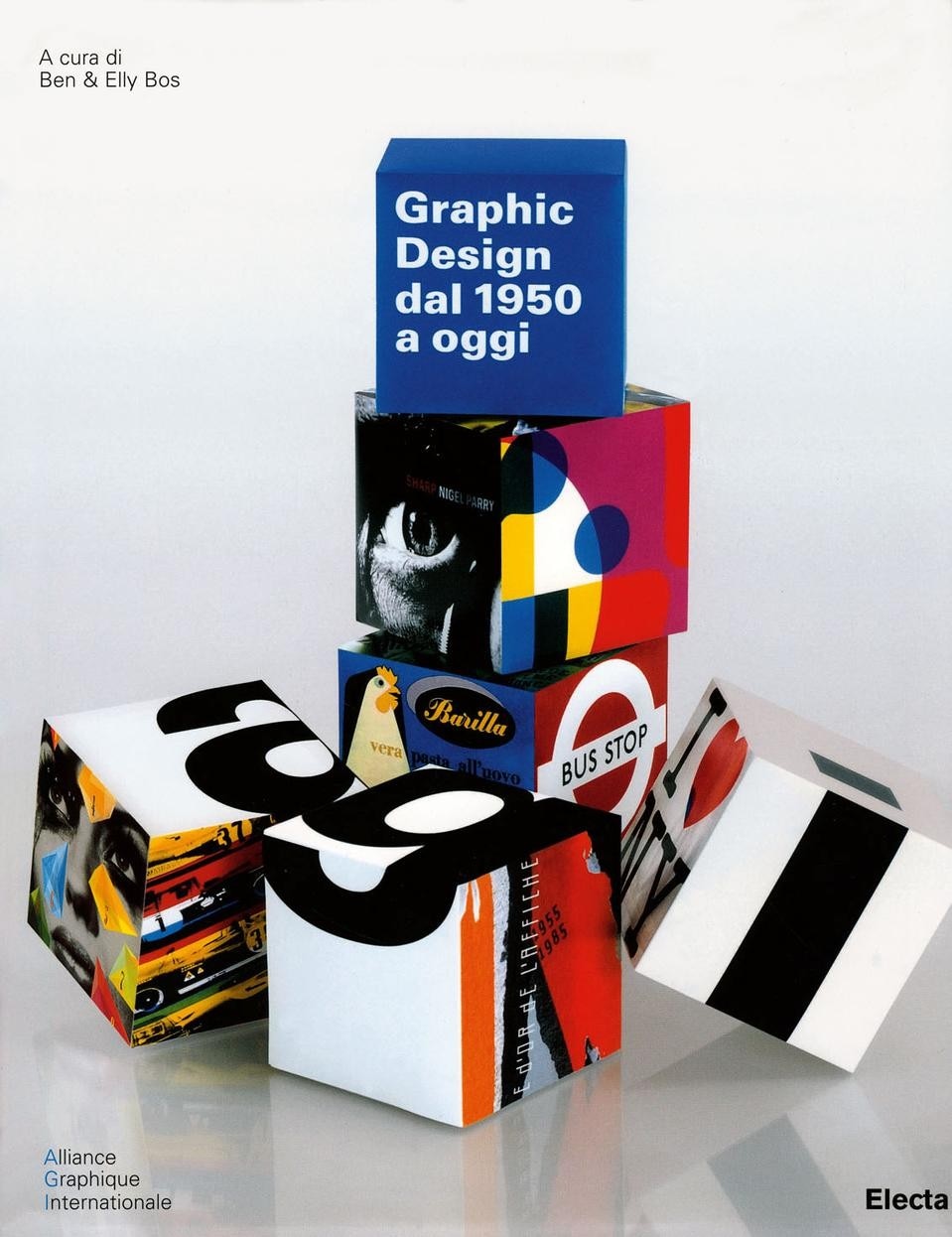
Graphic Design dal 1950 a oggi
a cura di Ben & Ely Bos, AGI – Electa, Milano 2008 (pp. 704, € 85,00)
The title is as ambitious as the book is voluminous, its 704 pages offering adequate space for a true “history of graphic design after 1950”. But this book is something more, and something less. There are two keys to it. The first relates to a rerun of what graphic design has produced since the mid-20th century. A second slant makes the book more like an Alliance Graphique Internationale family album: the most influential gathering of professionals in the sector, whose experience does not, however, cover everything that can be said or designed in the field of graphic design.
With 350 members, AGI is tiny compared with national associations such as the American AIGA (with approximately 55,000). Nor does it have the representative ambitions of Icograda, the International Council of Graphic Design Associations. It was born “out of curiosity”, remembers former president Laurence Madrelle, to enable the first protagonists in a marginal sector to meet colleagues whose work they hardly knew. Founded in 1951 by a small group of people from Switzerland and France, AGI grew rapidly in its early years. Each new candidate was screened and approved by the unanimous vote of existing members, a selection process that guaranteed prestige but perpetuated a consistent vision of graphic design, with little room for creative debate. A functionalist imprint, in vogue in AGI’s early decades, was shared by many of its members. Some of them were linked to the experience of the Cranbrook Academy, which launched graphic design’s reflection on the post-modern and deconstructionism. But the book – and the AGI – affords little attention to the broader trend that was born out of them and flourished in the 1990s.
However, it would be disparaging to speak of an “AGI style”. This is not any old club or the megaphone for a trend. It is an Olympus that attracted names such as Paul Rand, Lars Müller-Brockmann, Milton Glaser and Alan Fletcher to mention but a few. In Italy, the same criterion flags up Munari, Tovaglia, Mari, Lupi and Sonnoli (plus another 19). The first part of the book is structured chronologically. Decade after decade, it retraces the era’s socio-political context more than its artistic evolution, starting from the “choice of ends” of the Bauhaus and the Dutch graphic designers’ involvement in the Resistance (Albe Steiner’s similar experience in Italy is exemplary). The essays that address the AGI as an organisation allocate greater space to the design aspects, but not overly so and the “family album” effect prevails. Memories of coaches lost in the Polish countryside for the 1972 convention are mixed with others in more dramatic circumstances, such as the Yom Kippur War that stopped AGI meeting in Jerusalem the following year.
After the introductory texts, each section presents the graphic designers who joined AGI in that decade. The selection of their works includes previous or later projects, but a time scale does emerge and, with it, a sense of graphic design’s evolution as a discipline. It began to be recognised as an autonomous form of expression in the 1950s (it only started to be taught as a subject ten years later in Italy, where the graphic designers of the day excelled). Another evolution concerned its fields of application. The pre-eminence of the poster, which marked whole decades, gradually gave way to the creation of logotypes and then the creation of the corporate image true and proper – the visual counterparts of the corporation in economic and political space. A similar process applied to public space and services. Even signage was turned into a complex and integrated system. Developed in airports, stations, streets and the Olympic Games, this too reappeared in sophisticated applications in the corporate sphere. Publishing is a fil rouge that linked the eras, a “noble” terrain which saw competition between not only book-design specialists but also designers with a more eclectic calling.
represented in the book (a chance to reexamine Ootje Oxenaar’s much-admired Dutch banknotes, of which the euros are but a faint memory) and is the subject of two of the fifteen concluding essays on designers, trends and subjects such as teaching, opening film credits and the digital revolution. A history of graphic design seen as the story of the people and ideas that have made AGI would be incomplete, but hardly more so than others produced with encyclopaedic intents. As exhaustive as can reasonably be expected, this book – with nearly 2,000 illustrations – will also be a rich source of inspiration for any designer. The Dutch couple Bos who edited the work have successfully accomplished the task entrusted to them expressly by the association (of which Ben is a member). The Italian edition, which follows that by Thames & Hudson, contains the odd inaccuracy, the product of what is, in places, a hurried translation.