

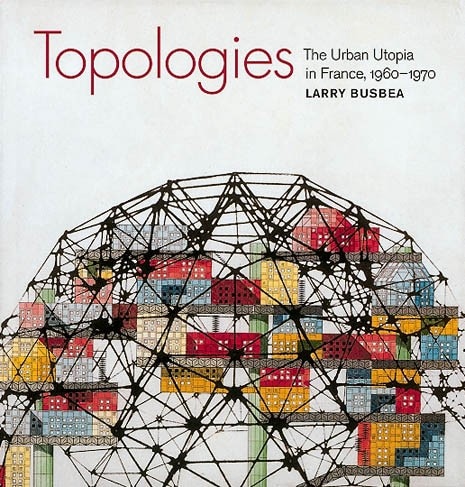
Topologies. The urban utopia in france, 1960-1970, Larry Busbea mit press, cambridge 2007 (pp. 230)
In the mid-1970s, Reyner Banham took a severe view of the work of the French utopians of the previous decade. He considered it a visual and stylistic reduction of concrete problems, and taken as a whole he saw them as representing a fl uctuating movement. To speak of it in more structured terms seemed a contrivance born out of a “journalist’s imagination”. In his book, Larry Busbea is less inclined to take journalistic invention for what he calls a school (doing so several times and referring to Michel Ragon). He is, however, willing to recognise the fictional element of the spatial city: the idea of city that runs through the work of artists and architects who were busy debating the relationships between technology and everyday life at a time when technological change seemed an incessant drive.
This is an interesting book for several reasons. Firstly, it taps into the atmosphere of the present day, so condescending in its discussion of neo-avant-garde radicalism. Secondly, it conscientiously tries to fill an evident gap in historiography, while adding to what we already know about those events. But most interesting is its verdict: French utopianism was more the mark of a moment in history than a revolutionary drive, a sign of the ambivalence that greeted the arrival of capitalistic modernity in France. The book provides a good description of the trusting and peaceful attitude towards technological and industrial energy, seen as forces that could be directed at maximising profit and well-being. And the spatial city was at the core of this ambivalence.
Busbea founds his opinion on the writings, drawings and designs of Michel Ragon, Pierre Restany, Henri Van Lier, Abraham Moles, Nicolas Schöffer, Victor Vasarely and, of course, Yona Friedman. This material shows a brightly lit city, hovering above the ground with fluid, synchronic fluxes running through it and where automated technological equipment guarantees material needs, orchestrates movements and satisfies demands for leisure. Rectilinear and versatile structures, towers that support living cells, streets and buildings: everything comes together in a sort of great sculptural artwork, with colours, lights and sounds condensed into the urban space in a huge spectacle. So far, not much is new compared with the experiences of those years in Europe. What Busbea stresses is the troubling nature of this synthesis. The spatial city is radical and pastoral, rational and picturesque, liberal and technocratic, structuralist and phenomenological, scientific and fantastic. It falls in with Valery, who sees the greatest freedom born out of maximum rigour, while pursuing the imaginative nature of fl uid and fantastic space. The concepts that come with it (spatial networks, textures, grids) are praised by economists as indicators of the liberating potential of postindustrialism; but they are attacked by neoand post-Marxist critics as the apotheosis of exchange and spectacle.
It is difficult to understand whether this view of the spatial city and its types is linked to a recognition of the crucial function of paradox (a foreign notion to rationalist historiographic culture) or to the complaisant supremacy of addition over selection. However, it is interesting how the neo-avant-garde measured itself against modernism, and in the conspicuous absence of a collective society. What the mega-structures proclaimed was the enrichment of individual lifestyles thanks to technology. At the core was the individual, the person’s freedom, which, writes Busbea, can be feebly traced back to the Fronte Popolare and the cultural movements of the 1930s. It was not inspired by the masters of the times: there was no Barthes or Foucault. But there were, on the other hand, economists such as Jean-Jacques Servan-Schreiber, Louis Armand and Jean Fourastié. In all this, there was something that lay uncomfortably with the architectural and urban Utopia. The radical new types were models that used space with a coming together of aesthetics and science, or rather architectural design, artistic practice and experimentation in the field of engineering. They failed because of the naive belief that the form of the world could be isolated from its raisons d’être, from the circulation of assets and from the spectacular nature of the post-industrial society. The Beaubourg, however, changed everything.
Cristina Bianchetti Professor of Urbanism at Turin Polytechnic