

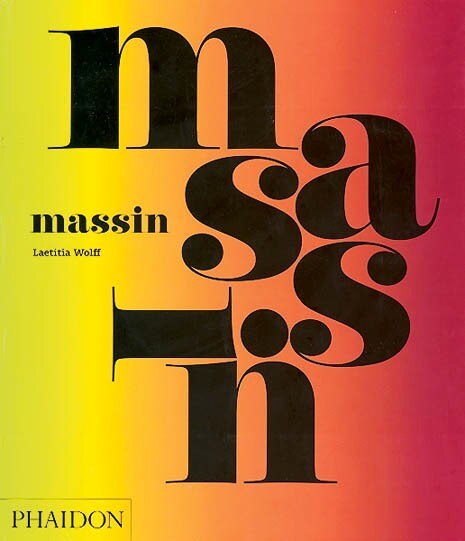
Massin, Laetitia Wolff, Phaidon, London 2007
(pp. 216, € 70,00)
The label “expressive typography” was not coined by Massin, but this creative genre is perhaps linked more closely to him than to anyone else. The warm vivacity of this Frenchman inclined to experimentation is the extreme opposite of the Swiss school’s rigorous graphic art and rationalist typography. Massin has always been driven by the desire to express his subjects’ voices faithfully, in an ongoing career that has spanned seven decades. As an essay writer, Massin is known for his Letter and Image, a catalogue of fi gurative alphabets that became an infl uential study of the longstanding relationship between western culture and printed lettering. As a typographer, he has an interventionist approach based on total harmony with the author and the conviction that he can be his/her faithful voice, something that requires firm belief rather than respectful neutrality. The typographical design of a theatrical piece on two-dimensional paper must retain the dynamism conveyed by the dramatic action on stage. In 1964, in The Bald Soprano, Massin transferred the theatrical concepts of time and space onto the printed page. He used the book’s surface as an architectural space, an allegory of the stage on which Ionesco’s characters move. He composed images with the text, enlarging it and reducing it, tilting it and enclosing it in text boxes shaped like people and objects. The letters must come to life and evoke the movements of the actors on stage. This was not only a revolution for graphic art, but also for literature: Massin’s work questioned the meaning of communication and its tools. His success was partly due to his total harmony with the sensitivity of contemporary playwrights, with whom the typographer was, after all, in direct and frequent contact in those years. With authors from other eras, Massin’s work always aims to “transcribe and interpret”, but his decisions, which are never arbitrary, are dictated by the historicisation and contextualisation of each author. As Massin’s maestro Pierre Faucheux taught him, “There are no ugly typefaces, only typographers who don’t know how to use them.” He explained his own concept of good use: “I fi nd it hard-going and even unpleasant to read Rabelais composed in Didot type or, on the contrary, Victor Hugo in Garamond. Similarly, I would not use the same font for Proust and for Céline, Claudel and Prevert, Balzac and Rimbaud.” Massin, who has been described as a sculptor of books, started in 1949 by designing book-club publications. He conducted research into materials and space, he extended the titles onto the back cover, used double and folding pages, tissue paper and jute – even silk for Proust, velvet for Francis Jammes’s Jeunes fi lles, and rough butcher’s paper for the illustrations commissioned to André François for Ubu roi. The creative use of typography — which had had many pioneers, from the futurist poets to advertising professionals — contributed to the success of organisations such as the Club du Meilleur Livre. The clubs were responsible for distributing huge quantities of books to postwar French homes, and took their promotion work seriously. Aided by the economy of large print runs, they also ventured into avant-garde design and drove a golden era of graphic book design. It was only later that mainstream French publishing started to tread on the same terrain, once it had overcome its snobbishness and uncertainty. As the art director of Gallimard, from 1952 to 1979, Massin positioned series such as the white Folio indelibly on the cultural landscape (and thanks to the review Eye, Massin was “the man on every French bookshelf”). Malraux, then De Gaulle’s Minister of Culture, asked Massin to review all the State’s publishing typography and he undertook a visual design project that affected the entire French cultural heritage. He laid down visual guidelines for exhibition catalogues and redesigned the Louvre’s entry tickets. In 1962, fi nding the burden of two such ambitious projects too much to manage, he opted to focus solely on Gallimard. In both cases, however, he displayed a revolutionary approach to brand identity. In his work, Massin has broad scope and total vision. Every detail of a vast array of visual solutions responds to a common sensitivity. The very concept of art director is changed and fi nds its true role in publishing. The same minute attention and consistent vision prompted Laetitia Wolff to produce the first international monograph on Massin (originally written in French, it is published in English), filled with pictures, many drawn from the typographer’s personal archives. Working in close collaboration with Massin, Wolff (the former editor of Graphis and now of Surface) has completed an exhaustive and enthusiastic book that also expands on the major Massin retrospective she curated in 2002 at the Cooper Union.
Giuliano Tedesco Giornalista