

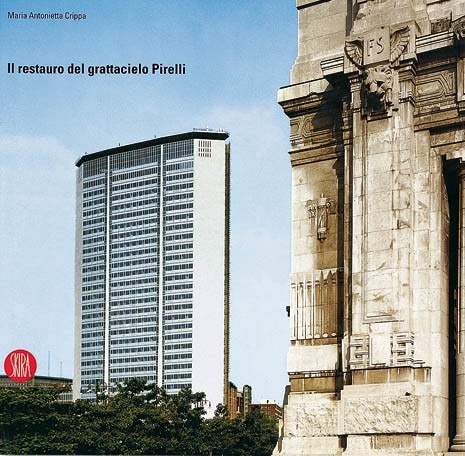
Il restauro del grattacielo Pirelli, a cura di Maria Antonietta Crippa, Skira, Milano 2007 (pp. 156, € 49,00)
On April 18, 2002, at 5:47pm, a singleengine Commander 112 TC crashed into the Pirelli building in Piazza Duca d’Aosta, Milan. The aeroplane penetrated the facade between the 26th and 27th floors, in the middle of its width. Following the impact and the explosion of the two fuel tanks located near the wings, the plane’s motor disconnected from the fuselage and exited the opposite side of the building, on the side of Via Fabio Filzi. At the time of the accident, 445 people were inside the building, two of whom were hit and killed instantly: lawyers Anna Maria Rapetti and Alessandra Santonocito. The plane’s 68-year-old Swiss pilot, flying alone, also died in the crash. The incident received international attention for its sinister similarity to the Twin Towers attack. No terrorist links were found, however.
A huge gash was left in Milan’s tallest building (32 stories, 127 metres high), one of the city’s major landmarks along with the golden Madonnina statue perched on top of the Duomo. The Lombardy Regional Government, whose headquarters have been located in the Pirelli tower since 1978, took immediate action to repair the damage and seized the opportunity to execute an exemplary overhaul of the building. Beyond fundamental and indispensable structural repairs, the plan was to restore the tower’s original finishes, which were typical of Ponti’s work, such as the splendid marbled yellow linoleum and the glass tiles of the outside cladding. The restoration was executed with the express will to respect Ponti’s original design. Only technical improvements that were strictly necessary were added to the project, and on the condition that they did not imply substantial modifications. This way of working constitutes an entirely new approach to refurbishment in modern architecture.
From its inception, the building was considered exemplary and emblematic. It was the world’s first skyscraper to use a long-span frame structure (25 metres). Here more than elsewhere, Ponti succeeded in putting his extraordinary organisational talent to good use, directing professional collaboration on an extremely high level. A determining factor was the structural design by Pier Luigi Nervi. Expressing his appreciation for the work that had been done with Ponti, Danusso, Valtolina and Locatelli, Nervi came to describe how “the collaboration produced far better results than the mere sum of our individual skills would have done.”
Reinforced concrete was chosen principally due to its inexpensiveness. It also allowed the construction of large spans and floors that were less thick than iron ones. An added benefit was the particularly expressive exposed cement surface of the structural walls inside, which gave an extraordinary effect to the interiors.
In the ’50s, when the building was designed and built, there was a heated debate surrounding structural reinforced concrete being used as a substitute for the traditional iron employed in skyscrapers. It is certain that the elegant Pirelli building, which for millions of railway travellers disembarking at Milan’s Central Station represents the first encounter with the city, had a significant role in the widespread adoption of reinforced concrete in Italy in those years. In his impassioned account of the studies for the building’s structure, Pier Luigi Nervi calls the result an ossatura, a bone structure, in reference to living organisms, and lists its specific characteristics meticulously. He describes the “skeleton’s” details in graceful prose that belies his great understanding of the engineering profession.
Just as impassioned is Gio Ponti’s description of the project, ten years after its completion. In a few lines devoid of any pomposity, he describes the job’s essential aspects. An extraordinary group of experts had worked together in a truly united fashion. “Commitment to the project was wholeheartedly dedicated to the creation of a dignified result that corresponded straightforwardly to the clear representation of its purpose. The building was to belong unmistakably to the present day, neither lagging behind progress, nor significant only in retrospection. This, in all simplicity, is what makes the building belong to modern architecture.”
Maria Garbari Clauser Architect