

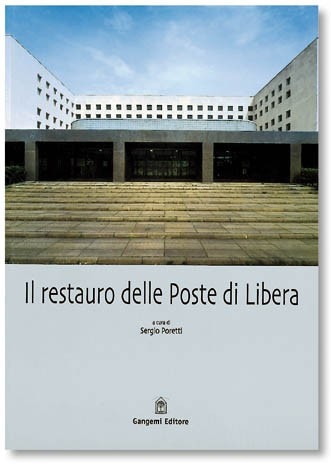
Il restauro delle Poste di Libera, A cura di Sergio Poretti, Gangemi Editore, Roma 2005 (pp. 80, € 18,00)
“After the competition for the new station in Florence, which despite a spirited and not always calm debate (triggered by all but the architects!) is, as wisely decided by the Minister Ciano, being constructed according to the winning project, the same Minister has launched competitions for four post offices to be constructed in as many parts of Rome,” wrote Giovanni Minnucci in the October 1933 issue of Architettura and he went on to announce the final results and winners’ names: Competition A (Appio district) Arch. Giuseppe Samonà; Competition B (Aventino district) Arch. Adalberto Libera; Competition C (Milvio district) Arch. Armando Titta and Competition D (Nomentano district) Arch. Mario Ridolfi.
The Palazzo delle Poste in the Aventino district was actually designed by Adalberto Libera and Mario De Renzi. The building consists of a tall C-shaped block with the ends opening in diamond-shaped windows and containing the staircases leading to the offices, and an entrance portico that serves the purpose of a pronaos, circumscribing a great central double-height hall designed as an internal courtyard, covered and illuminated by an elliptical skylight. The modernity of the whole was summed up in the functional organisation and continuity of the institutions in the most representative image, in a very precise synthesis of past and future.
In the mid-1990s, the technical office of the Italian postal service drew up a restructuring project for the Palazzo delle Poste in the Aventino district. It envisaged extraordinary maintenance of the constructed parts, adaptation and reordering of the systems and a new functional organisation of the service areas, as requirements had changed over the years. They also planned to reinstate the architectural features of particular worth: the portico, the entrance staircases and the main public hall. This book illustrates the experience of the group from the University of Tor Vergata led by Sergio Poretti that actually developed the restoration project, which flanked and supplemented the “improvement and restructuring” project created by the postal service’s technical office. As Poretti has said himself: “The experimental aspect of the work was based on mutual interaction between the historic analysis and the working design of the restoration project. On one hand, the historic investigation did not restrict itself to the traditional, general framework but was pushed to a minute and comprehensive philological reconstruction of the building’s original construction elements and, above all, it sought to pinpoint the crucial elements in the definition of the architectural expression. Analogously, the aim of the design became the reinstatement of the original architectural features while taking into account the causes that led to their deterioration and alteration - above all, those caused by immature design decisions taken at the time of construction.”
The book’s chapters are each devoted to a single part of the building and edited by a different collaborator of Poretti: the portico (Tullia Lori), the main public hall (Rosalia Vittorini), the skylight (Stefania Mornati) and other restoration works (Rinaldo Capomolla). This book, sustained therefore by specific theoretical and cultural motivations, is attentively illustrated and does not ignore the many difficulties encountered by the group at the various stages along the way. Reading this book introduces us to a complex reality in which the careful study of the work is flanked, as Poretti points out, by a careful redesign of the most significant architectural features. “I see restoration work as a phase that is part of the ongoing and never completed life of a building, so the aim to pursue was very clear: reinstate the original architectural characteristics without reproducing the excessive fragility of the initial solutions, which would only trigger new decay processes.” This interesting book will very probably also reopen the debate on the problems of restoring modern architecture: whether, that is, to reinstate the original or whether to take into account the nature of the architecture as a commodity, possibly subject to change and mutation caused by the passing of time and life, and to allow the signs of the various interventions that have succeeded one another over the years to coexist with a view to conserving it and saving it from decay.
Claudio Camponogara Architect