

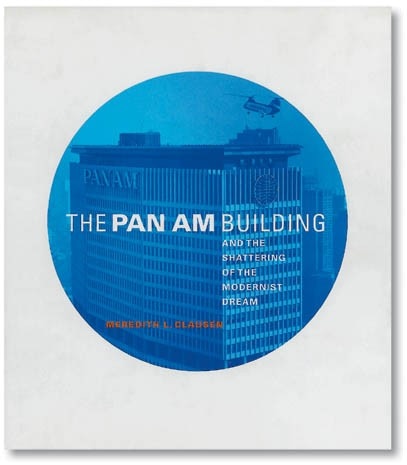
The Pan Am Building and the shattering of the Modernist dream, Meredith L. Clausen The MIT Press, Cambridge (Mass.)-London 2005 (pp. 477)
“What sphinx of cement and aluminium bashed open their skulls and ate up their brains and imagination?/ Moloch! Solitude! Filth! Ugliness! Ashcans and unobtainable dollars! Children screaming under the stairways! Boys sobbing in armies! Old men weeping in the parks!/ Moloch! Moloch! Nightmare of Moloch! Moloch the loveless! Mental Moloch! Moloch the heavy judger of men!/ (...) Moloch whose mind is pure machinery! Moloch whose blood is running money! (...)/ Moloch whose eyes are a thousand blind windows! Moloch whose skyscrapers stand in the long streets like endless Jehovahs!” Meredith Clausen begins her vigorous study of the Pan Am Building (now the Met Life Building) in New York with this quote from Allen Ginsberg’s “Howl”.
The story of this skyscraper’s construction contains much food for thought and Clausen, a lecturer in the history of architecture at the University of Washington and author of a fine monograph on Pietro Belluschi, tells it in 470 pages without boring the reader, thanks to the clever intertwining of different research paths. First of all, the location and the historic context: Grand Central Station and Park Avenue in New York between the late 1950s and the early 1960s. Then, the principal players: Erwin Wolfson, the building contractor; James Ruderman, the structural engineer; Walter Gropius, Pietro Belluschi and Emery Roth & Sons, the architects; Juan Trippe, head of Pan American World Airways; Douglas Haskell, Wolf von Eckardt, Peter Blake, Ada Louise Huxtable, Sibyl Moholy-Nagy, Jane Jacobs and Bruno Zevi, the critics.
Finally, the content of the story: the transformation of a nerve centre in the metropolis, the American culture and its relationship with history, the pre-eminence of private initiative over public interest, the decline of the railway industry and the rise of air transport, corporate image, the construction, form and significance of the skyscraper, the work of the large American architectural practices and the involvement of two famous architects (in both professional and academic circles), the role of architectural critics and, above all, as the title of the book says, the shattering of the Modernist dream.
The construction of the Pan Am Building started in 1958 and was completed in 1963. The initial project was by Emery Roth & Sons, but Walter Gropius and Pietro Belluschi played a crucial role in giving the building its final architectural image and, indeed, the critics focused on their role and, more specifically, on the responsibilities of Gropius. It must be said that the construction of Mies van der Rohe’s Seagram Building was completed in 1958 on the Park Avenue axis, just a few blocks before the Pan Am Building. The following year, Frank Lloyd Wright (who died in April) only just missed the inauguration of the Guggenheim Museum, his last masterpiece. In the same period, Le Corbusier was busy, on the other side of the world, with his Chandigarh adventure.
Just think how these projects reflect on the various tragic fates of the “Four Great Makers of Modern Movement”: Wright’s white museum represents the swansong of the power of the individual; Mies’s black skyscraper “takes a step back and says nothing” before the urban chaos, withdrawing into the sublime intellectual perfection of the “Baukunst”; Le Corbusier twisted reinforced concrete into poetic forms to redeem the history of another civilisation; and Gropius placed himself at the service of the new American technocracy. The skyscraper by Gropius and Belluschi is 246 metres tall and has 59 floors. It was originally called Grand Central City but, in 1960, Pan American World Airways signed an agreement with Wolfson to rent the building’s top 15 storeys and place its famous “Pan Am” logo (replaced in 1981 with that of the new owner, Metropolitan Life Insurance Company) on the top.
The Pan Am Building thus also represented the supremacy of American air transport: in 1965, a helicopter transport service was started that could fly in seven minutes from the helipad on the roof to JFK airport; the service was suspended in 1977 following a spectacular crash. The other “events” that have marked the history of this skyscraper include the art installations of Lippold, Kepes and Albers in the lobby, as well as the crowded Jimi Hendrix press conference held in 1968. Meredith Clausen tells all this, but most of all she explains why the Pan Am Building has aroused much controversy in international architectural culture and has, at the same time, become the skyscraper “most hated” by the people of New York. Its form was clearly inspired by the Le Corbusier project for a skyscraper in Algiers (1938-42) and the Pirelli skyscraper built by Gio Ponti and Pierluigi Nervi in Milan in 1960.
Like the Milan skyscraper, the layout of Gropius and Belluschi’s building has the shape of an elongated octagon and its distinctive facade accentuates the vertical lines with prefabricated concrete panels, the rhythm of which is visually broken by two empty horizontal lines and concluded before the roof. However, it is its relationship with the surroundings that resulted in the thumbs down by American architectural critics, who opposed the mechanisms of private revenue for the first time, raising issues of relationships with existing constructions and the urban design. In short, you keep reading, the huge mass of the building violently crushes the old station and blocks the view of Park Avenue making the slender tower of the Grand Central Terminal Office Building by Whitney Warren look silly. “Marvel or Monster?” this is how Ada Louise Huxtable led the chorus of criticism of the Pan Am Building while work was still in progress, in the New York Times on 24 January 1960.
The chorus formed of illustrious names such as Douglas Haskell of The Architectural Forum, Peter Blake and right down to the Italian Bruno Zevi, who six months after the building’s inauguration voiced harsh words in Espresso on the “unconvincing testament” of the German master: “Nothing is more painful than the fatigue that grips our old masters. Walter Gropius, the inspiration behind the Bauhaus, is not a great creative artist but his impassioned educational calling and loyalty to the principles of urban planning and modern building made him a firm point of ethical reference. (...) Today, even the myth of Gropius wanes. The Pan Am Building constructed in New York above Grand Central Station is an urban planning absurdity that no dialectical argument can ever justify.” Gropius responded promptly to Zevi’s criticism (cf. L’Architettura. Cronache e storia, April 1964), but the condemnation of the Pan Am Building seems to have been unanimous (with the rare exception) and final; it certainly did not spare the architects who made the operation possible: Gropius and Belluschi, among other things both deans of schools of architecture, were accused of having betrayed the civil duty of the modern architect, allowing their art to bow to the interests of financial gain, engaged in a work that destroyed the urban environment and its surroundings.
In actual fact, Gropius’s position in that period was manifested in more than just the forms of the Pan Am Building. In October 1965, the new series of the journal Casabella, edited by Bernasconi after the sudden departure of Rogers, contained a long essay by Walter Gropius entitled “The architect and society” in which the German master set out the duties of the architect and then wrote: “I cannot therefore subscribe to the verdict of the critics who believe that it is the profession of the architect, as such, that should take all the blame both for the discontinuity in the mould of our metropolises and for the disorderly and rampant expansion of urban centres into the surrounding countryside. As we all well know, the architect, or the urban planner, hardly ever receives a mandate from the population to conceive the best possible framework suited to a desirable way of life. What he is usually given is no more than a simple individual contract, with very limited objectives, by individual clients who have, at last, decided to build themselves a place of their own in the sun.”
This seems a further defence against the criticism of the Pan Am Building, but actually it is the unconditioned surrender of modern architecture before a society, the American one in particular, that translates urban space, socialising space, into purely financial terms. With cynical realism, Walter Gropius stepped out of the shoes of the European intellectual and, in America, ended the Modernist dream of a society liberated by technology. The poets will be left to scream against Moloch.
Federico Bucci Professor of History of Contemporary Architecture