

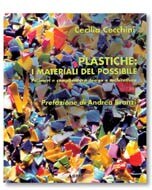
Plastiche: i materiali del possibile. Polimeri e compositi tra design e architettura Cecilia Cecchini Alinea, Firenze 2004 (pp. 164, € 25,00)
Just as it did 30 or 40 years ago, plastic today is a material that keeps forcing us to take sides. This century-old synthetic resin with its not-so-light environmental impact, with its conceptual and quantitative unwieldiness, is also a frequent bearer of liberating technological solutions. Its case is pleaded in the subtitle of Cecilia Cecchini’s book: “a material of possibilities”. And indeed, it is the material that is currently most active, trespassing into unthinkable fields and continuously changing its identity.
The book is about a fundamental passage in our post-industrial era: the substance of new experimentation is no longer a raw material, but a “semi-finished one that contains specific performance properties”. This makes it a pre-manufactured material that is ready for any number of transformations. Even though plastic was the last to arrive on the industrial scene, with the highest degree of artificiality, it is now destined to even lose its classic connotations in its continuous transformation into something new. Polyurethane gels, polyethylene honeycomb structures, high-density polyethylene micro fibres, tubular honeycomb insulation panels, polypropylene geo-textiles: innovation cannot go anywhere without plastics.
In its multifarious applications, it seeps into things almost without us noticing: the gluing of airplane wings, the playful repositioning of little yellow Post-Its… In technical fabrics we see its widest application range yet, one that favours enriched two-dimensionality. In layered, bonded, composite and laminated fabrics, micro-texture is being experimented with, and unusual performances are being tested that pertain to degrees of protection, shielding, filtering and even electrical conductivity. Anywhere its accomplishments are still unknown, its qualities magically become of interest. Born without morality and with the bellicose aim of substituting the entire material universe, plastic today seems especially destined to be a civil and hidden service medium.
It doesn’t want to come to the foreground too much, yet it is in charge everywhere. First-generation plastic was evil and borderline noxious, but it was sculptural. This plastic is good, and forthcoming, only that there’s so little of it! In its mostly two-dimensional quality, it seems to be an insubstantial semblance of the former. Sottsass, who has always been anthropologically sensitive to shifts in values, is right when he brands plastics as being “more optical surprise than conceptual perception”. In passing from matter to semi-finished product, it cannot avoid a certain disappearance act, a loss of its physical-perceptive consistency. It can be charged as much as we want with phosphorescent pigment, vegetable fibre and polychrome fluid, but second generation plastic remains a visually inert polymorph with an almost prop-like logic: suspended, ready to become something else.
Is this one of the new possibilities? High-level service on a par with a general lowering of aesthetic levels and mass characteristics of the material? We must resign ourselves to the idea that the possibilities contain the concept of maximum drama of material combined with a transformation of its performance content. Performance is an innovation that lasts for two or three years, after which it is rapidly replaced by something else. The book has two parts with two completely different paces. In the first, the possibilities are explored in an interesting overview of a whole generation of semi-finished materials that are in constant evolution.
In the second, plastics are spoken about through the mouths of grand design masters such as Mendini, Sottsass, Pesce, Sadler and Lomazzi. The plastic they speak of is immeasurably far from today, as if in speaking of contemporary architecture, the subject of megaliths was touched upon. It is a plastic from another era, where even the most subversive acts of homemade crafting by Gaetano Pesce seem to be the archaic gestures of an artisan. Today’s plastic is in hospital beds, heart valves, geo-textiles that protect cars in the lots of Italian car dealers, and Mater-Bi film (starch-based biodegradable plastic) that is used for mulching purposes along the berms of Italian state roads. These are products that have come to fruit through lack of attention and over which users cannot exercise any judgement at all. The interviewees, on the other hand, were all designers who believed in the totem-like presence of objects.
Manolo De Giorgi Professor of Interior design at the Milan Polytechnic