

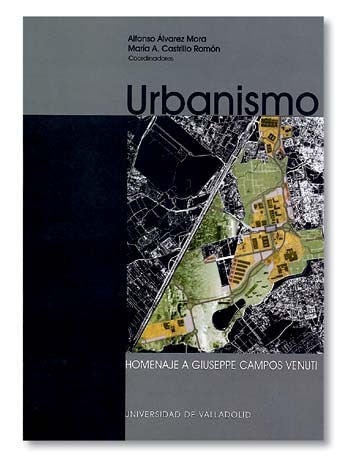
Urbanismo. Homenaje a Giuseppe Campos Venuti, Alfonso Alvarez Mora María, A. Castrillo Romón, Universidad de Valladolid (pp. 104, s.i.p.)
1960. Bologna – seat of the largest communist Federation in Western Europe – is experiencing rapid growth in all sectors: production, commerce and construction. The only shortcoming is town planning. Its recently approved town plan drawn up by Plinio Marconi is very similar to others formulated for the (few) cities with town planning capacity, and does not get off the ground. Being jumbled with cumbersome volume measurement it is difficult to manage and not even practical for building speculation. Up and coming PCI officials and administrators want change, renovation and to succeed the old guard, also in the sense of continuity. Dozza, the illustrious Liberation mayor remains a bulwark, and under his protection innovative economic and cultural programmes requiring a capable town planner are produced. With nobody suitable found in Bologna, a name is solicited from the party leadership in Rome. Giuseppe Campos Venuti thus enters stage, and not only in Bologna. Little or nothing is known of him. He was possibly Marconi’s assistant. In just a few years – from 1960 to 1966, during his municipal councillorship – he becomes a presence in Italian town planning culture. With Bologna as his trampoline, he sets aside the town plan that he would define (in a Freudian manner) as “first generation”. He does not cancel the zones of expansion, but replaces them largely with economic-popular building plans, being the first to label them PEEP. He decrees that public areas are indispensable to achieve the standards and lays down the conditions for safeguarding the historic centre. In short, he recruits young, recently graduated people and trained professionals (especially from Rome) to apply the principles of modern town planning. From the inter-municipal context to the “office district”, from the large “service axes” (the famous north orbital road arranging and sorting the motorways converging on the city) to public and hilly parkland: he engages everything in the lively town planning debate underway. Bologna becomes a reference model for the country. Camilla Cederna would define the new administrators as rose diamonds, and Campos is the most brilliant of them all, the Pole Star. He connects political incisiveness to zoning rationality and fights building speculation with various means, such as the PEEP and the revolutionary “fifty-fifty”. Half of the urbanisable land must be public and the other half left private. It is a successful lesson in administrating town planning. He does not restrict himself to Bologna. Leaving his mark on towns in the district, he provokes radical reconsiderations in Emilia-Romagna cities and directly influences national laws (first with the town planning law prepared by minister Sullo, and after its failure with the law defined in 1967 as “Ponte”). 1992. Under the wise direction of Bernardo Secchi, Campos Venuti enters the Olympus of “Italian town planners”. He is on a level with Piccinato, Marconi, Samonà, Quaroni, De Carlo and Astengo. In this book (edited by P. Di Biagi and P. Gabellini and published by Laterza) Secchi - in relation to Foucault’s writings and particularly “What is an author?” - identifies town planners in the long post faction who have had monographs written on them as “authors of behaviour and questions who influenced the obscure multitude involved in town planning in the same period”. For the ever-active Campos the accentuated underlining of the work carried out in Bologna is undoubtedly restrictive. The plans drawn up for Ancona, Florence, Madrid, Reggio Emilia, etc. (as well as the activity he carries out for INU, the intense political press aimed at reforming the discipline and refining the principles that allow equalising the value of the land) show Campos’s diversity and incisiveness compared to others. They also demonstrate how the “obscure multitude” – Secchi’s brilliant synonym for clone – finds a true and possibly unique paradigm in Campos that would continue over the years. If the Bolognese beginning was built on the technical/political tie, the university teacher, INU president and town planner who was a municipal and regional councillor, now combines the profession with politics. It is no coincidence that he would define himself as a “reformist town planner”, with reform as a guarantee for correct and modern city development. Despite the emptying of urban centres and the exodus towards the countryside, the vision of a city in expansion remains deep-rooted. When he returned to working in Bologna (in 1985 with a plan he baptised as “third generation”) he made areas suitable for building (called “interstitial”) that were already considered fundamental in the ‘60s for the equilibrium between free and built up spaces. For those who believe that cities (to remain cities) must avoid endless growth with the recovery of the existing, the upgrading of built up suburbs and what remains of the countryside, the distributive equity of ground suitable for building or equalisation might appear overly anchored in the pioneering period of building and urban development. When the construction frenzy was dominant, the expropriation of terrain suitable for building constituted (and was) a revolutionary act. The very high percentage of housing in possession and the frantic consumption of territory should now suggest new planning criteria. The magnificent amount of public parkland, which the reformist Campos speculated while compiling the plan for Rome, must be contrasted with the no less magnificent amount of cubic metres that - in exchange – must be realised more or less next to these areas. But whoever seeks the solution to the economic crisis (considered, perhaps wrongly, cyclical) with a return to the criteria of the economic boom years regards the project – passionately defended by Campos - of the “north link road” as “tenable”. A super motorway that cuts obliquely across the plain should fulfil the function of a new orbital road to the old Bolognese orbital road. 2026. Giuseppe Campos Venuti turns 100 years old (happy birthday). He still lives in the city that has seen him as actor and spectator, always protagonist of urban and territorial matters. The city has profoundly changed and is unrecognisable despite his second, third and fourth generation plans. Despite his arguments and convictions, they have often become common language. As Secchi wrote, this is a reference for anyone involved in town planning. The 1960’s were the years of Administrating Town Planning, when one had to be on the front line to denounce unconstitutional laws and overcoming building speculation meant being subversive. The ‘90s become Planning along the way, but without tarnishing the continuity of a technical approach that risks sacrificing the physicality and identity of places just to guarantee development. It costs what it costs. Reforms in the ‘90s seem as though they are about to be carried out at any moment, but the problem of the presumed rights of the land owner remain open and unresolved. Even if it were, the result would not be very different. The failed planning in the ‘60s was replaced by the delayed reform of the ‘90s. The doyen of Italian town planners continues his battle with ever more refined instruments. Unfortunately the rural landscape has become a disastrous panorama of small villas. The size of the non-urbanised areas – equalisation after equalisation – is very reduced. Traffic congestion and pollution have increased. The up-and-coming town planners promote the new settlements as a “cradle of urban life experiences projected into the future”. Campos, ex-revolutionary and post-reformist, has become neo con, not like those of a quarter century ago along the lines of Bush. Now he is the standard bearer in defence of the increasingly rare properties that have relinquished dividing into lots, bartering and trading – possibly with equity – land just to obtain more cubic metres. The new battle is the hardest of all. Good luck people. Pierluigi Cervellati Professor of Urban and regional rehabilitation at the University of Venice