

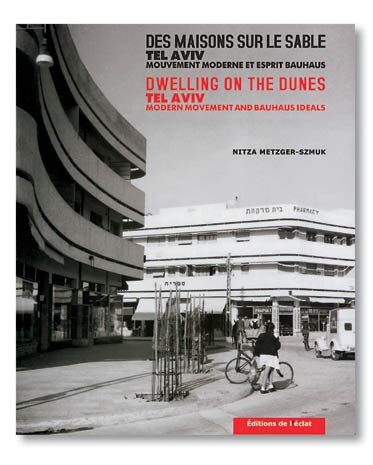
Des Maisons sur le sable. Tel-Aviv. Mouvement Moderne et Esprit Bauhaus/ Dwelling on the dunes. Tel Aviv. Modern Movement and Bauhaus Ideals, Nitza Metzger-Szmuk, Éditions de l’éclat, Paris-Tel Aviv, 2004 (pp. 448, € 65,00)
Among the current frontiers of historical research into modern architecture, Palestine in the last years of the British Mandate (1917-1948) is certainly one of the most fascinating. The multiple complexities of the political, social and ideological components on the scene at that time generated a unique and entirely modern city that has recently been included by UNESCO in the list of human patrimonies. Abraham Yehoshua recently wrote, “Zionism is not in itself an ideology but a common platform for different and sometimes contradictory ideologies”.
A historical teleology correlated to the prevailing political line of Ben Gurion’s socialist Zionism that identified with modern architecture was only established after 1948, following the construction of the State of Israel. Adopting the criteria of the Modern Movement, also called the International Style, seems apparently natural for a nation born out of the impulse of an internationalist movement like Zionism, and seeking to construct its identity distinguishing itself both from Arab architecture and the English colonial style. At the time of the British Mandate, however, there were heterogeneous, and in many cases alternative political and architectural lines of thinking and action. For example there was the work of Erich Mendelsohn, closely linked to the cultural Zionism of Martin Buber, or the anti-urban ideology of the city garden favoured in the early Twenties particularly by the German Zionists, then applied by Richard Kauffmann and culminating in the adoption of Patrick Geddes’s plan for Tel Aviv in 1924.
Tel Aviv then assumed the form of a large white chessboard made of little two-storey building units organised by a small number of tree-lined commercial avenues in a north-south direction and many residential streets running east west. This allowed the sea breeze to flow into the city centre. During the Eighties and up to today, British Mandate architecture has been historicised largely thanks to the studies of Michael Levin, classifying it as a historical style, alternatively “Bauhaus” or “international Style”. UNESCO’s recognition in 2003 also defines the centre of Tel Aviv as a “White City” and place with the greatest concentration of “early International Style” buildings.
The study of Nitza Metzger-Szmuk also follows this approach, and for about ten years he directed the council of Tel Aviv’s Department of conservation starting the preservation and cataloguing of more than 1,600 buildings. The book betrays the classifying framework that Metzger-Szmuk made use of, ordering a significant quantity of mostly unknown buildings according to the various typologies and originally intended uses by placing photographs of the time (1920-50) alongside more recent photographs (1991-2004). The book’s main strength is perhaps in the reconstruction of the principle architects’ biographies.
The majority of them are not yet well known due to the dearth of personal documents and archives, but they are indispensable to understanding the context of a city that has experienced a dizzying evolution in just a few years. It is rather clear that 1934 was the turning point. Tel Aviv, established in 1909 as a suburb of Jaffa, was officially declared a city by the British Mandate on 1 January and Meir Dizengoff was nominated mayor. In the previous year the fifth alyyah had begun – ascent in Eretz Israel – the migratory wave of central European Jews: dynamic, active, well-educated and well-off minorities. The “Germans” among them brought considerable capital that was immediately invested in industry, business and also construction.
This unprecedented type of immigrant, back bone of the future upper-middle class, would prefer to live in the large urban centres, above all Tel Aviv, rather than embrace the Zionist path par excellence of the Kibbutz. By 1936, 166,000 people were living in Tel Aviv and its suburbs, about 41% of the entire Jewish population in Palestine. In a similar context the “Circle of architects” also stands out for activism. This group known as Chug was founded in 1932 and headed by Arieh Sharon, Dov Karmi and Ze’ev Rechter.
Sharon was a student at the Bauhaus and then worked with Hannes Meyer, Karmi studied in Ghent and Rechter at the Ecole des Ponts et Chaussées in Paris. Other young architects with Polish and Russian origins quickly joined the group, which met every evening in the Ginati café. All of them had educational experience in Europe: Josef Neufeld, possibly the most gifted, who worked in Mendelsohn’s Berlin studio and then with Bruno Taut in Russia; Genia Averbouch, who studied in Ghent and worked in Brussels for a brief period; and Werner Wittkover from Berlin, brother of the famous art historian, Rudolph.
The group set up a review that was immediately used as an instrument of pressure against local government authorities. It tried to force the Geddes plan and at the same time quickly undermined more mature professionals like Yehuda Magidovitch and Josif Berlin who were inclined to Art Deco stylistic features. Furthermore, there was the disappearance of every trace of orientalism and reference to a pre-existent local tradition. In its place appeared a white, tabula rasa architecture, the only one suitable for the construction of a new national Zionist society.
In a five-year period, a large number of openly modern, although generally mediocre projects were approved and realised, indelibly marking the city’s image. Some works by Chug stand out among these, such as Sharon’s building cooperatives, Engel house by Rechter (the first building on pilotis in Palestine), Zlotopolsky house by Karmi, the arrangement of Dizengoff Square by Averbouch and the Kupat Olim centre by Neufeld. Many of the profiles of this milieu are still waiting to be investigated for the first time. Reconstructing their intellectual and professional biography through the few remaining documents would contribute to restoring the plurality of cultural options – not only in architecture – present in the Thirties in Tel Aviv and Palestine. This would permit a better understanding as to why one precise political and cultural line asserted itself to the detriment of others.
Manuel Orazi Historian of architecture