

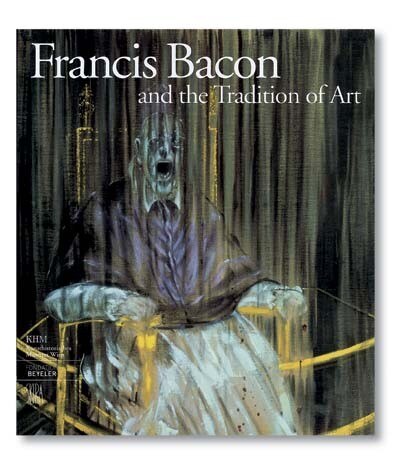
Francis Bacon and the Tradition of Art, A cura di Wilfried Seipel, Barbara Steffen, Christoph Vitali edizione inglese e tedesca, Kunsthistorisches Museum Wien, Skira editore, Milano 2003 (pp. 372, $ 60.00 - £ 38.00)
Francis Bacon had his studio at 7 Reece Mews in South Kensington. It was a kind of goldmine of meaningful elements: a chaotic universe ruled by the paint scattered on the walls. There were also brushes, and cans grouped in unlikely families, bits of paper and pages on the floor. In 1992 when the artist died, about 7000 objects were catalogued inside the studio, including paintings, photos, illustrations, books, catalogues, magazines, newspapers, sketches and destroyed paintings.
Bacon himself asserted that this inexhaustible workshop, which he had used from 1961, was a source of constant inspiration. This research carried out by Barbara Steffen on the materials found there provides an original overview of Bacon’s sources and how he related to photography. The results are contained in an interesting volume and a show that ended on June 20 at the Beyeler Foundation in Basel. It was curated by Steffen, with the contribution of many scholars and experts.
The book is also a catalogue and a fine scientific product. The constant relationship with the past, in first place Velázquez’s papal portraits (and also those by Titian and Sebastian del Piombo and Ingres too) was a kind of obsession for Bacon who collected the images of the paintings, tore them out of the book and reworked them. Thus he revealed all the anxiety of today’s humanity that wants to uncover everything, for those faces conceal the mystery of painting.
In fact, Bacon’s ravished attitude interprets and digs into the subjects. As Steffen points out, he manifests all the enigmatic surreal attitude that Ingres only wanted to hint at in the famous text Oedipus and the Sphinx. Oedipus had a bloody leg and was speechless. The Irish artist is interested in a kind of appropriation of the body and symbol by means of painting’s image in the reproduction of paintings. He also uses photos as sources. He seeks to approach the models, showing how much they are distanced. Ernst van Alphen says this in his essay “Reconcentrations. Bacon reinventing his models.”
They are a set of sources presenting vertical striping as if they wanted to separate the true subject from your gaze, like the famed Portrait of Cardinal Philip Archinto by Titian (1551-1562). In reality, there is a brand new unexpected, mysterious luminosity; it is almost energetic and is interposed almost extinguishing the form. It is even true that in Bacon’s Study after Velázquez’s Portrait of Pope Innocent X of 1953 is transformed into pure light energy.
As van Alphen shows, this was due to parallel investigations in the early 20th century’s materialisation phenomena: Bacon used it a lot. He took the black and white pictures of a seated woman and Velasquez’s portrait of pope Innocence X half hidden by a curtain. It was covered with paranormal energy or there was the image of a head squirting out a strange liquid. These subjects were redone by the artist using pure energy pouring from the bodies and the special language of painting; they produce jets of colour, revealing a heretofore little probed surrealist factor. Another major subject was the scream.
Bacon used it so often he generated a wide range of existential interpretations. Judging from the sources it stems from Picasso’s Guernica then goes to the most obvious origin, the famous example by Munch (without excluding intermediary passages through Schiele). Or it is obviously sociological based on Eisenstein’s Battleship Potemkin or the pages of an American book of war photographs. Eventually, in his last paintings, it takes on an anatomic meaning of the mouth and tongue. Bacon tore illustrations from anatomy books, with the mouths held open by clamps. He collected absurd ads for artificial tongues, seemingly anticipating the ‘post human’ wave.
Olivier Berggruen points out the special ties with Picasso and surrealism, especially the early Bacon. In Giacometti, of whom the artist had many catalogues of drawings, Steffen identifies a primary source for the structure of the bodies and the frontal faces.The post mortem exam of Bacon reveals an unexpected complexity of sources and their relations. This shows he wandered through the media, time and space more like today’s artists than his contemporaries.
Paolo Campiglio Art critic