

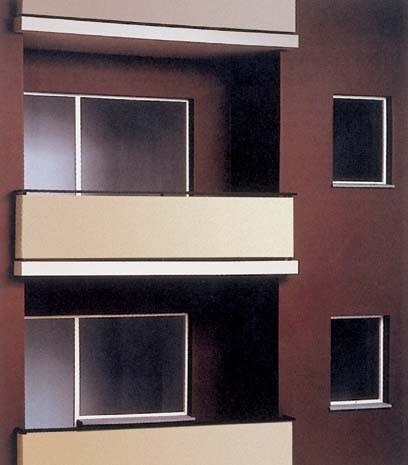
The Architect: Women in Contemporary Architecture, AA.VV., Preface by Peter Pran, Wiley-Academy Editions, London, 2001 (180 pages, s.i.p.)
What would Frank Gehry say if someone asked him how he manages to have a profession plus a family and children, if he has any? We will never know: nobody will ever ask him – or any other male architect – this question. In fact, what male architect must choose between a career and family? Having the time and right to carry out one’s own work are unchallenged principles for men. However, they seem to be social triumphs in a woman’s career as well as outstanding topics for debate in today’s society, whose feminine models tend to swing between sterile career women and fertile housewives. More modern, dignified expectations would provide a very different social scenario. Perhaps this would be a more fruitful topic for discussion than discrimination against women in the field of architecture.
Surely discrimination exists, is notable, tricky, constant, historically oppressing and intellectually deadening. But women involuntarily fuel discrimination, too, led by the demands of their status as mothers or companions to request leave for family reasons, for some situations are inadequate. They have not had time to be sufficiently prepared. They have the capacity and will to know how to listen, to leave room to those opposing them without imposing themselves in a stubbornly dictatorial manner. They generate ideas that are often shared, authoritative but not authoritarian, yet lacking authentic recognition. This is why the first pages of this book seem like war news, like lists of casualties. That is, women who are deprived of their right to practice the profession because of what happens every day in our society: there is not enough time to have both a profession and a family. There is also a marked dialectical sensitivity, for men are unable to detach themselves from the figure of women as mothers. Often they are the obliging, loving slaves men seek and favour.
Fortunately, the days of self-pity are long gone; the volume does not dwell on the chain of horrible behaviour that a woman architect encounters during her training; perhaps there is a danger in this discretion that those who want to ignore the problem will not fully understand. It is quite possible that this book, almost entirely written by women about women, will remain a book for women. But that does not matter. What counts is that the text exists and testifies that, despite the hurdles, something is changing, heedless of the problems while aware that it is helping to solve them. On the positive side, there are women architects who have found little space in the journals, but they do exist and build. They have chosen to do their craft and performing their skills, and they accept judgements on the results. There is a second level of the question: do the works of these architects – having a common origin– differ from men’s designs?
There is one attribute widely shared, at least in the statements of the authors; it may be taken as a trite commonplace, but it actually can produce tangible results. It is a sense of real life as a powerful cornerstone for building, a frequency for modulating architectural options. In some cases, this translates into the construction of places within landscapes, contrasting with the idea of architectural objects dropped into environments, almost in mutual conflict. One of these is the beautiful Park Café by Kazuyo Sejima, who openly declares that she seeks buildings wedding the rhythms of everyday life and their sites. Some seek to shape those moments of the day that are defined as pauses between two activities. Their suspension value becomes important and demands architectural definition when they are inside a dwelling, as in the homes of Cathi House. Others seek to mould schools that resemble the spaces of life, like Dartmouth College in New Hampshire by Frances Halsband.
However, it really is difficult to decide whether a feminine spirit is able to manifest in its works the reading of the world and the situations her sensitivity offers daily. One thing is certain, however. As Zaha Hadid, working on the Rome Centre for Contemporary Art, puts it, ‘Like artists, architects can produce culture; therefore, they more than anyone else should be committed to focusing their own attention on what is happening’. So why should they deprive themselves of opportunity stemming from a different stance? But if art’s synthetic capacity is strong enough to comprehend outcomes of every kind, this may also be a false problem. Since everyone is the master of his or her fate, and since in architecture the works decide the fortunes of those who create them and favour the growth of the occupants, let evolution take its course. We cannot do anything, anyway. The buildings, oblivious to all the debate and hot air, will determine the fate of their creators, and life will decide the destiny of the constructions.
Cecilia Bolognesi is an architect