Issues of postwar preservation are at the heart of Margreiter's sculptures and installations.
The widespread destruction of post-war architecture conceived as social
project is fuelled, according to Rem Koolhaas and OMA,
by global rage. In an era when preservation is not only ubiquitous but deemed
a noble cause, that genre of social architecture generated fifty years ago by a
strong public sector is unjustifiably reviled. "There is now a global consensus",
they assert, "that post-war architecture—and the optimism it embodied about
architecture's ability to organize the social world—was an aesthetic and
ideological debacle". In its stead, with public sector initiatives severely
handicapped and the market subject to caprice, the more exceptional
instances of flamboyant modernism are cherished. However, as preservation
becomes a political issue, and heritage a right, the lack of both criteria and a
theoretical basis on which its effects should be managed—"how the
'preserved' could stay alive, and yet evolve"—threatens its credibility and
viability as public policy. Historical amnesia increasingly distorts our
understanding of the past and, at the same time, impoverishes our vision of the
future.
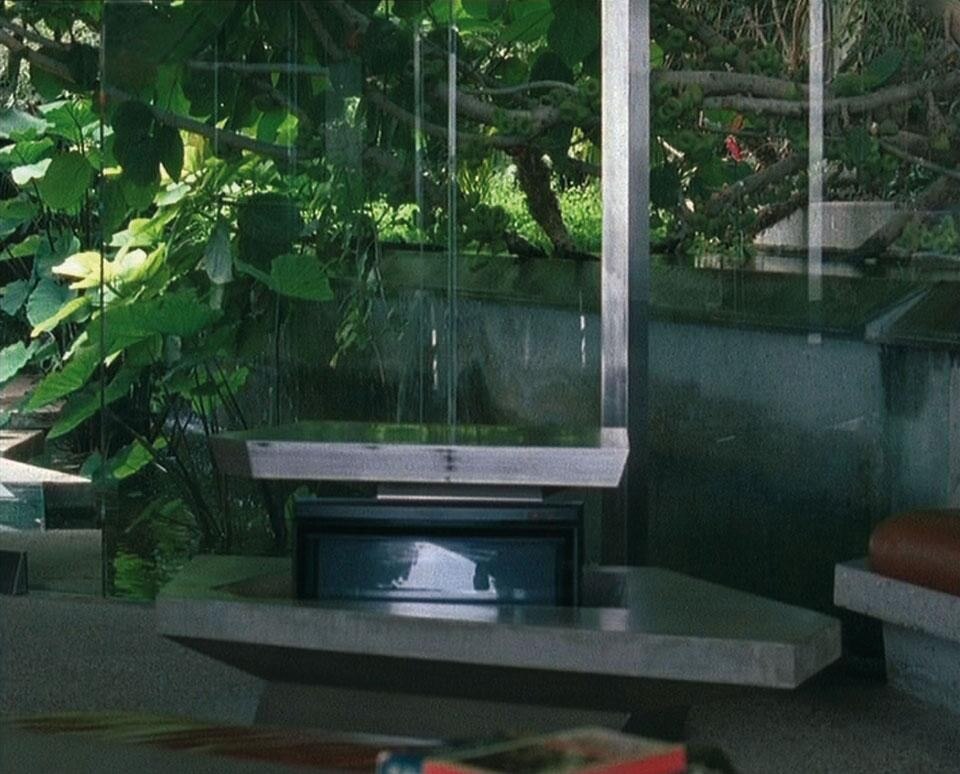
10104 Angelo View Drive, 2004. Silent movie in 16 mm, 6 min 57 seconds, colour. Museum Moderner Kunst Stiftung Ludwig Vienna.
For Dorit Margreiter questions pertaining to the preservation or, conversely, the
destruction of late Modernist architecture provide the occasion for probing
larger issues shaping our contemporary socio-cultural context. Comprised of a
carefully calibrated selection of works made over the past seven years,
"Description", her first major survey show, highlights an abiding preoccupation.
Four installations involving projected film are accompanied by ancillary related
works. A nexus of interrelated pieces titled "zentrum", (2004 and ongoing), is
located like a hinge at the juncture of the exhibition's two principal axes.
Tellingly, "zentrum" has also provided the point of departure for the quartet of
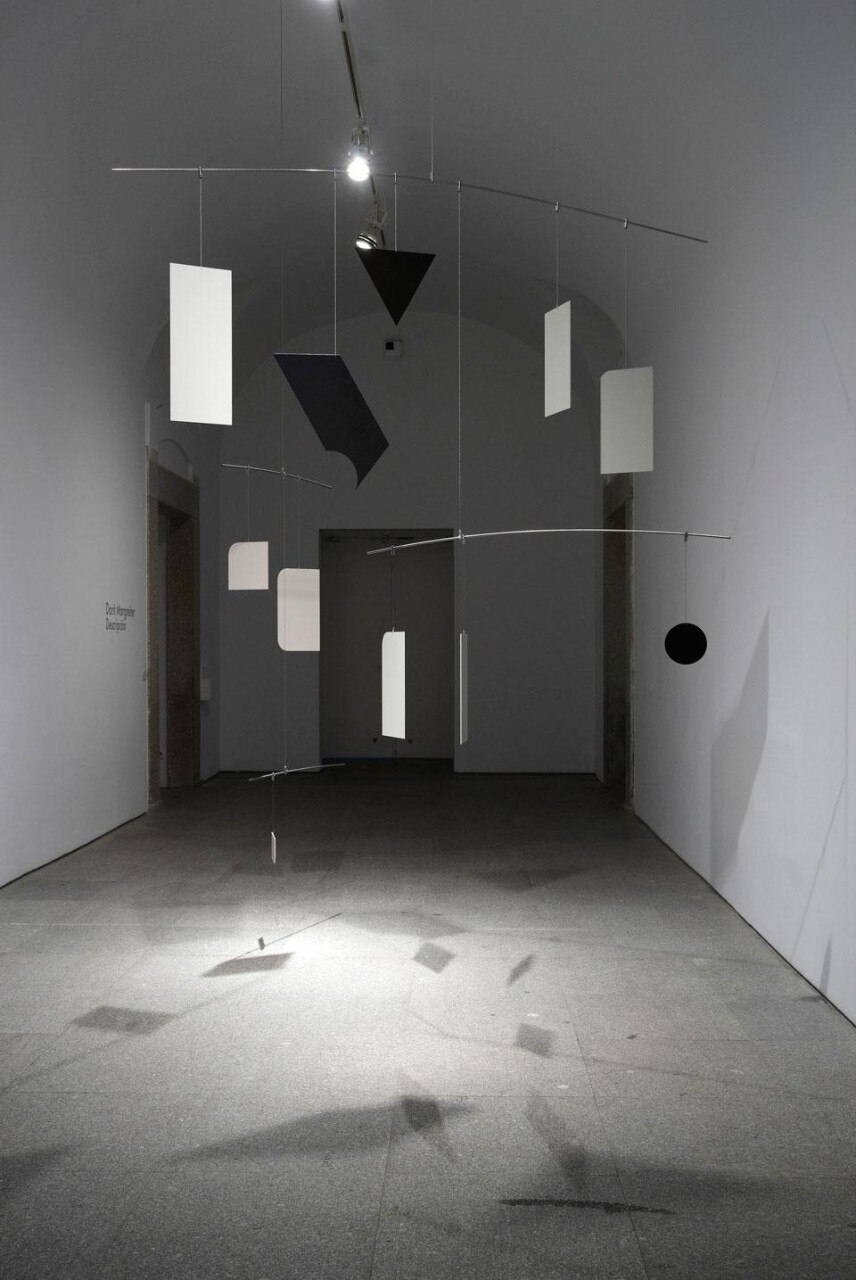
new works dispersed throughout the galleries. Monumental metal mobiles,
these sculptures reference text-based works installed in adjacent spaces in that
they, too, are comprised of letters from an alphabet created by the artist; when
they are considered as moving images, however, their closest affinities are with
her film projections.
Zentrum (Lynne), 2011. Painted steel mobile. Courtesy Dorit Margreiter, Krobath Vienna/Berlin, Stampa; Basel. Photo Jaoquim Cortes and Roman Lores.
Not polemic but description was the rhetorical mode Margreiter chose when
conceiving this exhibition. Her disarmingly restrained timbre is nonetheless
inflected with an incisive gender politics that has variously informed her
practice over the past decade. Here it is perhaps most evident in the
conjunction of subjects that fall loosely under the rubric of architecture: housing
(both public and private), space (domestic and social), interiors (psychic and
physical), display and exhibition. The theoretical and practical conundrums
intrinsic to the preservation/destruction dialectic as outlined by Koolhaas are
restated in "Description". Clearly at issue in this ensemble of works, they are not,
however, articulated as binary alternatives: rather, they are presented as
fundamentally incongruent. Margreiter thereby opens up alternative ways of
conceptualizing such questions. Key, for her, are the forms in which they are
represented and, consequently, the terms in which their discursive field is
mapped. Seeking neither to theorize nor historicize the problematic of
preservation/destruction, she offers instead models that can serve as heuristic
devices—as ways of unpacking—socio-cultural representations which shape
and govern the built environment.
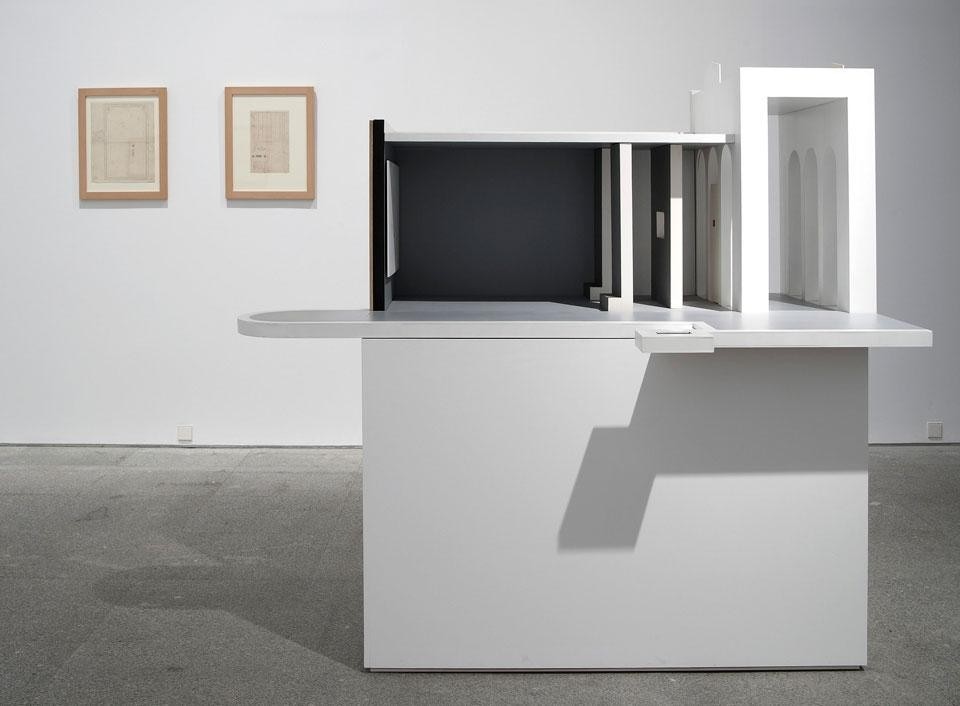
Pavilion (model of the installation), 2009. Model in scale 1:10 80 x 185 x 120 cm. Gabu Heindl Architektur. Photo Joaquin Cortés and Roman Lores.
Until 25 April 2011 Dorit Margreiter. Description Museo Nacional Centro de Arte Reina Sofía
Sabatini building 3ºfloor
Organized by: Museo Nacional Centro de Arte Reina Sofía
Curated by: Lynne Cooke
Coordinated by: Lucía Ybarra