

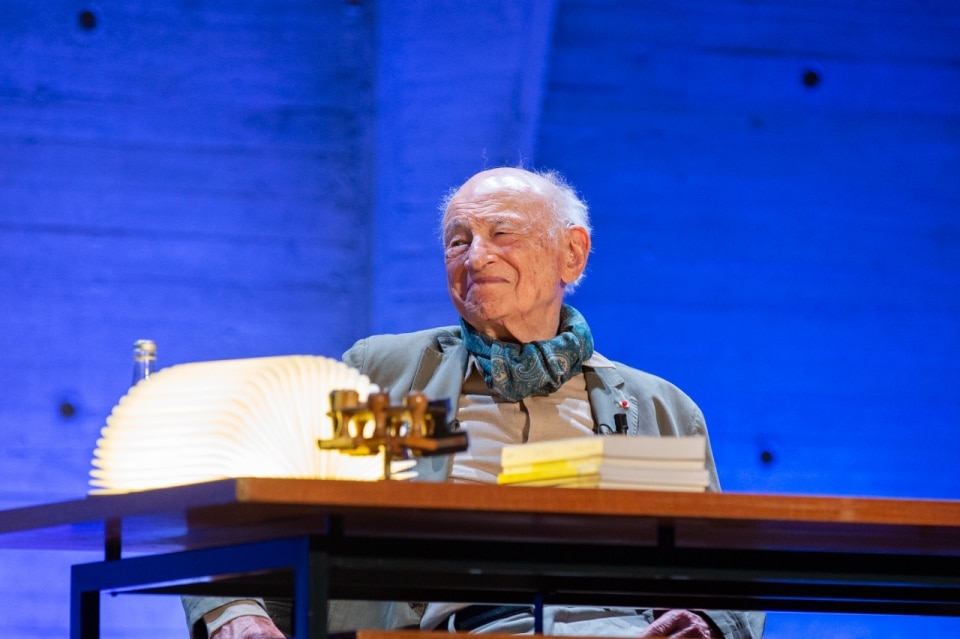
Theorist, researcher, philosopher, sociologist, thinker, and explorer of complexity – whose atlas he began to map fifty years ago in his landmark work La Méthode – Edgar Morin’s immense intellectual stature and cultural legacy defy any single tribute. Instead, we leave space to his own words, first entrusted in 2022 to Domus under the editorship of Jean Nouvel.
Born David Salomon Nahoum and known as “Morin” since the years of the French Resistance, Edgar Morin went on to become one of the world’s most influential public intellectuals. After a lifetime at the CNRS, he directed in the 1970s and 1980s the Centre d’Études des Communications de Masse, which would later bear his name. He approached the world through the lenses of a deeply constructive “pessi-optimism” and an unwavering commitment to connecting disciplines, debates, and struggles, while remaining firmly rooted in pacifism. The interdependence of city and countryside, as a shared territory of practices and coexistence in need of radical rethinking, was the subject of the essay he published in November 2022 in issue 1073 of Domus, now available in full in our Digital Archive.
Against dynamics of consumption, extraction, and mutual impoverishment, Morin proposed agroecology, conviviality, a politics of civilisation, and the idea of the “city as a loving institution.”
For a politics of the city and the countryside
Reflection on the future of humanity in the course of the 21st century cannot overlook the fact that, according to current forecasts, over the next few decades the widespread phenomenon of urbanisation risks incorporating more than 80 per cent of the population. Among the consequences of this are, at one and the same time, human desertification of the countryside and industrial, standardised and intensive agriculture and livestock farming. It is already possible to imagine the harmful effects for urban dwellers.

It means that the huge problem of the widespread urbanisation of the great majority of humanity is inseparable from the problem of the countryside, since it is evidently the countryside, the rural world, that feeds the cities. How can we expect an extremely underpopulated rural world to feed an enormous urban fabric? The trend towards urbanisation does not merely make a big number of cities larger and larger by creating suburbs, dormitory areas, ghettoes and shantytowns. It also creates new types of cities, among which megalopolises with populations in excess of 10 million. On the one hand is the megalopolis, an enormous built-up area, on the other urban fabrics that stretch seamlessly for hundreds of kilometres, such as the one between Tokyo and Osaka.
The huge problem of the widespread urbanisation of the great majority of humanity is inseparable from the problem of the countryside, since it is evidently the countryside, the rural world, that feeds the cities.
Edgar Morin
This is the twofold trend of globalisation today, and if it continues the urban problems with which we are already familiar will only get bigger. Many megalopolises are without non-polluting and efficient public transport networks and are asphyxiated by the undue use of private cars. Cities have undergone a large number of changes over the last 5 thousand years and more are sure to take place in the future. We would achieve important advances if we were to apply art and thought to the central human interests in cities with a new devotion to the cosmic and ecological processes that affect all beings. We have to restore to towns and cities all the maternal and protective functions of life, the autonomous activities and symbiotic associations that have been long neglected, if not cancelled.

For the city has to be an amorous institution and the finest urban economy consists in cultivating human beings. The problem of the humanisation of cities is unavoidable insofar as the current trend is towards segregation and the isolation of individuals according to their socio-economic and cultural category, but also according to ethnic origin, while in certain cities in the old days population diversity in the same neighbourhoods preserved a social mix. Marginalisation and exclusion lead to the disintegration of social bonds and urban poverty.
This is compounded by the perverse effects of journeys from place of residence to workplace and back, as well as by a dynamic of globalised competitiveness that makes the wealthy wealthier and the poor poorer, disadvantaged not only in terms of quality of life but also quality of nutrition. Today we know from reliable scientific sources that large-scale industrial agriculture turns out standardised food products that are low in nutrition and taste, and contain dangerous chemical residues from the pesticides and antibiotics it uses to cultivate millions of hectares of grain and raise millions of chickens, cows and pigs.

If we add to this the fact that produce from industrial agriculture is packaged for the transport and preservation required to distribute it to millions of people in megalopolises – and that this packaging requires, likewise, the use of chemical preservatives and artificial colouring – the process comes full circle, meaning that the damaging effects of industrial agriculture and factory farming are the cause of the damaging effects of urban food consumption. One damaging effect is maintained by the other.
All this means that it is impossible today to draw up an urban politics without drawing up a rural politics. The first is intrinsically tied to the second. Therefore, the fundamental question is to understand whether it is possible to reverse the course of events within a reasonable period of time in order to avoid demographic desertification and rural decline, not to mention urban overdevelopment. I believe it is possible. Paris already shows us how centrifugal forces have become more important than centripetal ones. So what are the possibilities for ruralisation? An increasingly high number of young people are convinced of the virtues of agroecology and the benefits of organic food, market gardening and livestock farming.

Another extremely perverse and harmful phenomenon has recently emerged: that of the sizeable capitals China, the United States and Europe are investing in the buying and leasing of huge tracts of land in countries of the Global South, especially in Africa (where it is often the most fertile) with the complicity of state administrations, which tend to be corrupt. This land is used for export-driven industrial agriculture and factory farming.
The phenomenon has increased the difficulties encountered by governments in implementing well-reasoned and complementary – at once rural and urban – agricultural politics prioritising the diversified development of produce locally, while taking into account the culture and traditions of their country. This fuels the rural exodus to shanty towns, creating urban sprawl and poverty.

Let us not forget that with its economic exploitation, the Global North is increasing the rural desertification of the Global South, urban sprawl in the Global South, and the food dependency of the Global South. As far as the urban problem is concerned, urban life is dependent on the rural world and, reciprocally, the rural world is dependent on urban life.
Insofar as they imply recognition of otherness and the personalities of others, courtesy and conviviality are not psychosocial epiphenomena in the lives of individuals.
Edgar Morin
This dependency has grown increasingly complex and has now reached a critical – harmful – point, at which twofold regeneration is in order: of rural life and of urban life. As for the world in general and the question of cities in particular, financial capital and its corollary financial speculation are compounding all these problems.

What place should finance occupy in globalised capitalism? How can we prevent speculation from altering and worsening urban and rural life? We can see this problem in the trading of grain. We are now witnessing aberrant phenomena whereby products are held back – to the detriment of the food security of populations (namely those of the most defenceless countries and regions that have suffered natural catastrophes) – in order to reap extra benefits from speculation on shortage in supply.
Finance joins up with speculation to generate obscene profits and constantly jeopardise the governance and regulation of urban and rural life. Hence, there are two problems to tackle with the articulators of complex thinking: the governance of cities and the governance of the countryside, which are intrinsically bound. They call for a global policy for humankind. We must go about elaborating this policy today in order to put it in place as soon as possible. The history of most modern cities (fortified cities apart) began with a very interesting anarchic dynamic of creation. Such anarchy possessed aesthetic value in its poetical and creative dimension. Today anarchy is born of property speculation in pursuit of maximum profit with no regard for the real needs of residents.

I wish to stress that property speculation has caused the destruction of social bonds and natural fabrics of conviviality and solidarity in the old neighbourhoods of cities in which social exchange and difference were the creative melting pot of human relations. The quality of suburban housing has likewise been degraded by property speculation, which has led to the uniform industrialised architecture of estates on the outskirts of cities.
Insofar as they imply recognition of otherness and the personalities of others, courtesy and conviviality are not psychosocial epiphenomena in the lives of individuals. “Good morning, sir” and “Good evening, madam” signify that the other exists. The need for recognition and respect is one of the human being’s fundamental needs, a cornerstone of urban conviviality. We are thus in the presence of a need to humanise cities. This need travels several routes.
Opening image: Photo Unesco Headquarters Paris via Flickr