

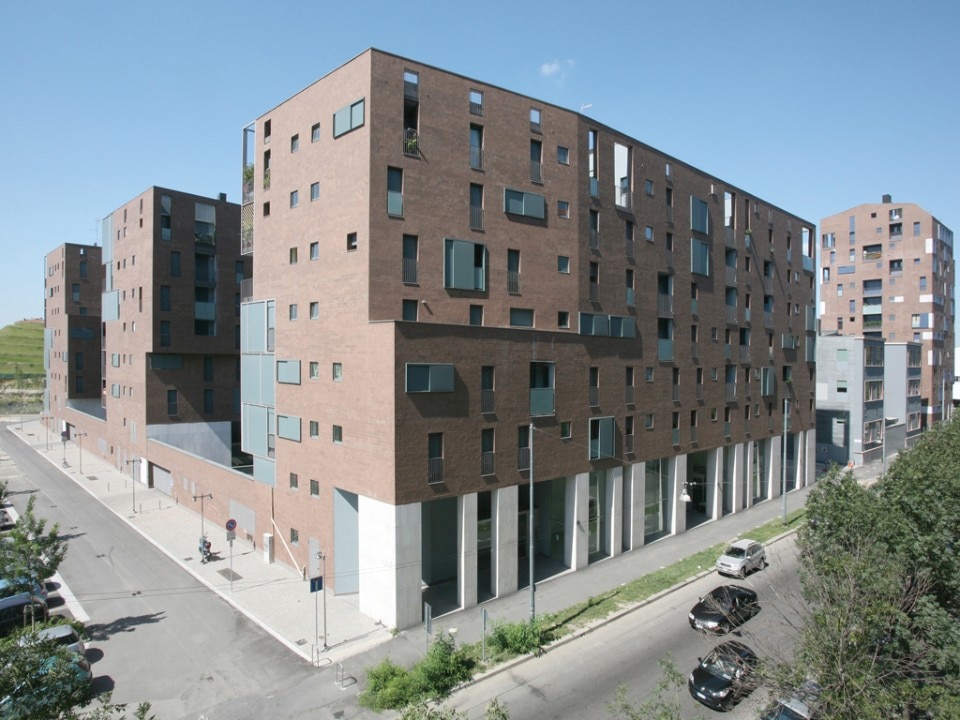
This whole complex is distinctive both for its housing types and their layout.
It includes the refurbishment of the former Alfa Romeo canteen, the building of which, clad in Cardoso stone, is cut across by a diagonal route and an atrium.
The south zone has three aligned eight-storey blocks for subsidised housing. The three facades on Viale Serra are protected from noise and traffic by the fact that they are closed and set back at a certain distance. The orientation of the three blocks parallel to Via Traiano maximises exposure to the sunshine. Open service courtyards allow access to the blocks from the opposite side, through high porticoes with columns clad in white stone that overlook the communal gardens.
The north zone features five slender towers that offer views from Via Traiano towards the park behind. Two subsidised housing blocks are aligned with the street. Another three non-subsidised housing blocks are set in an inner garden.
The windows and materials adopted (decoloured terracotta and white Trani stone) offer a precious reference to postwar construction in Milan.
Origally published in Domus 900 / February 2007
Urban dialogue
On the edge of the city, in a strategic area where Milan has been trying ever since the 1930s to forge itself an original and contradictory image of modernity [...], an architectural and urban fragment is being slowly built. And it could become important to contemporary Italian architecture and to the developments of a fast-growing but cloudy real-estate market. The area formerly occupied by the Alfa Romeo factory at Portello, wedged between the QT8 and the fair, was reappraised in the late 1990s by Gino Valle, who designed its master plan. Summoned later to work on it were Valle himself, who did the first work on a shopping centre, followed by Cino Zucchi and Guido Canali for the residence, and Charles Jencks with Andreas Kipar and Land for the urban park. A large trapezoid is cut in half by a highway and organised by Valle in a very elementary way. Four sectors, one occupied by the park, and the others allocated to normal or subsidised housing, are linked by diagonal pedestrian paths that relate to the main road via a bridge. The first completed housing unit, designed by Cino Zucchi, is located behind the shopping centre whose outsized central portico launches one of the pedestrian trajectories to define the outer limit of the block facing the park. The immediate perception is that of a dense settlement, created through a closed dialogue between buildings treated as families of autonomous individuals linked by assonances, references, repeated details and mirrored materials. [...] The ex-canteen converted into offices stands out at the centre of the complex due to its mass and density. The slice of original facade on Via Traiano having being salvaged, the rest of the building that follows, wedged in as far as the centre of the block, is treated with a cladding in long slabs of horizontal Cardoso hewn stone and with glass and aluminium frames. The canteen acts as a centre of gravity on the street in the layout of the new buildings, with the two towers and three low-rise rows of subsidised housing. On the opposite side, three other residential towers overlook the park to define the south front of the block. All the fronts are treated in a dual narrative key, extended in continuous, skilful variations on the theme: a harder, more closed front towards the city, and a second that is resolved with a very deep, complex system of loggias opening onto the park and transforming a plain treatment of the facades into an autonomous, porous volume. The leftover elements in the interplay of openings and cobalt blue frames; the thoughtful arrangement of the facades in the counterpoints between the de-chlorinated facing tiles and the white Trani stone; the sophisticated treatment of the loggias in the recesses that let light into the inner rooms of the apartments: all indicate the architect’s conscious desire to sharpen a formal idiom in which inspiration received from Caccia Dominioni, Asnago and Vender, but also from Bottoni at the QT8 and at the Harar district, is combined with more recent Dutch and German housing experiences. [...] The whole block maintains a care and control of details and of the ground floor elements, from the doorkeepers’ lodges to the benches, from the enclosures of the various residential areas and the ratio of greenery to roads and paths. This seems intended to flag up a necessary goal for residential urban architecture, be it public or private: the compensation for that dramatic rift between the inner space of the home and the neglect of quality public space that has marked the growth of Italian cities since the 1960s. [...]