OK
Domus Domus
newsstand
SUBSCRIBE
  • Magazine
  • Digital Edition
  • Digital Archive
LANGUAGE
  • it
  • en
Hi Logout
Sign up / Log in
  • News
  • Architecture
  • Interiors
  • Design
  • Art
  • Archive
  • Products
  • Design Essentials
  • Design Stories
  • Submit your project
Sections
  • News
  • Architecture
  • Interiors
  • Design
  • Art
  • Archive
  • Products
  • Covers
  • Biographies
  • Architecture Firms
  • Sustainable Cities
  • Gallery
  • Design Stories
  • Domus for Design
Magazine
  • Subscriptions
  • Digital Edition
  • Current Issue
  • Guest Editor
  • Digital Archive
  • Nordic Design
Specials
  • Design Essentials
  • Modern Work
  • DomusAir
  • Milano Design Week
  • Worldesign
Current Issue

Domus 1106 hits the shelves

Follow us
LANGUAGE
  • it
  • en
Hi Logout
Sign up / Log in
newsletter Icon
results No results Please enter a long search term

      Six museums to visit in Naples for their architectural value

      Six museums to visit in Naples for their architectural value

      Next gallery

      A Japanese villa in Paris, from Kenzo to Kengo Kuma

      1. MADRE Museum

      The MADRE - Museo d’arte contemporanea Donnaregina (Donnaregina Contemporary Art Museum) is an exceptional example of a historically layered building: developed on 18th and 19th- century structure around two courtyards, it overlooks a section of the city walls dated back to the 5th and 6th century. During the 1900s, the building was subject to a series of architectural and purpose changes, then abandoned for a time, until it was chosen as the first regional museum for contemporary art and inaugurated in 2005. Designed by the architect Alvaro Siza, the project shaped a 7,200 square-meters museum divided into library, media library, and café. As many as 2,662 square-meters are allocated to exhibition areas: on the second floor is dedicated to the permanent collection, while on the third floor to the temporary exhibitions.

       Axer / Désaxer, opera di Daniel Buren. Courtesy MADRE Museum

      View article
      View article
      • SHARE
      • PIN IT

      1. MADRE Museum

      La Voce, Marco Bagnoli. Courtesy MADRE Museum

      View article
      View article
      • SHARE
      • PIN IT

      1. MADRE Museum

      Photo by Michele Alberto Sereni

      View article
      View article
      • SHARE
      • PIN IT

      2. Museo Napoli Novecento 1910 - 1980

      Dating back to the 18th century, the monumental complex that hosts Castel Sant’Elmo and the Museum has become part of the social and cultural life of Naples only since the 1980s. From Robert of Anjou, who transformed it in a patium for the court in 1329, to the Aragonese, who made it into a defensive fortress in 1456, to the last Bourbon garrison, who turned it into a military prison in 1860, the building underwent so many changes that the work to recover its original form and its ancient paths started in the 1970s took seven years to reach completion. It was opened to the public in 1989 hosting 170 pieces that aimed at representing the artistic development of the 1900s in Naples by portraying the main movements. 

      Panoramic view. Courtesy Museo Napoli Novecento 1910 - 1980

      View article
      View article
      • SHARE
      • PIN IT

      2. Museo Napoli Novecento 1910 - 1980

      Courtesy Museo Napoli Novecento 1910 - 1980

      View article
      View article
      • SHARE
      • PIN IT

      2. Museo Napoli Novecento 1910 - 1980

      Mimmo Paladino, Sant'Elmo (2004-2010). Courtesy Museo Napoli Novecento 1910 - 1980

      View article
      View article
      • SHARE
      • PIN IT

      3. Museum of Capodimonte

      With an exhibition area of over 15 thousand square-meters spread over three floors and an artistic heritage of 47 thousand art works ranging from the Middle Ages to present day, the National Museum of Capodimonte is unique within both the national and European scene. Inaugurated in 1957, its exhibition itinerary includes areas dedicated to ancient art, a section of contemporary works, a Wunderkammer, and a Royal apartment. The palace, at first built as King Charles’s hunting reserve, remained a royal residence for three different dynasties: the Bourbons, the French sovereigns Joseph Bonaparte and Joachim Murat, and the Savoy after the unification of Italy. The Museum is nestled in the Real Bosco, the Royal Park, which has been named the best park of Italy in 2014 for its historical, architectural, and botanical heritage.


      Palazzo Reale di Capodimonte, Salone della Culla. Photo © Luciano Romano 2016

      View article
      View article
      • SHARE
      • PIN IT

      3. Museum of Capodimonte

      Real Bosco of Capodimonte, Fontana Belvedere. Photo Courtesy Museum of Capodimonte

      View article
      View article
      • SHARE
      • PIN IT

      3. Museum of Capodimonte

      Photo Courtesy Museum of Capodimonte

      View article
      View article
      • SHARE
      • PIN IT

      4. Naples National Archaeological Museum

      Among the most ancient and relevant museum of the world for the uniqueness of its pieces, the Museo Archeologico of Naples (Naples National Archaeological Museum) is housed in the Palazzo degli Studi, one of the most imposing buildings in Naples. The collection started thanks to King Charles of Bourbon, who implemented a massive cultural policy in 1734. After various alterations, during the decade of French domination, the first arrangements were made and, after the return of the Bourbons in Naples, it took the name of “Royal Bourbonic Museum.” The Museum’s collections, among which the Egyptian and Farnese collections, have been increasingly expanding until they reached their current form: the rooms are situated on the first floor, organized around the eastern courtyard with a splendid red porphyry labrum, part of the Farnese collection, at its center.

      Campania romana. Courtesy Museo Archeologico Nazionale di Napoli

      View article
      View article
      • SHARE
      • PIN IT

      4. Naples National Archaeological Museum

      Campania romana. Courtesy Museo Archeologico Nazionale di Napoli

      View article
      View article
      • SHARE
      • PIN IT

      4. Naples National Archaeological Museum

      Giardino della Vanella. Courtesy Museo Archeologico Nazionale di Napoli

      View article
      View article
      • SHARE
      • PIN IT

      5. Cappella Sansevero Museum

      Located in the heart of the historical center of Naples, the Cappella Sansevero Museum is a gem of international artistic heritage, surrounded from its very origins by a legendary aura. In 1710, it was transformed from a votive temple into an art treasure chest at the wish of Raimondo di Sangro, seventh prince of Sansevere, patron and exponent of the first European Enlightenment. The work on the reorganization of the Chapel, which has a single-nave longitudinal plan, followed completely new and personal criteria of the prince: an example of this are the six splayed windows that illuminate the entire Chapel and the optical illusion of a fake dome at the height of the apse.

      Cappella Sansevero, part.
      Photo by Raffaele Aquilante and Alessandro Scarano for 327Collective
      © Archivio Museo Cappella Sansevero

      View article
      View article
      • SHARE
      • PIN IT

      5. Cappella Sansevero Museum

      Cappella Sansevero, part.
      Photo by Marco Ghidelli 
      © Archivio Museo Cappella Sansevero

      View article
      View article
      • SHARE
      • PIN IT

      5. Cappella Sansevero Museum

      Cappella Sansevero, part. 
      Photo by Raffaele Aquilante and Alessandro Scarano for 327Collective 
      © Archivio Museo Cappella Sansevero

      View article
      View article
      • SHARE
      • PIN IT

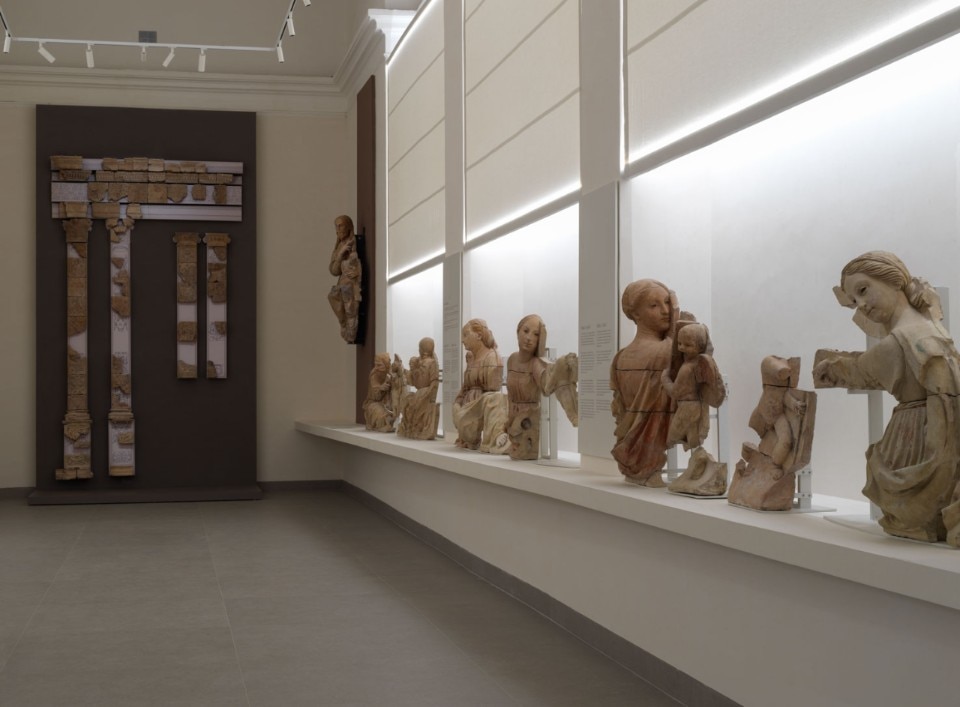
      6. Certosa di San Martino and National Museum

      Similarly to the nearby Castel Sant’Elmo, the Certosa di San Martino (Charterhouse of Saint Martin) is an exceptional example of Baroque architecture and one of the best vantage points to admire the Gulf of Naples. Its construction dates back to 1325 at the behest of King Charles of Anjou, but very little remains of the original building: the Charterhouse as we know it today is the result of the work of the architect Cosimo Fanzago, who transformed its stern and Gothic appearance into the current refined, Baroque guise in the 1610s: thus appear decorations of foliage, fruits, stylized volutes, whose chromatic and volumetric effects still characterize the inside of the complex with realism and sensuality. Having been recognized as a National Monument, the National Museum of San Martino is structured onto two levels within the Charterhouse and opened to the public in 1867.

      View article
      View article
      • SHARE
      • PIN IT

      View article
      View article
      • SHARE
      • PIN IT
      Loading
      Share
      • Sections
        • Art
      • Keywords
      • News
      • Architecture
      • Design
      • Art
      • Opinion
      • Archive
      • Products
      • Foreign Editions
      • Biographies
      • Architectural movements
      • Buildings
      • Architecture Firms
      • Design Essentials
      • Urban stories
      • Gio Ponti
      • Contacts & Editorial Team

      • Follow us
      Legal Note

      Editorial DomusEditoriale Domus Spa
      Via G. Mazzocchi, 1/3
      20089 Rozzano (Mi) -
      Codice fiscale, partita IVA e iscrizione al Registro delle Imprese di Milano
      n. 07835550158
      R.E.A. di Milano n. 1186124
      Capitale sociale versato € 5.000.000,00 - All rights reserved - Privacy - Informativa cookie completa - Gestione Cookies

      China Germany India Mexico, Central America and Caribbean Sri Lanka Korea icon-camera close icon-comments icon-down-sm icon-download icon-facebook icon-heart icon-heart icon--mobile-logo icon-next-sm icon-next icon-pinterest icon-play icon-plus icon-prev-sm icon-prev Search icon-twitter icon-views icon-instagram