OK
Domus Domus
newsstand
SUBSCRIBE
  • Magazine
  • Digital Edition
  • Digital Archive
LANGUAGE
  • it
  • en
Hi Logout
Sign up / Log in
  • News
  • Architecture
  • Interiors
  • Design
  • Art
  • Archive
  • Products
  • Design Essentials
  • Design Stories
  • Submit your project
Sections
  • News
  • Architecture
  • Interiors
  • Design
  • Art
  • Archive
  • Products
  • Covers
  • Biographies
  • Architecture Firms
  • Sustainable Cities
  • Gallery
  • Design Stories
  • Domus for Design
Magazine
  • Subscriptions
  • Digital Edition
  • Current Issue
  • Guest Editor
  • Digital Archive
  • Nordic Design
Specials
  • Design Essentials
  • Modern Work
  • DomusAir
  • Milano Design Week
  • Worldesign
Current Issue

Domus 1106 hits the shelves

Follow us
LANGUAGE
  • it
  • en
Hi Logout
Sign up / Log in
newsletter Icon
results No results Please enter a long search term

      14 “magic” parks and labyrinths to visit across Europe

      14 “magic” parks and labyrinths to visit across Europe

      Next gallery

      Other must-see exhibitions in Venice besides the Biennale

      Alfred and Sara Fox, Glendurgan Garden, Falmouth, UK 1830

      Located amidst soft valleys along the Helford River in Cornwall and now protected by the National Trust, the park was conceived in the early 19th century: the Fox couple introduced rare and exotic vegetation here, which found a favourable habitat thanks to the valley's mild climate. The small thatched building replicates the demolished school building once used by the owners to educate the village children. The maze, planted in 1833 along the lines of Sydney Gardens in Bath, still retains most of the original cherry and laurel hedges.

      Photo bySteve Bittinger on Flickr

      View article
      View article
      • SHARE
      • PIN IT

      Alfred and Sara Fox, Glendurgan Garden, Falmouth, UK 1830

      Photo by Markles55 Photos on Flickr

      View article
      View article
      • SHARE
      • PIN IT

      Gardens of Marqueyssac, Vézac, France 1860

      The estate in Aquitaine, which includes the 17th-century private castle of Marqueyssac and the romantic park, covers 22 hectares and includes winding paths through the vegetation, rock gardens, belvederes, waterfalls and theatres in the greenery. Special features of the site are the 150,000 hundred-year-old, hand-pruned box trees with their rounded, winding shapes that create an attractive natural spectacle. The park is open at various times of the year and on summer evenings is lit up with thousands of candles, making the atmosphere even more magical.

      Photo by Wolfgang Sauber on wikimedia commons

      View article
      View article
      • SHARE
      • PIN IT

      Gardens of Marqueyssac, Vézac, France 1860

      Photo by Angel de los Rios from Flickr

      View article
      View article
      • SHARE
      • PIN IT

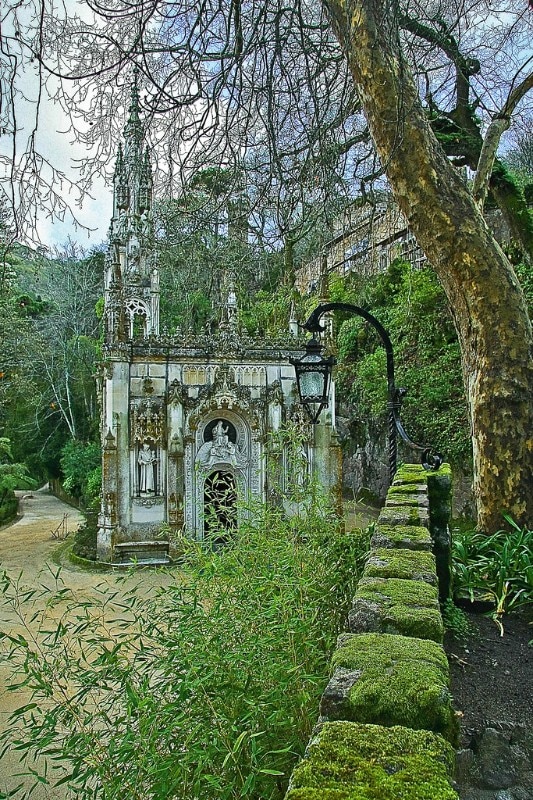
      Luigi Manini, Quinta da Regaleira, Sintra, Portugal 1910

      Quinta da Regaleira is a 4-hectare estate with a historic palace and park, located in the historical centre of Sintra and configured in its present form in the early 20th century. The gothic-looking complex includes exotic gardens, ponds, grottoes, labyrinths and temples, in a rich mix of architectural styles: from Manueline Gothic to Renaissance and Romanesque revivals. Several references to esotericism, Freemasonry, alchemy and classical mythology can be found: the Initiatic Well is the most relevant, a nine-storey spiral staircase penetrating down to 30 metres into the ground, where the Templar cross is carved at the bottom. After a plunge into darkness, returning to the light becomes the ultimate urge.

      Photo by Vitor Oliveira on Flickr

      View article
      View article
      • SHARE
      • PIN IT

      Luigi Manini, Quinta da Regaleira, Sintra, Portugal 1910

      Photo by Vitor Oliveira on Flickr

      View article
      View article
      • SHARE
      • PIN IT

      Antoni Gaudí, Parque Güell, Barcelona, Spain 1926

      Commissioned by the wealthy entrepreneur and intellectual Eusebi Güell, who was impressed by the phenomenon of Anglo-Saxon garden cities, the park is the only built part of a larger urban plan to create a green suburb on the hills in the outskirts of Barcelona. The park, punctuated by buildings in sinuous, primeval shapes and bright colours, is an enthusiastic hymn to life and an example of the balance between architecture and nature, between the dreamy and the playful.

      Photo by Wojtek Gurak on Flickr

      View article
      View article
      • SHARE
      • PIN IT

      Antoni Gaudí, Parque Güell, Barcelona, Spain 1926

      Photo Enrique Fernández on Flickr

      View article
      View article
      • SHARE
      • PIN IT

      Grez Bright, Longleat Hedge Maze, Horningsham, UK 1975

      With a course of 2.75 kilometres lined with over 16,000 yew hedges, Longleat Hedge Maze near the village of Horningsham in Wilshire, England, is one of the longest mazes in the world. The 2.50m high hedges make it impossible to glimpse a way out, unless you activate your sense of direction or rely on chance. It is located in a 400-hectare park that also houses a safari park, a mansion and three other smaller mazes.

      Photo by Jon Candy on Flickr

      View article
      View article
      • SHARE
      • PIN IT

      Grez Bright, Longleat Hedge Maze, Horningsham, UK 1975

      Photo by Karen Roe on Flickr

      View article
      View article
      • SHARE
      • PIN IT

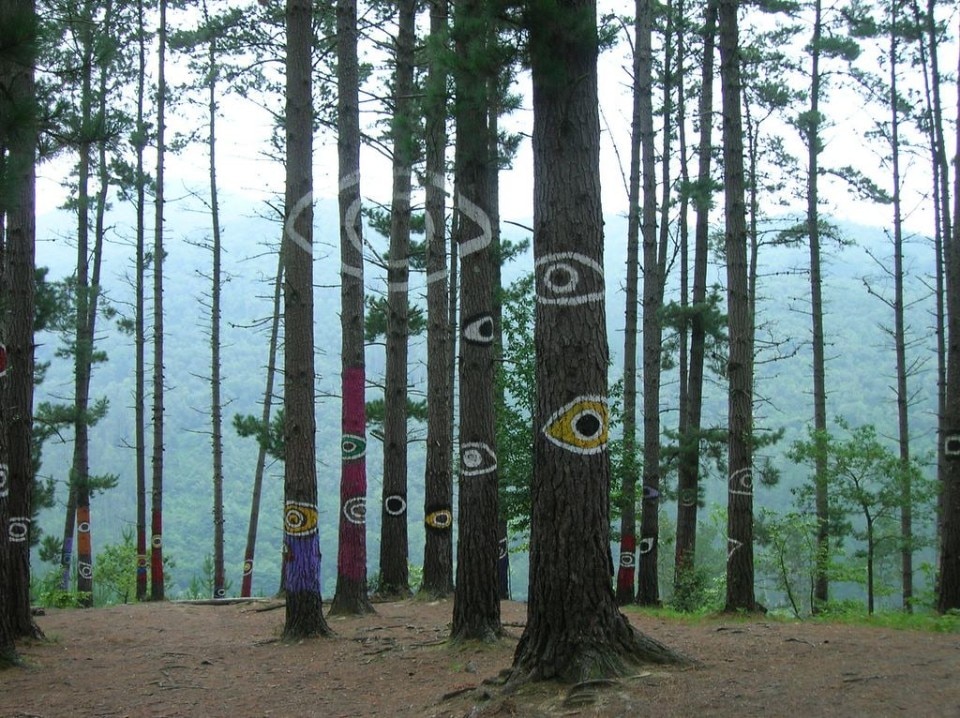
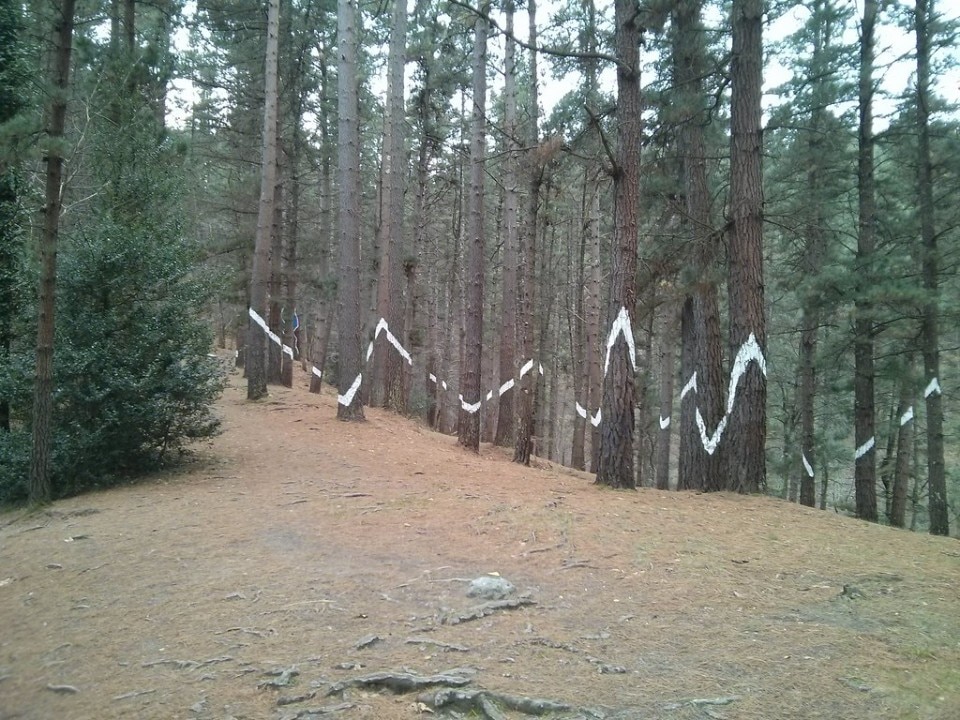
      Agustín Ibarrola, Bosque de Oma, Cortézubi, Spain 1985

      The Basque painter and sculptor Agustín Ibarrola conceived the "animated forest" or Bosque de Oma, within the Urdaibai Biosphere Reserve, as a manifesto of the relationship between nature and human presence. The polychrome traces painted on the trunks of the trees form geometric, anthropomorphic and zoomorphic figures, can be perceived in their entirety only from some precise points of view and could remain mysterious and incomprehensible to inattentive or unconscious viewers.

      Photo by Javi on Flickr

      View article
      View article
      • SHARE
      • PIN IT

      Agustín Ibarrola, Bosque de Oma, Cortézubi, Spain 1985

      Photo by Álvaro Bohórquez on Flickr

      View article
      View article
      • SHARE
      • PIN IT

      Bernard Tschumi, Parc De La Villette, Paris, France 1991

      The 55-hectare park, located on the outskirts of Paris and among the largest in the city, is an important attraction from both an architectural and a scientific-cultural point of view. Its plan is generated by the overlapping of different geometric patterns, punctuated at their intersections by red structures called folies. In the area there are the Cité des Sciences et de l'Industrie, the largest science museum in Europe, the Géode, a hemispherical projection hall with a mirror surface, the Cité de la musique, a museum of musical instruments with a concert hall and home to the Conservatoire, the Zénith, a 6,300-seat arena, the Grande Halle, a space dedicated to fairs and events, and the Philharmonie de Paris (by Jean Nouvel), a symphonic concert hall with 2,400 seats. Entertainment gardens, such as the Jardin du Dragon with a large steel dragon and the Jardin de Bambou, attract visitors of all ages.


      Photo by Jean-Pierre Dalbéra on Flickr

      View article
      View article
      • SHARE
      • PIN IT

      Bernard Tschumi, Parc De La Villette, Paris, France 1991

      Photo by Carl Campbell on Flickr

      View article
      View article
      • SHARE
      • PIN IT

      Beverley Lear, Peace Maze, Castlewellan, Northern Ireland 2001

      With a total area of 11,215 square metres, Peace Maze in Castlewellan is one of the largest permanent hedge mazes in the world and a symbol of peace for Northern Ireland. Planted with community involvement, the hedge includes 6,000 yew trees. The aim of the walk, which is about 3 km long, is to get to the centre of the maze where the peace bell, with its is auspicious tolling, stands.

      Photo by Paul at English wikipedia on wikimedia commons

      View article
      View article
      • SHARE
      • PIN IT

      Beverley Lear, Peace Maze, Castlewellan, Northern Ireland 2001

      Photo by bishib70 on Flickr

      View article
      View article
      • SHARE
      • PIN IT

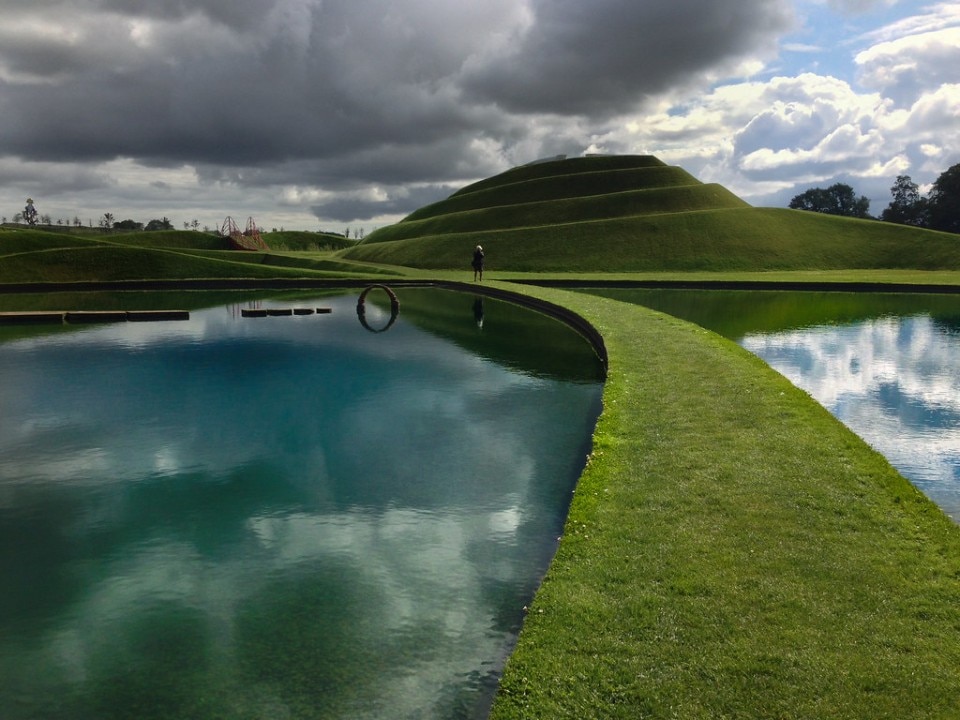
      Charles Jencks, Garden Of Cosmic Speculation, Dumfries, UK 2002

      A park that translates the complexity of different scientific theories into land art: this is how architectural and landscape designer and theorist Charles Jencks has conceived the garden at his estate in Portrack House, Scotland, where mathematical formulae and apparently ineffable subjects – such as the distortion of time and space caused by black holes – are narrated on a 12-hectare area amidst landscaping games of symmetries and curvatures, terracing, bridges and sculptures. The garden is private, opening to the public once a year as part of Scotland's Gardens programme.

      Photo by Gary Denham on Flickr

      View article
      View article
      • SHARE
      • PIN IT

      Charles Jencks, Garden Of Cosmic Speculation, Dumfries, Regno Unito 2002

      Photo by Flexdream on wikimedia commons

      View article
      View article
      • SHARE
      • PIN IT

      Jupiter Artland, Edimburgh, UK 2009

      The 40-hectare park nestled in the Scottish countryside, just a few miles from Edinburgh on the estate of Bonnington House, a 19th-century country house, is home to permanent installations, contemporary art and land art works by the most celebrated international artists and landscape designers, from Anish Kapoor, to Christian Boltanski, to Charles Jencks. In 2015, Benjamin Tindall Architects has designed two new buildings for service and exhibition spaces.

      Photo by Steve Hodgson on Flickr

      View article
      View article
      • SHARE
      • PIN IT

      Jupiter Artland, Edimburgh, UK 2009

      Photo by Rosa Menkman on Flickr

      View article
      View article
      • SHARE
      • PIN IT

      Mary Reynolds, Brigit's gardens, Pollagh, Rosscahill, County Galway, Ireland 2011

      Nestled in the hills of Connemara, Brigit's Garden is an open-air museum inspired by Celtic mythology and the Celtic calendar, and is dedicated to Brigit, the goddess of fertility and springtime who was particularly loved by the Druids. The design of the site pays homage to the four great events of the Celtic year, which are represented in four natural areas: Samhain (winter), Imbolc (spring), Bealtaine (summer) and Lughnasa (autumn). A sacred path through the spiral of the seasons, among water lilies, coloured berries and symbolic plants, leads the visitor to explore with the senses the cycle of life in all its phases.

      Photo by Young Shanahan on Flickr

      View article
      View article
      • SHARE
      • PIN IT

      Mary Reynolds, Brigit's gardens, Pollagh, Rosscahill, County Galway, Ireland 2011

      Photo by Jacline on Flickr

      View article
      View article
      • SHARE
      • PIN IT

      Josep Pujiula, Parc d'en Garrell, Argelaguer, Spain 2014

      Located in Catalonia, this work is due to Josep Pujiula, a local resident, who started it in the 1970s, to rebuild it several times over the years (due to vandalism, fires and the construction of a railway) until it got to today's version (the fourth). Since 2014, the park has been open to the public and is regarded as a local attraction, amidst oddities and esoteric charms, such as 30 m high towers made of acacia branches, tunnels, mazes of crossed branches, rock carvings and anthropomorphic totems made of rusty metal.

      Photo by Smolera on wikipedia

      View article
      View article
      • SHARE
      • PIN IT

      Josep Pujiula, Parc d'en Garrell, Argelaguer, Spain 2014

      Photo by Smolera on wikimedia commons

      View article
      View article
      • SHARE
      • PIN IT

      Tim Smit, Lost Gardens Of Heligan, Pentewan, United Kingdom 1990

      This 18th-century garden complex is located on the Heligan estate in Cornwall. The gardens, considered by the 19th century among the most beautiful in Britain, fell into disrepair after the First World War (hence the name 'lost gardens') but were recovered in the 1990s as part of the largest green restoration project in Europe. The park with pavilions, ponds, grottoes and sculptures covers an area of about 32 hectares and includes Italian, English and exotic gardens. Among the most curious works are Mud Maid and The Giant's Head, sculptures that peep out of the ground among the trees and bushes.

      Photo by Rob Young on Flickr

      View article
      View article
      • SHARE
      • PIN IT

      Tim Smit, Lost Gardens Of Heligan, Pentewan, United Kingdom 1990

      Photo by Alan Weir on Flickr

      View article
      View article
      • SHARE
      • PIN IT

      Ann Atkin, The Gnome Reserve, Bradworthy-Devon, UK 1979

      If a garden gnome goes missing from time to time, one can assume its escape (or kidnapping) has brought it to Devon where Ann Atkin, an art scholar, has created a fairytale garden open to the public. The 1.6-hectare estate includes a wood, a stream, a pond, a meadow and a garden with some 250 species of wild flowers and ferns, where over 1,000 gnomes and elves have found their place.

      Photo by Lewis Clarke on wikimedia commons

      View article
      View article
      • SHARE
      • PIN IT

      Ann Atkin, The Gnome Reserve, Bradworthy-Devon, UK 1979

      Photo by Lewis Clarke from wikimedia commons

      View article
      View article
      • SHARE
      • PIN IT

      View article
      View article
      • SHARE
      • PIN IT
      Loading
      Share
      • Sections
        • Summer
        • Architecture
      • Keywords
      • News
      • Architecture
      • Design
      • Art
      • Opinion
      • Archive
      • Products
      • Foreign Editions
      • Biographies
      • Architectural movements
      • Buildings
      • Architecture Firms
      • Design Essentials
      • Urban stories
      • Gio Ponti
      • Contacts & Editorial Team

      • Follow us
      Legal Note

      Editorial DomusEditoriale Domus Spa
      Via G. Mazzocchi, 1/3
      20089 Rozzano (Mi) -
      Codice fiscale, partita IVA e iscrizione al Registro delle Imprese di Milano
      n. 07835550158
      R.E.A. di Milano n. 1186124
      Capitale sociale versato € 5.000.000,00 - All rights reserved - Privacy - Informativa cookie completa - Gestione Cookies

      China Germany India Mexico, Central America and Caribbean Sri Lanka Korea icon-camera close icon-comments icon-down-sm icon-download icon-facebook icon-heart icon-heart icon--mobile-logo icon-next-sm icon-next icon-pinterest icon-play icon-plus icon-prev-sm icon-prev Search icon-twitter icon-views icon-instagram