-
Sections
-
Keywords
The ambiguous iconography of the dragon in architecture, from East to West
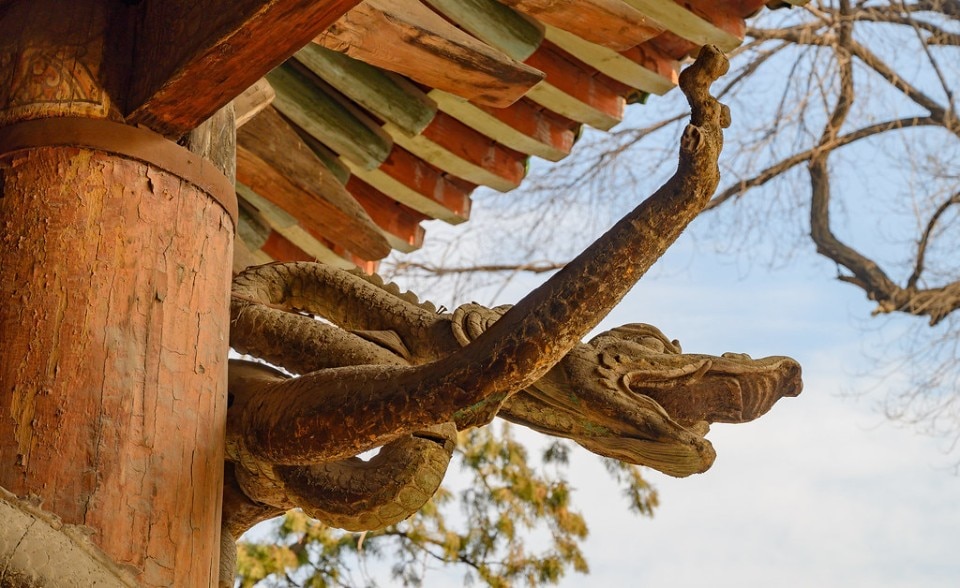
Jinci Temple, Taiyuan, Shanxi, China 373 B.C.
More than a temple, the complex - consisting of a hundred or so buildings - is a model of the perfect fusion of ancestral architecture and natural landscape. Among the many 'wonders' it contains, there are the eight columns of the Hall of the Holy Mother, around which wood-carved dragons twine, dating back to 1087 A.D. and the first examples in China.
Photo by Gisling from wikimedia commons
Jinci Temple, Taiyuan, Shanxi, China 373 B.C.
More than a temple, the complex - consisting of a hundred or so buildings - is a model of the perfect fusion of ancestral architecture and natural landscape. Among the many 'wonders' it contains, there are the eight columns of the Hall of the Holy Mother, around which wood-carved dragons twine, dating back to 1087 A.D. and the first examples in China.
Photo by xiquinhosilva from Flickr
York Minster (Golden Dragon), York, United Kingdom 1472
In the largest Gothic cathedral in Northern Europe, and certainly one of the most spectacular and best-preserved, a gilded wooden dragon's head emerges from the triforium of the north aisle. Its original function is unknown but it is believed to have been part of the lifting mechanism of a lid of the baptismal font below. The head is a 19th century reconstruction, following damage to the nave vault in the 1840 fire.
Photo by IBBoard from Flickr
Antoni Gaudí, Casa Figueras (Bellesguard), Barcelona, Spain 1909
Located on the slopes of the Collserola Natural Park, this house that Gaudí designed on the traces of a 15th-century tower combines Catalan modernism with neo-Gothic style. The austere façade in local stone of different shades with elongated windows suggests the idea of a medieval fortress: from a particular perspective of the terrace, the geometry of the roof of the central structure evokes the face of a dragon with a somewhat threatening look.
Photo by GerthMichael from wikipedia
Antoni Gaudí, Casa Figueras (Bellesguard), Barcelona, Spain 1909
Photo by Pablo Alejandro Araujo Granda da Flickr
Casa della Vittoria (House of Dragons), Turin, Italy 1920
The building, considered one of the most interesting examples of a civil residence in eclectic style with neo-Gothic tendencies in the city, is characterised on the main façades by a rich decorative display of allegorical and zoomorphic figures in lithocement, such as the pair of large dragons flanking the wooden entrance portal.
Photo Uccio “Uccio2” D’Ago…from wikimedia commons
Casa della Vittoria (House of Dragons), Turin, Italy 1920
Photo Enryonthecloud from wikimedia commons
Wat Samphran Dragon temple, Sam Phran District, Nakhon Pathom, Thailand 1985
This unusual building, a 17-storey pink tower, 80 metres high and completely enveloped by a huge red and green dragon, was a now abandoned Buddhist temple. The dragon, made of iron and fibreglass, is completely hollow on the inside and can be walked up to its head.
Photo Pierrick from Adobestock
Dragon Holes, Hong Kong
In the dense and vertical landscape of Hong Kong it is not difficult to come across strange holes in the body of buildings. Not a formal quirk of the architects but a way of conveying 'Chi', the vital energy that flows in every being and is blown into the inhabited space by the breath of dragons. In their flight from the mountains to the ocean, however, the dragons run into obstacles caused by urban constructions and, so as not to interrupt their flow as the rules of Feng Shui dictate, the tallest buildings house large openings through which the dragons can pass, thus bringing wealth and prosperity to those who inhabit those places.

Foto by ThisParticularGreg from Flickr
NEXT architects, Lucky Knot Bridge, Changsha, China 2013
This 185m long and 24m high steel bridge, located in the megacity of Changsha, connects the banks of the Dragon King Harbor River, the street and the park with several levels at different heights. The sinuous shape of the structure is inspired by traditions of Chinese culture, such as the ancient art of knotting, and evokes the coils of a dragon's agile body.
Photo by Julien Lanoo
Studio Libeskind, The Vanke Pavilion, Milan, Italy 2015
Vanke China's corporate pavilion, designed by Studio Libeskind for Expo Milano 2015 'Feeding the Planet, Energy for Life', incorporates three values of Chinese culture related to food: the shi-tang, the traditional Chinese dining room; the landscape, a fundamental element of life; the dragon, metaphorically linked to agriculture and sustenance. The sinuous design and the metallic red tile covering in iridescent tones create an expressive pattern reminiscent of a dragon's skin.
Photo by Jean-Pierre Dalbéra from Flickr
Beijing Architect design institute, Bengbu Sports Centre, Anhui Bengbu, China 2018
The huge 144,000sq m sports complex includes a stadium, a gymnasium, a multi-purpose hall, a viewing tower, a sports school and two museums. The design of the complex is inspired by the shape of a dragon that moves and wraps itself around the open space, with an iridescent skin recalled by the aluminium composite panels cladding.
Courtesy of 3A Composites (China) Ltd.
Beijing Architect design institute, Bengbu Sports Centre, Anhui Bengbu, China 2018
Courtesy of 3A Composites (China) Ltd.
Cheng-Tsung Feng Design Studio, Dragon Palace, Budai Seaview Park, Chiayi, Taiwan 2020
The pavilion made of bamboo, wood and rope, set up in the Chiayi marina as a reception space for tourists, is inspired by the organic forms of marine life and has a symbolic and ritualistic significance: as light falls, it lights up like a living creature waking up at night.
Photo by Yi-Hsien LEE (YHLAA)
Cheng-Tsung Feng Design Studio, Dragon Palace, Budai Seaview Park, Chiayi, Taiwan 2020
Photo by Yi-Hsien LEE (YHLAA)