OK
Domus Domus
newsstand
SUBSCRIBE
  • Magazine
  • Digital Edition
  • Digital Archive
LANGUAGE
  • it
  • en
Hi Logout
Sign up / Log in
  • News
  • Architecture
  • Interiors
  • Design
  • Art
  • Archive
  • Products
  • Design Essentials
  • Design Stories
  • Submit your project
Sections
  • News
  • Architecture
  • Interiors
  • Design
  • Art
  • Archive
  • Products
  • Covers
  • Biographies
  • Architecture Firms
  • Sustainable Cities
  • Gallery
  • Design Stories
  • Domus for Design
Magazine
  • Subscriptions
  • Digital Edition
  • Current Issue
  • Guest Editor
  • Digital Archive
  • Nordic Design
Specials
  • Design Essentials
  • Modern Work
  • DomusAir
  • Milano Design Week
  • Worldesign
Current Issue

Domus 1106 hits the shelves

Follow us
LANGUAGE
  • it
  • en
Hi Logout
Sign up / Log in
newsletter Icon
results No results Please enter a long search term

      The remarkable architecture of communist Albania and its revival

      The remarkable architecture of communist Albania and its revival

      Next gallery

      “Sanremo è Sanremo”. But what is Sanremo?

      1. Pyramid of Tirana – Pirro Vaso, Klement Kolaneci, Pranvera Hoxha e Vladimir Bregu (1988), MVRDV (2018)

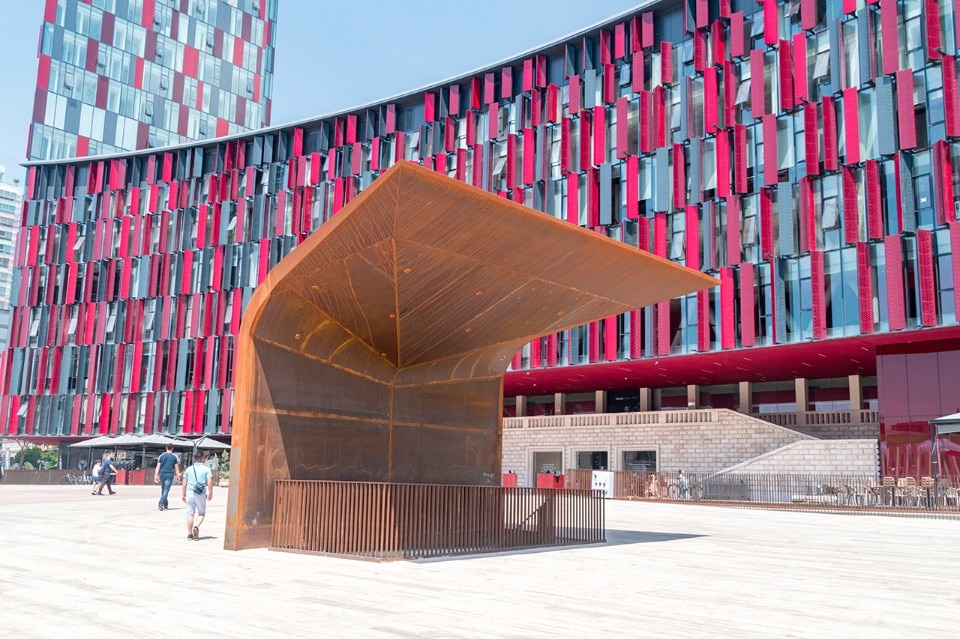
      Built in 1988 as a celebratory museum after the death of the historic leader, the Tirana Pyramid is perhaps one of the capital's most recognizable pieces of architecture. Faced with numerous proposals to demolish the building, in 2018 the Pyramid underwent a radical renovation project signed by MVRDV. The new project transformed the former mausoleum into an IT center for young people, hosting cafes, studios, offices for start-ups, and workspaces. Today, a series of modular and polychrome elements are placed inside and outside the structure, giving a new look to the architecture itself. MVRDV inserted stone staircases alongside these elements to surmount the reinforced concrete bands that marked the external shell. These run along the volume's surfaces to the top, while glass bands punctuate and illuminate the large internal void.

      © Ossip van Duivenbode

      View article
      View article
      • SHARE
      • PIN IT

      1. Pyramid of Tirana – Pirro Vaso, Klement Kolaneci, Pranvera Hoxha e Vladimir Bregu (1988), MVRDV (2018)

      © Ossip van Duivenbode

      View article
      View article
      • SHARE
      • PIN IT

      1. Pyramid of Tirana – Pirro Vaso, Klement Kolaneci, Pranvera Hoxha e Vladimir Bregu (1988), MVRDV (2018)

      © Ossip van Duivenbode

      View article
      View article
      • SHARE
      • PIN IT

      2. Qender Zjarri and Pike Zjarri bunker – Josif Zagali

      The construction of anti-atomic bunkers, and for the defense of the Albanian territory, because of a possible external attack, marked the spread of countless prefabricated structures that today continue to dot the Albanian territory. Bunkers are built everywhere - on the roadsides, in the open countryside, in the middle of cemeteries, or on the sea coasts - and fall into two main typologies. The Qender Zjarri, small bunkers entirely prefabricated and transportable, are designed as military garrison points for one or two people, 2 meters and 10 meters high, 3 meters in diameter; they have a small space covered by a reinforced concrete cap where you can shoot any enemies. The second type, Pike Zjarri, is considerably larger in size and can, therefore, be assembled by joining several prefabricated elements, thus giving rise to caps of 8 meters in diameter and up to 5 meters in height.


      Photo by Thomas on AdobeStock

      View article
      View article
      • SHARE
      • PIN IT

      2. Qender Zjarri and Pike Zjarri bunker – Josif Zagali

      Photo by Robson90 on AdobeStock

      View article
      View article
      • SHARE
      • PIN IT

      2. Qender Zjarri and Pike Zjarri bunker – Josif Zagali

      Photo by Robson90 on AdobeStock

      View article
      View article
      • SHARE
      • PIN IT

      2. Qender Zjarri and Pike Zjarri bunker – Josif Zagali

      Photo by Robson90 on AdobeStock

      View article
      View article
      • SHARE
      • PIN IT

      3. Palace of Culture of Tirana – / (1958-1963)

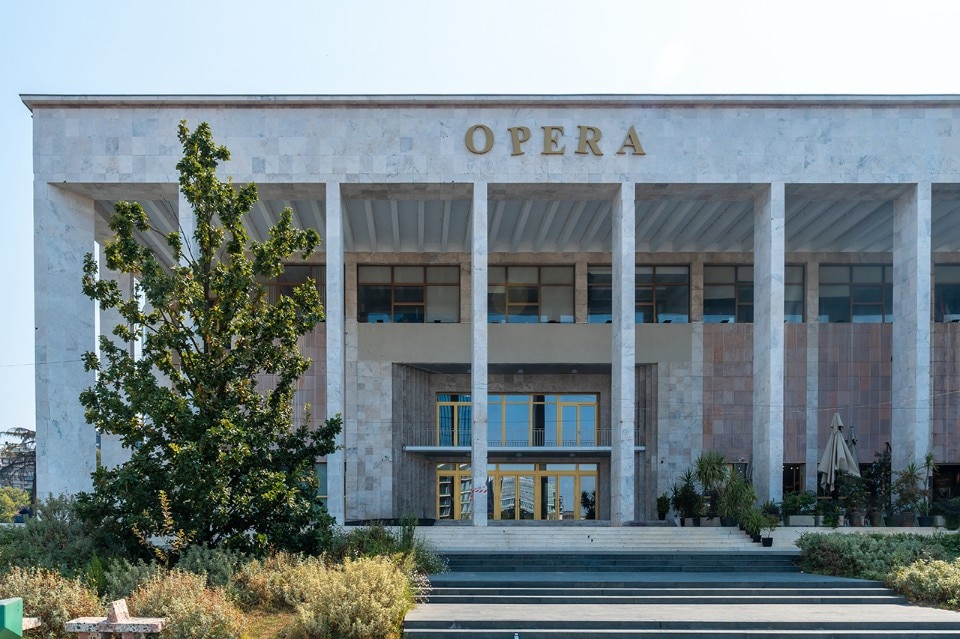
      Erected in the central square of Tirana at the direct request of Enver Hoxha, it saw the first stone laid by Nikita Khrushchev, general secretary of the Communist Party of the Soviet Union at the time. Here, the building that houses the Opera and Ballet has the typical stylistic features of Stalinist buildings in its architecture. A portico is excavated and supported by narrow concrete blades covered in stone in the main facade of the compact shape that defines the structure. The general rigor of the architecture then sees a light podium that raises it from the ground, placing it in dialogue with the large void of the square in front, imposing itself within the urban scenario of the capital.

      Photo by unai on AdobeStock

      View article
      View article
      • SHARE
      • PIN IT

      3. Palace of Culture of Tirana – / (1958-1963)

      Photo by Leonid Andronov on AdobeStock

      View article
      View article
      • SHARE
      • PIN IT

      4. National Museum of Fine Arts of Tirana – / (1974)

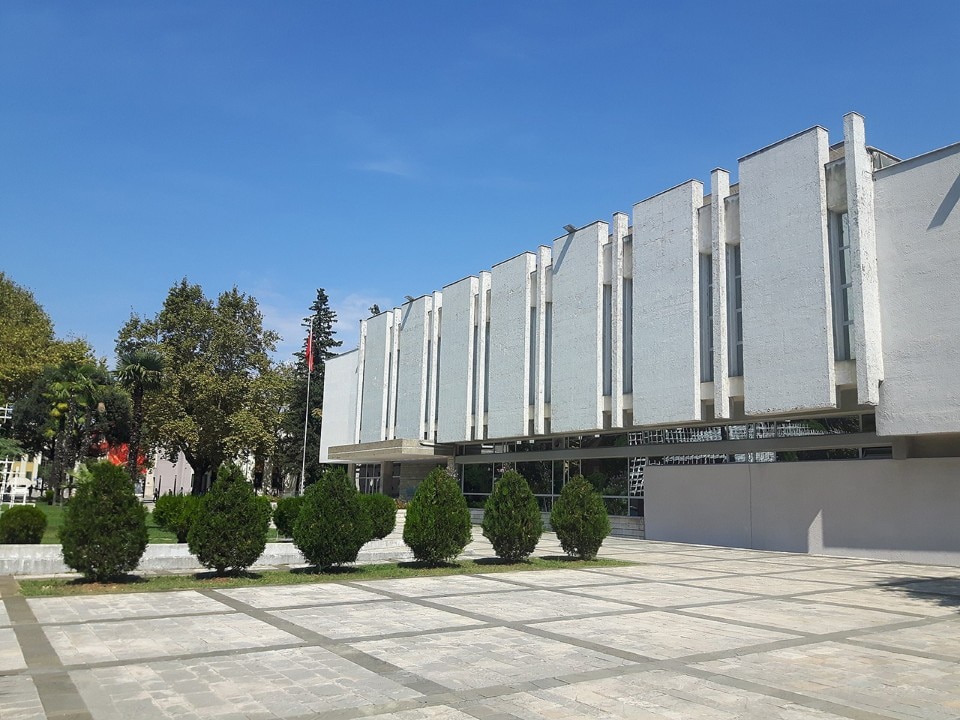
      Having some similarities with the Palace of Culture, the National Museum of Fine Arts of Tirana is a monumental building with characters that are also close to the late modern international language.
      In the definition of the external facades, the structure sees a dry and austere language. Here, the perimeter wall is fragmented, leaving space for the windows punctuating and giving rhythm to the facade. The volume, therefore, is broken down between the external skin and the contained space, where the opaque masses of the national gallery appear to be heavy monumental blocks.

      Photo by Sailko on wikimedia commons

      View article
      View article
      • SHARE
      • PIN IT

      4. National Museum of Fine Arts of Tirana – / (1974)

      Phoyo by ErtonKashta on wikimedia commons

      View article
      View article
      • SHARE
      • PIN IT

      5. National History Museum of Tirana – Sokrat Mosko, Enver Faja, Nina Shehu, Petraq Kolevica (1981)

      Built at the end of Enver Hoxha's regime, the National History Museum of Tirana is part of those buildings intended to represent both a monument to the Albanian people and a demonstration of the regime's strength.
      Architecture sees its expressiveness in the play of volumes. The entrance, raised from the street level, is surmounted by a projecting body with a mosaic dedicated to the history and value of the Albanians. The base, covered in dark stone, recedes from the volume, thus leaving the upper body as the main urban presence. The surface is then punctuated by vertical windows, which design the only elements of discontinuity on the facade.

      Photo by sforzza on AdobeStock

      View article
      View article
      • SHARE
      • PIN IT

      5. National History Museum of Tirana – Sokrat Mosko, Enver Faja, Nina Shehu, Petraq Kolevica (1981)

      Photo by unai on AdobeStock

      View article
      View article
      • SHARE
      • PIN IT

      6. Palace of Congresses of Tirana – Klement Kolaneci (1986)

      Built as a palace for the workers' party congresses, the building seeks a visionary declination of the language of socialist architecture. The massive volumes here become glass spaces, and the projecting body that surmounts the entire work becomes plastic, curving and moving the composition. The entrance, raised and reachable by a small staircase, is framed by two monumental pillars that generate support ribs for the projecting body in their vertical development.
      Strongly in tune with the language of the Pyramid of Tirana, the composition of the Congress Palace's overhangs, pillars and towering elements presents itself as a continuous dialogue between heaviness and lightness.

      Photo by milosk50 on AdobeStock

      View article
      View article
      • SHARE
      • PIN IT

      6. Palace of Congresses of Tirana – Klement Kolaneci (1986)

      Photo by Robson90 on AdobeStock

      View article
      View article
      • SHARE
      • PIN IT

      7. Vlorë railway station - Arben Meksi (1983-1985)

      One of the actions promoted by Enver Hoxha's regime was the construction of the Albanian railway system, which, until the mid-1940s, was still absent. This promotion, therefore, also led to the construction of railway stations in the main cities of the State. In Vlorë, the third most populous city in Albania, there is the old station, which elegantly reproduces the synthetic features of the regime's architecture. The stone base opens up to the street with a canopy, the crowning expands and takes on a plastic, almost decorative shape. Finally, the body of architecture proposes a windowed theory in which a sculptural work is inserted.

      Photo by Jan Pešula on wikimedia commons

      View article
      View article
      • SHARE
      • PIN IT

      8. Arena Kombëtare – Gherardo Bosio/Marco Casamonti, Archea Associati (1946/2019)

      The capital's main stadium follows a rather singular story. Its construction began under the fascist occupation, designed by the Italian architect Gherardo Bosio. It was then completed following the liberation, and under the Hoxha regime, it saw various expansion works. In the 2000s, however, a heavy renovation changed heavily the old stadium, which was almost completely demolished to make room for the new forms designed, once again, by an Italian firm, Marco Casamonti's Archea Associati studio. What remains of the rationalist trace is the only entrance, which monumentally introduces the new stadium. In this work, the stratifications, and perhaps the contradictions, of an architecture that transforms a constantly changing nation are thus condensed.

      Photo by sports photos on AdobeStock

      View article
      View article
      • SHARE
      • PIN IT

      8. Arena Kombëtare – Gherardo Bosio/Marco Casamonti, Archea Associati (1946/2019)

      Photo by Robson90 on AdobeStock

      View article
      View article
      • SHARE
      • PIN IT

      View article
      View article
      • SHARE
      • PIN IT
      Loading
      Share
      • Sections
        • Architecture
      • Keywords
      • News
      • Architecture
      • Design
      • Art
      • Opinion
      • Archive
      • Products
      • Foreign Editions
      • Biographies
      • Architectural movements
      • Buildings
      • Architecture Firms
      • Design Essentials
      • Urban stories
      • Gio Ponti
      • Contacts & Editorial Team

      • Follow us
      Legal Note

      Editorial DomusEditoriale Domus Spa
      Via G. Mazzocchi, 1/3
      20089 Rozzano (Mi) -
      Codice fiscale, partita IVA e iscrizione al Registro delle Imprese di Milano
      n. 07835550158
      R.E.A. di Milano n. 1186124
      Capitale sociale versato € 5.000.000,00 - All rights reserved - Privacy - Informativa cookie completa - Gestione Cookies

      China Germany India Mexico, Central America and Caribbean Sri Lanka Korea icon-camera close icon-comments icon-down-sm icon-download icon-facebook icon-heart icon-heart icon--mobile-logo icon-next-sm icon-next icon-pinterest icon-play icon-plus icon-prev-sm icon-prev Search icon-twitter icon-views icon-instagram