

Ofis was founded in 1996 by Rok Oman (Jesenice, Slovenia, 1970) and Špela Videcˇ nik (Ljubljana, Slovenia, 1971), both graduates of the Faculty of Architecture of Ljubljana with master’s degrees from the Architectural Association of London. Their education was influenced by the important modernist legacy of Jože Plecˇ nik and Edvard Ravnikar, and by the opening to stylistic pluralism that became possible after the independence of Slovenia in 1991.
As young architects, Oman and Videcˇ nik witnessed the intense period of economic and cultural reappraisal and reinvention of their country. In 1998, Ofis received critical acclaim for its extension of the City Museum of Ljubljana, but the firm is best distinguished by its design of housing from 30 to 50,000 square metres, ranging from the mountain cabin (see the Alpine Shelter in Skuta, 2016) to large complexes of inexpensive housing. The latter show the exploration of modular units, variously aggregated in plan and elevation, presenting variations in pattern.
The two blocks of Honeycomb social housing in Izola, Slovenia (2005) are graced with balconies shaded by coloured fabric and cladded with high-pressure laminate. Similarly, the Tetris apartments in Ljubljana (2007) are built from extruded units of alternating solid walls, glazed segments and balconies positioned for a rhythmic effect. The balconies of the Basket student housing in Paris (2012) are made of strips of high-pressure laminated wood, and angled to turn away from each other, transforming the facade into a playful composition.
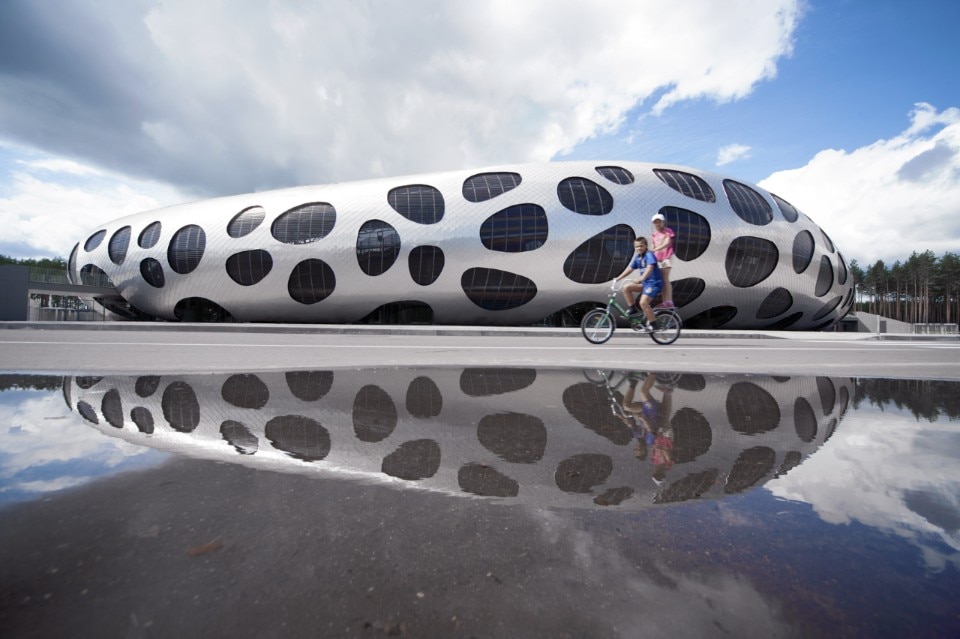
The organically haped Ofis-built football stadium in Borisov, Belarus (2014) is faced with shaped aluminium panels with cut-outs that allow the entrance of natural light and favour passive ventilation. At Ofis, the starting point is function, the relation to the site, local imagery and building techniques. Then they follow the modernist route, from master plan to construction detail.