

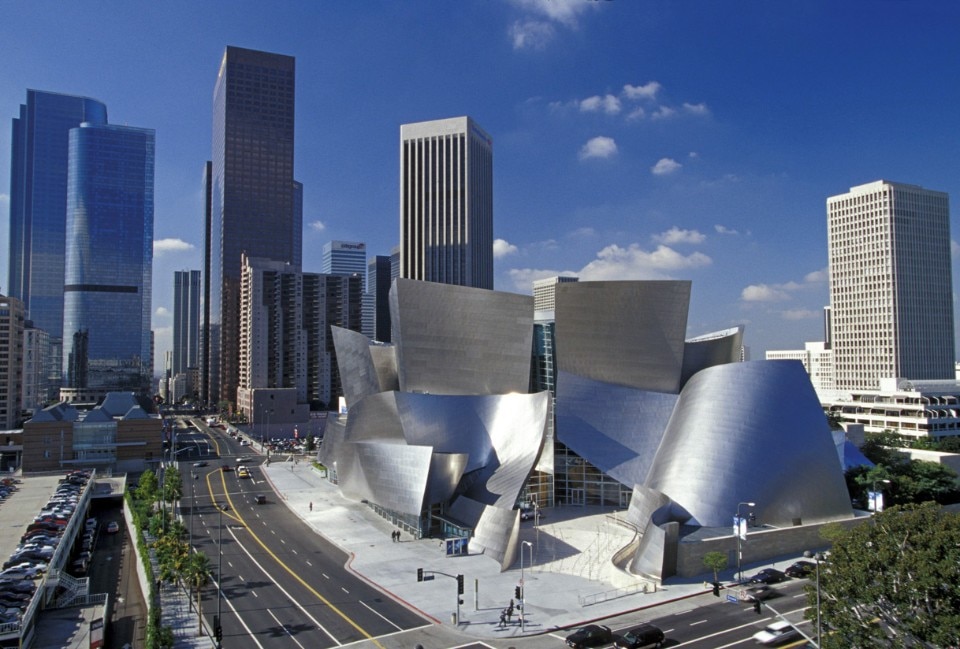
The American architect Philip Johnson had no doubts about Frank Gehry’s Guggenheim Museum in Bilbao: it was no less than “the greatest building of our time”. Completed in 1997, it was a disruptive project in many respects. Not only did it reverse the fortunes of the Spanish city struggling with post-industrial conversion, but it importantly suggested an unprecedented connection between architecture, planning and urban marketing. The “Guggenheim effect” was something many cities the world over relied on in the following decades to enhance their attractiveness, and Gehry became a beloved interpreter of this new phenomenon.
Born in Toronto in 1929, Frank O. Gehry was a leading figure of the deconstructivist movement when Johnson and Mark Wigley included him in the exhibition “Deconstructivist Architecture” they curated at the Museum of Modern Art, New York in 1988. He is a virtuoso of parametric design, a Pritzker Prize winner (1989), and has built countless iconic buildings including the Chiat/Day “binoculars building” in Venice, Los Angeles (1991, with artists Claes Oldenburg and Coosje van Bruggen), the “Fred and Ginger” Dancing House in Prague (1996), the Beekman Tower in New York (2011) and the Fondation Louis Vuitton in the Bois de Boulogne, Paris (2014).
More than half a century after establishing his practice in Los Angeles in 1962, Gehry remains controversial. Legend has it that on an infamous morning in the early 1990s, he dealt a hammer blow to the walls of his bathroom at his Santa Monica house in order to make it brighter. True or false, it is just an example of the brilliant, whimsical attitude of an artist who embodies better than most the multiple meanings of the widely misused neologism starchitect.