Autonomy and Negation

Lectures, published as books, were an intrinsic means of proclamation of modern thought. With his new book, the Japanese architect Kazunari Sakamoto recourses on this tradition by reflecting his own projects in the contexts of dwelling, city and life.

Kazunari Sakamoto: Lecture
Kazunari Sakamoto: Lecture, Tao Baerlocher and Samuele Squassabia (Eds), Quart Publishers, Lucerne 2015.


Within the discipline of architecture, a lecture is an often-used form of theory making. Its character is somehow ephemeral, and for this reason, sometimes lectures are published as books. Le Corbusier’s Une Maison – Un Palais (1928) and Précisions (1930) are well known examples. The latter was recently re-edited at Park Books (2015) and also the lecture held by Louis I. Kahn in 1969 at ETH Zurich is finally available in book form (Silence and Light, Scheidegger & Spiess, 2013). Kazunari Sakamoto now connects to this tradition with his lecture at the Accademia di Architettura in Mendrisio in December 2013.  
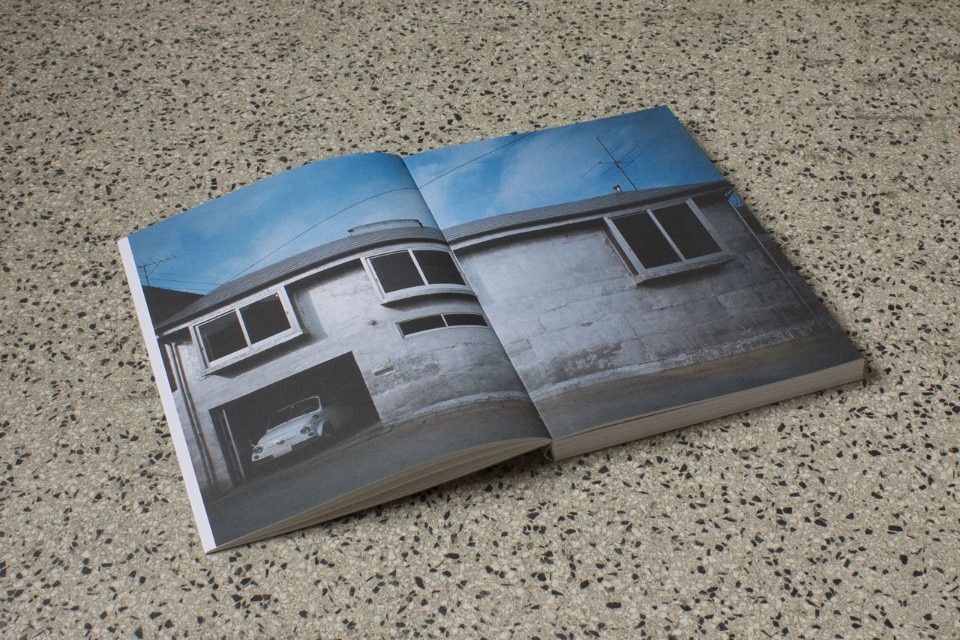
Kazunari Sakamoto: Lecture
Kazunari Sakamoto: Lecture, Tao Baerlocher and Samuele Squassabia (Eds), Quart Publishers, Lucerne 2015
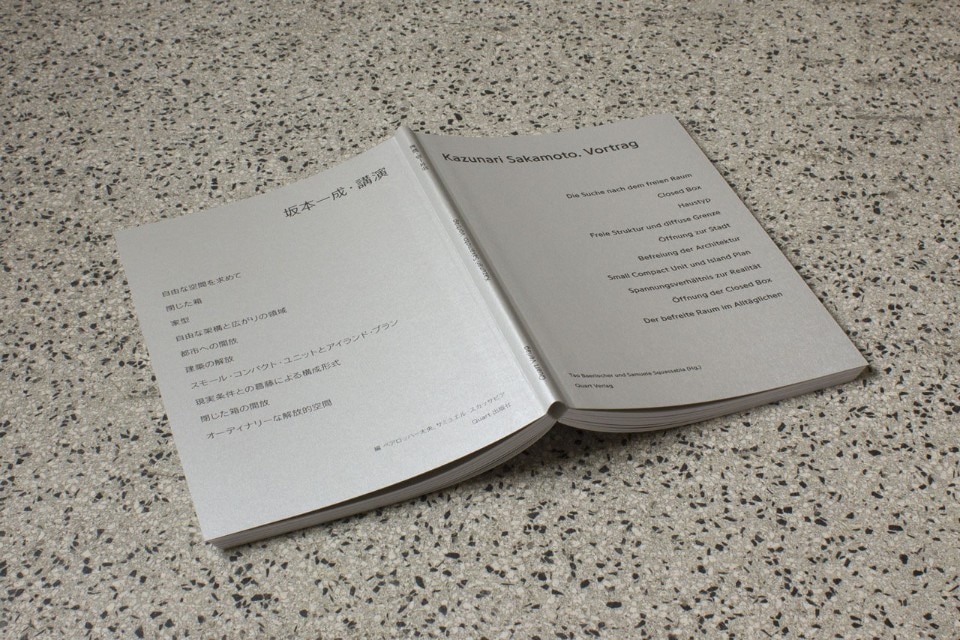
The book was released last year. Its succinct title is Lecture since it strictly follows this format: one picture per side, as projected in the auditorium, supplemented with some explanations. A reverence to Une Maison – Un Palais? Sakamoto held his lecture on invitation by Go Hasegawa who was teaching as guest professor at the Accademia.

There is a Japanese link behind the organization of the lecture: A certain genealogy, which essentially leads back to European modern architecture and eventually to Le Corbusier. Hasegawa was a student in Yoshiharu Tsukamoto’s Laboratory at Tokyo Tech. Tsukamoto studied in the atelier of Sakamoto who himself was a student of Kazuo Shinohara (1925–2006). Shinohara in turn studied architecture with Kiyoshi Seike (1918–2005) who knew modern architecture directly from his own experience, traveling through Europe. David B. Stewart wrote a lucid article about this genealogy in werk, bauen + wohnen 12, 2015.

Sakamoto’s thinking hence is deeply influenced by Shinohara’s concepts of space and architecture, and it is fascinating to follow step-by-step Samakoto’s path of emancipation through the pages of the book (the slides of the lecture).
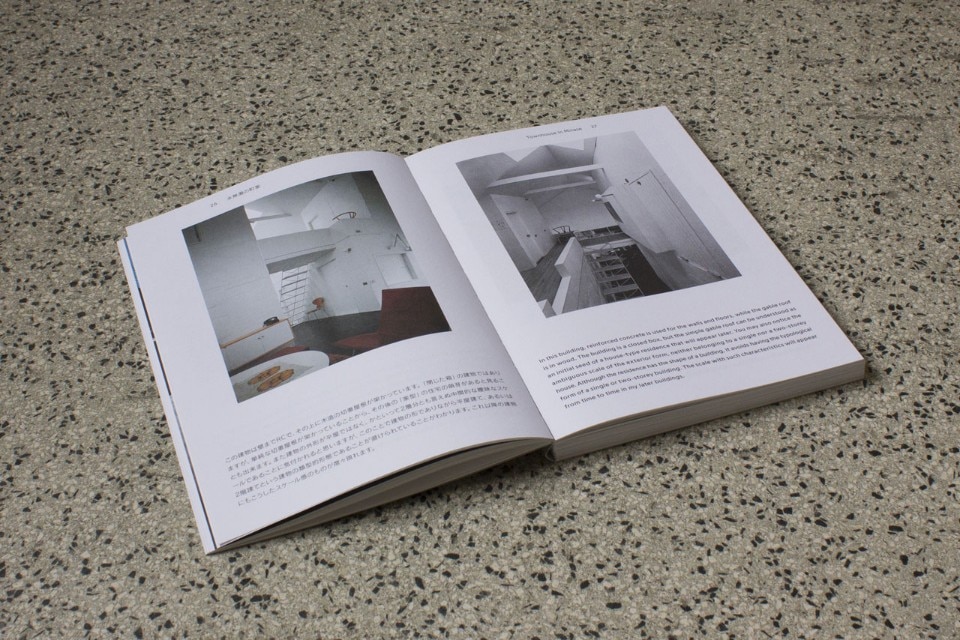
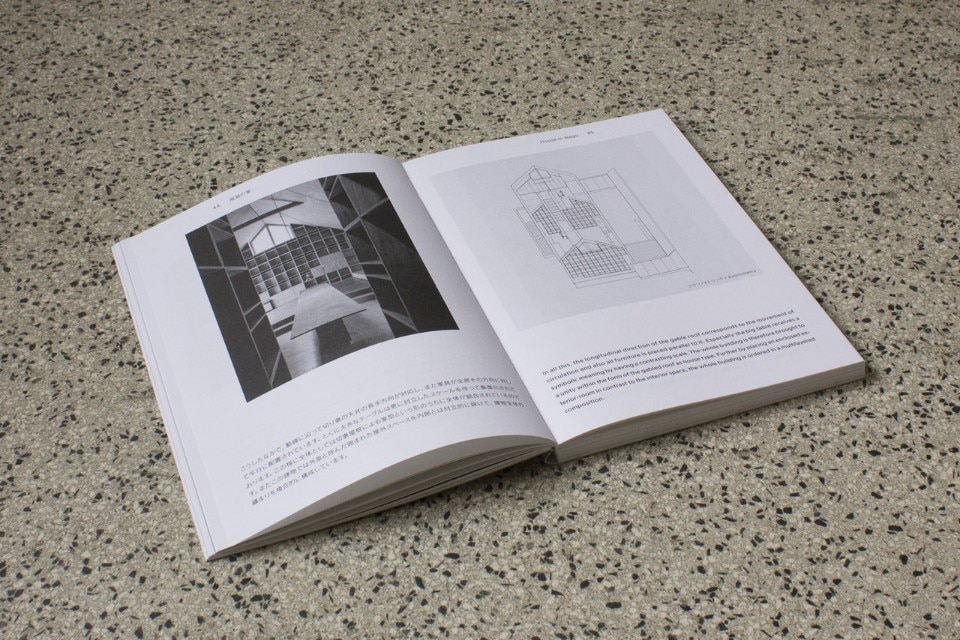
Kazunari Sakamoto: Lecture
Kazunari Sakamoto: Lecture, Tao Baerlocher and Samuele Squassabia (Eds), Quart Publishers, Lucerne 2015
The division of his creative work into periods must be inspired as well by Shinohara, as the aim is to conceptualize architectural space. “In Asia, imitation remains the sincerest form of flattery and is considered an essential element of any successful artistic apprenticeship,” Stewart writes about the young Shinohara proving reverence to Kenzo Tange. But Sakamoto’s work wouldn’t be worth mentioning if it stayed with that. Throughout his work, Sakamoto’s spatial concept shifts from complementary and abstract terms towards an investigation on anonymous dwelling typologies and from this towards a synthetic view on urban spaces and their use.
Kazunari Sakamoto: Lecture
Kazunari Sakamoto: Lecture, Tao Baerlocher and Samuele Squassabia (Eds), Quart Publishers, Lucerne 2015
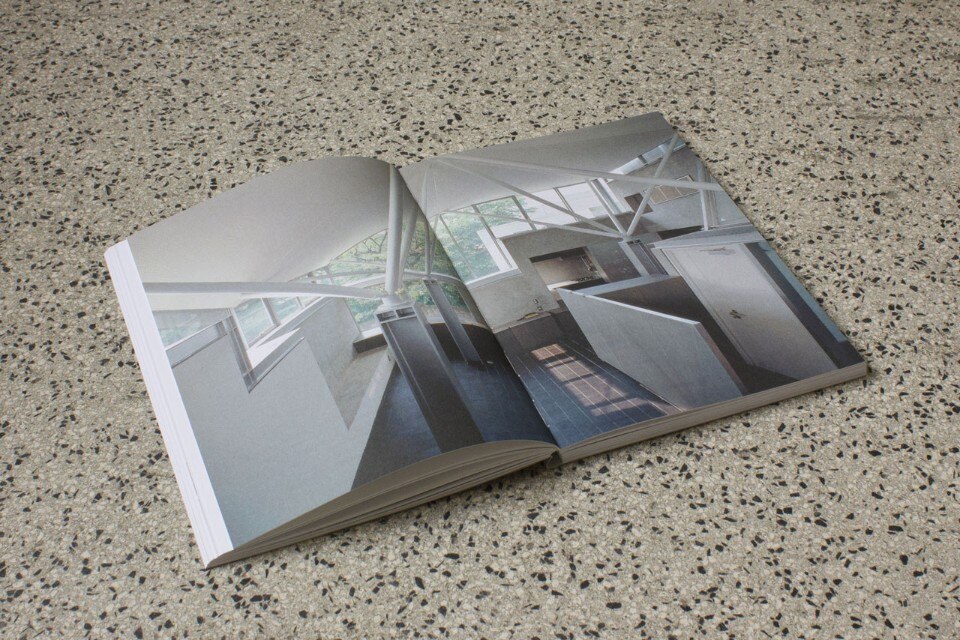
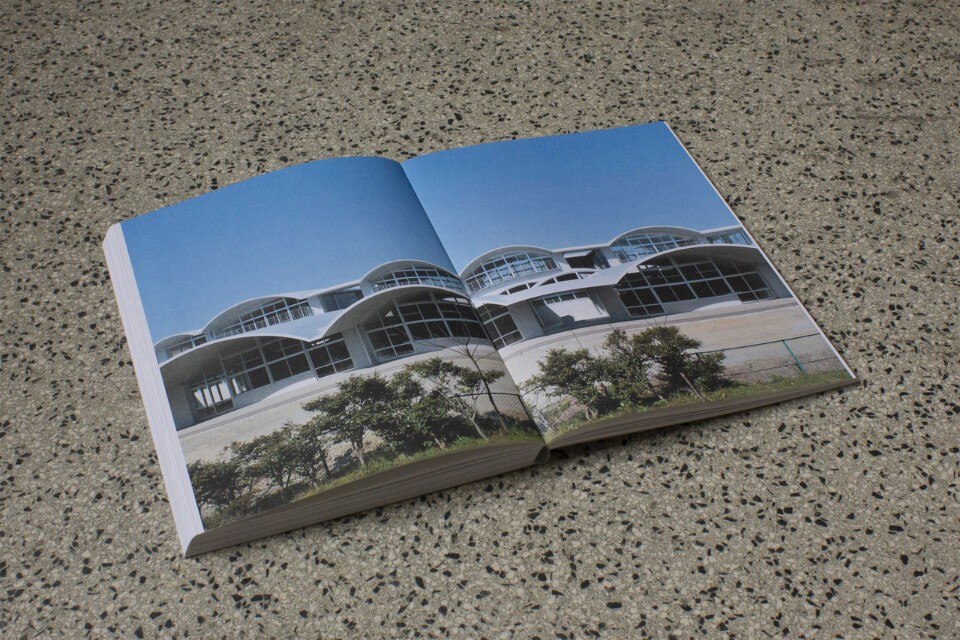
Sakamoto’s own artistic position becomes clear with the notion of “composition”, which is used quite often in the book. It is the key to the understanding of his work, but it remains also a well-kept artistic secret. Composition as a design principle owed to Shinohara is clearly recognizable between 1969 and 1973; volumes, space and structure are rendered into a tense inner-world for the cubic and mute first houses. From the midst of the 1970’s on, the sharp distinction between plain and void is given up in favour of a strong spatial moulding and the beginning of an interweaving of the house’s inside and outside. From 1978 on, composition also appears as a guiding principle on the house’s elevations; furthermore, inner and outer spaces are characterized by increasing continuities.
Kazunari Sakamoto: Lecture
Kazunari Sakamoto: Lecture, Tao Baerlocher and Samuele Squassabia (Eds), Quart Publishers, Lucerne 2015
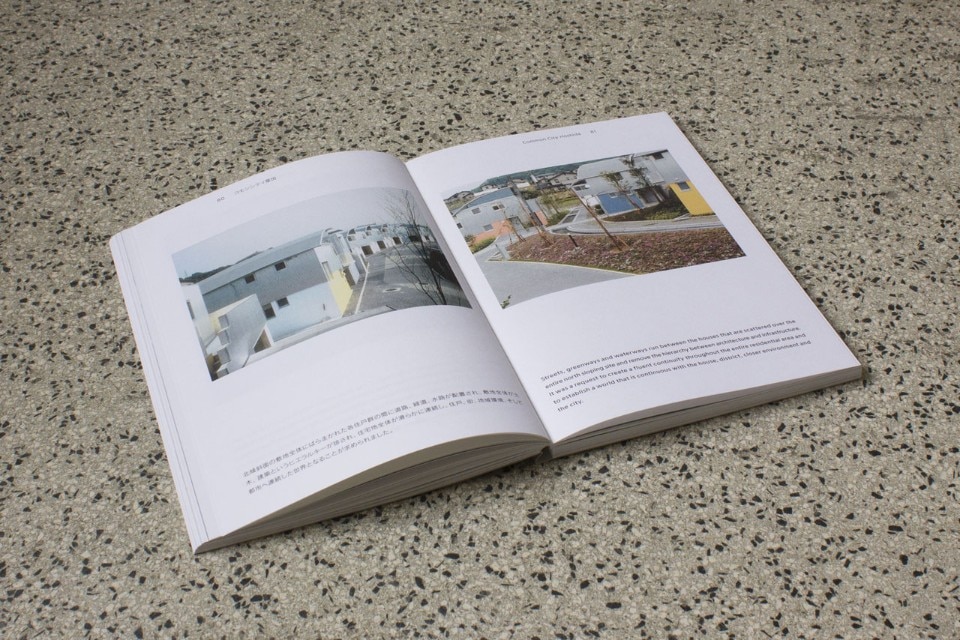
These become one of the principle topics from the midst of the 1980ies and locate the projects in the city’s texture. After a period of speculations on the constraints of complex architectural forms, the projects become more and more reduced towards an architectural realism by the beginning of this century. In two important works, the houses in Egota in Tokyo and the 1st prize in the competition for the Werkbundsiedlung in Munich, the volumes again become clearly shaped cubes. In both projects, Sakamoto composes a pattern of small and large spatial units into an even field of urban relationships. Houses and living units are defined by a stark spatial interaction with the urban fabric. In these two projects, the urban pattern draws back almost all architectural expression. It overcomes any mimetic or typological reference towards the city.
Kazunari Sakamoto: Lecture
Kazunari Sakamoto: Lecture, Tao Baerlocher and Samuele Squassabia (Eds), Quart Publishers, Lucerne 2015
The investigation on the critical relation between city and form brings Sakamoto’s recherche architecturale again into the proximity of his master Shinohara: Sakamoto’s latest work in an urban context stands next to Tokyo Tech’s Centennial Hall which has been designed by Shinohara in the mid 1980ies. In contrast to Shinohara, Sakamoto sees urban space as a part of the building itself. At the entrance of Tokyo Tech’s campus, form anew is released and is now subject of an oscillation between autonomy and negation; Shinohara would have spoken of a ‘machine’, which permanently produces urban chaos. Whilst in Shinohara’s own words, the Centennial Hall reflects the irregular beauty of the metropolis as “a random condition of objects”, Sakamoto sees in “the compositional form [a potential of contemporary architecture], which balances conflicts and includes contradictions”. Shinohara’s forceful idea of the city as a ‘machine’ made of discrete parts – and thought to be a reverence to Le Corbusier – has now been transformed by Sakamoto into “conditions of reality” in a much smoother way, giving existence to the building by “varying surrounding environments and different functions”.
Kazunari Sakamoto: Lecture
Kazunari Sakamoto: Lecture, Tao Baerlocher and Samuele Squassabia (Eds), Quart Publishers, Lucerne 2015
Sakamoto’s lecture gives us a clue on how architecture could be relieved from the dilemma between form and urban life. It achieves this in a very Japanese way by allusion and vagueness and not by explicitly expressing the contradictions between city and architecture. Nevertheless, it would have helped if the lecture in the book was accompanied by an essay, bridging cultural differences and shedding some more light on Sakamoto’s interesting method.
© all rights reserved

Latest News

Latest on Domus

China Germany India Mexico, Central America and Caribbean Sri Lanka Korea icon-camera close icon-comments icon-down-sm icon-download icon-facebook icon-heart icon-heart icon-next-sm icon-next icon-pinterest icon-play icon-plus icon-prev-sm icon-prev Search icon-twitter icon-views icon-instagram