

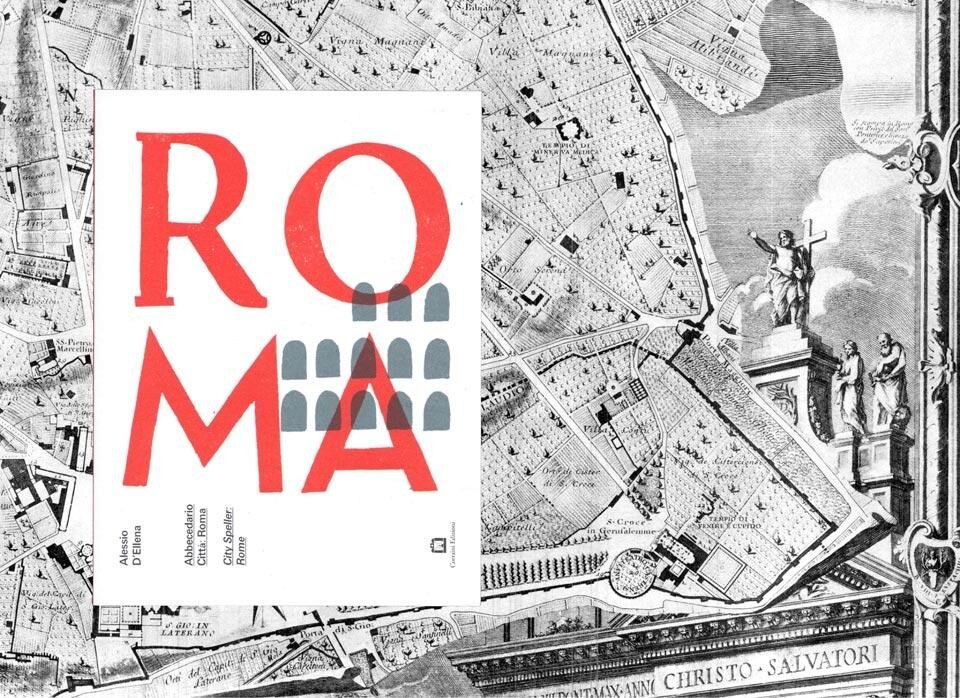
The curiosity that designers of urban spaces have reserved over the course of history for the inscriptions on the base of Trajan's Column in Rome or the architrave of the Temple of Sibyl at Tivoli bears witness to the long-standing relationship between the design of alphabetical letters and architecture. What of the letters constructed, deliberately or otherwise, in urban space from the combinations of architectural elements of the actual buildings? Who has not seen in a colonnade a series of lower case "m"s and "n"s?
This is the basis for Alessio D'Ellena's Abbecedario: Roma. The alphabet becomes an interesting pretext rather than an objective that enables the author to construct a series of bright and textural illustrated plates. It becomes possible for the reader to observe from a different angle, perhaps by half-closing the eyes, both well known and lesser known buildings, solid presences in the images of Rome stored in the minds of its inhabitants. The various forms of the letters, skilfully carved in linoleum, accompany the reader in a collection that pays tribute to the most stratified city in urban history.
Each illustration consists of an association between a capital letter and a significant architectural object from the urban fabric of Rome. The superimposition is made using transparent inks that make it possible to compare the structures of the objects under scrutiny. The silhouette of the Pyramid of Cestius at Porta San Paolo becomes an "A", while the columns of the Tangenziale Est, seen for example from via dello Scalo San Lorenzo, make up a continues series of "T"s, connected by the viaduct above. In the same way, the colonnade of the Colosseo Quadrato at EUR seems to be formed from a series of upside-down "U"s, neatly arranged in a typographic grid.
![Top and above: Alessio D'Ellena, <em>Abbecedario: Roma</em>, Corraini edizioni, Mantua 2012. Page detail. On the background, Nolli and Piranesi, <em>Nuova Topografia di Roma</em> ["New Topography of Rome"], 1748](/content/dam/domusweb/en/reviews/2013/03/22/abbecedario-roma/big_408513_2268_21141.jpg.foto.rmedium.jpg "Top and above: Alessio D'Ellena, <em>Abbecedario: Roma</em>, Corraini edizioni, Mantua 2012. Page detail. On the background, Nolli and Piranesi, <em>Nuova Topografia di Roma</em> [\"New Topography of Rome\"], 1748")
![Alessio D'Ellena, <em>Abbecedario: Roma</em>, Corraini edizioni, Mantua 2012. Page detail. On the background, Nolli and Piranesi, <em>Nuova Topografia di Roma</em> ["New Topography of Rome"], 1748](/content/dam/domusweb/en/reviews/2013/03/22/abbecedario-roma/big_408513_1154_31102.jpg.foto.rmedium.jpg "Alessio D'Ellena, <em>Abbecedario: Roma</em>, Corraini edizioni, Mantua 2012. Page detail. On the background, Nolli and Piranesi, <em>Nuova Topografia di Roma</em> [\"New Topography of Rome\"], 1748")
The alphabet becomes an interesting pretext rather than an objective that enables the author to construct a series of bright and textural illustrated plates
![Alessio D'Ellena, <em>Abbecedario: Roma</em>, Corraini edizioni, Mantua 2012. Page detail. On the background, Nolli and Piranesi, <em>Nuova Topografia di Roma</em> ["New Topography of Rome"], 1748](/content/dam/domusweb/en/reviews/2013/03/22/abbecedario-roma/big_408513_1196_41007.jpg.foto.rmedium.jpg "Alessio D'Ellena, <em>Abbecedario: Roma</em>, Corraini edizioni, Mantua 2012. Page detail. On the background, Nolli and Piranesi, <em>Nuova Topografia di Roma</em> [\"New Topography of Rome\"], 1748")
passanno còr marito
sotto l'arco de Tito,
vidde una Gatta nera
spaparacchiata fra l'antichità.
— Micia che fai? — je chiese: e je buttò;
un pezzettino de biscotto ingrese;
ma la Gatta, scocciata, nu' lo prese:
e manco l'odorò.
Anzi la guardò male
e disse con un' aria strafottente:
Grazzie, madama, nun me serve gnente:
io nun magno che trippa nazzionale!"
— Trilussa, Romanità, 1913
"One day a foreign Lady
Passed with her husband
Under the arch of Tito
She saw a black cat
Sprawled amid the antiquities
Pussy what are you doing? She asked and threw
A piece of biscuit
But the Cat, annoyed, didn't take it
Didn't even sniff it
In fact he looked at it with disdain
And said with an impudent air
Thank you madam, I need nothing
I eat only national tripe!"
— Trilussa, Romanità, 1913
![Alessio D'Ellena, <em>Abbecedario: Roma</em>, Corraini edizioni, Mantua 2012. Page detail. On the background, Nolli and Piranesi, <em>Nuova Topografia di Roma</em> ["New Topography of Rome"], 1748](/content/dam/domusweb/en/reviews/2013/03/22/abbecedario-roma/big_408513_8777_5851.jpg.foto.rmedium.jpg "Alessio D'Ellena, <em>Abbecedario: Roma</em>, Corraini edizioni, Mantua 2012. Page detail. On the background, Nolli and Piranesi, <em>Nuova Topografia di Roma</em> [\"New Topography of Rome\"], 1748")