

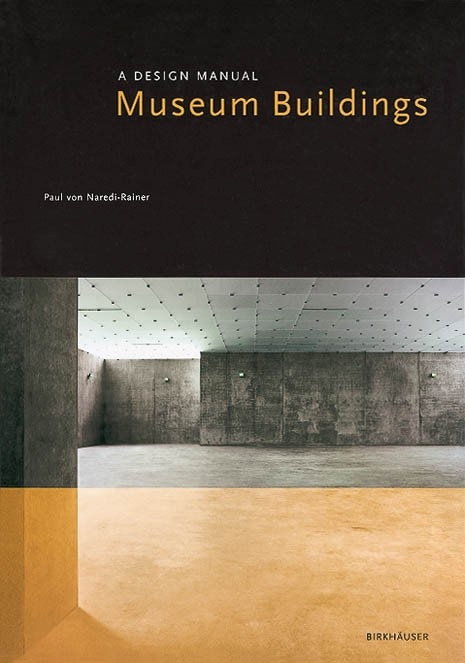
Museum Buildings. A Design Manual, Paul von Naredi-Rainer, Birkhäuser, Basel-Berlin-Boston 2004 (pp. 248, s.i.p.)
Paul von Naredi-Rainer has put together this fi ne book with considerable attention to detail. Reading its pages, one has the feeling of being taken straight to the heart of the matter without beating around the bush, accompanied by an author who has a great deal of direct experience in museum projects. It comes across as more of an atlas than a manual in the classic sense, as it makes no attempt to dictate rules for building museums (something that would be impossible anyway). Far more simply, it offers a point of reference for understanding the subject of museums through a series of specialist contributions and an extensive set of examples with generally concise and simple descriptions.
Nonetheless, the book has been written with the awareness that it is presenting a selection from within the world of museums that has over recent decades received much attention from critics and the public. It is divided into two sections. The fi rst discusses the general principles that apply to the museum as a building. A second, larger section is entirely dedicated to a series of built designs. After an initial historical digression on the museum as an institution, the book addresses the semantics of new museums. An examination of current trends reveals how we now consider the aura of the museum space itself as well as that of the exhibited works. The result is architecture that often seems very distant from traditional museum concepts and in which the work of art can sometimes appear almost a pretext for exhibiting the container.
This is a new museum model for us to grapple with, and it has a number of consequences. Firstly, talking about new museum spaces today also implies a consideration of context as a tool designed to create new values and establish different relationships, a self-celebration with the intention of making history where there is none. The fi rst part of the book ends with a useful section on the museum’s essential technological components, such as security, microclimate control and lighting – what we might call the fundamentals for those involved in museum design. In the six chapters of the book’s second part the author tackles the question of layout as a way of analysing approaches to museum design.
The 71 examples range from open-plan museum spaces to layouts with galleries placed in sequence, as well as the renovation and extension of spaces in monumental architecture. They represent the best of what has been built in recent years, including James Stirling’s Neue Staatsgalerie Stuttgart, Richard Meier’s Museu d’Art Contemporani Barcelona, and Tadao Ando’s Literature Museum Himeji I and II. The presence of the international star system is strongly felt. Italy is represented by the work of Aldo Rossi and Renzo Piano, strictly on foreign territory. To this is added a valuable example of the reuse of an existing space: the Expansion of the Gipsoteca Canoviana di Possagno by Carlo Scarpa. It is an Italian cultural masterpiece, but insuffi cient with respect to Italy’s museum situation. However, it does refl ect the mainly stagnant situation in Italy over recent decades regarding the country’s remarkable cultural heritage.
Roberto Cecchi Director General of Architectural, Historical and Artistic Haritage