

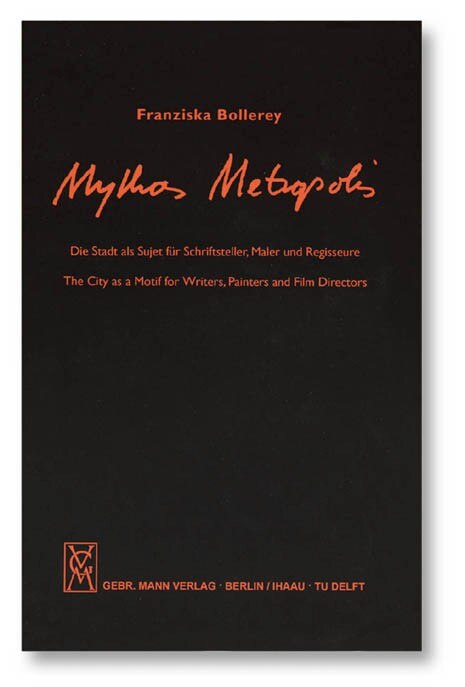
Mythos Metropolis. Die Stadt als Sujet für Schriftsteller, Maler und Regisseure , Franziska Bollerey, Gebr. Mann Verlag, Berlin/I.H.A.A.U. Delft 2006, German/English text (pp. 154, € 24,90)
Can today’s urban designers acquire perspectives on the metropolis from the example of artists - writers, painters and filmmakers – who looked at large cities one, two or three centuries earlier? This is the challenge proposed by this book. Its title would suggest a large format containing numerous examples of documentary photography. But instead, it is strangely small with an all-black cover, marked only by a red stroke similar to handwriting – almost as if it were a sort of diary. In this book, Franziska Bollerey (director of the institute for history of art, architecture and urban planning at Delft Polytechnic) investigates the visual poetics linked to the city, concentrating more on method than content. What symbols does the large city evoke, and what aspects of the city enable us to perceive them? The foreword mentions recent socio-urbanistic studies such as those of André Corboz but, a few pages later, the author moves away from the essay tone and leads us gently to Berlin with the words of Wim Wenders , and then to Paris, New York and Chicago – the metropolises. The book addresses around ten figures per chapter – from Marcel Proust to Georg Grosz, Le Corbusier and Louis Sébastien Mercier (a contemporary of Piranesi), and offers excerpts from interviews, letters and novels that are linked by the domino principle: a word or a detail refers to the previously mentioned motif. Wenders’s wall in Berlin defining apparently empty spaces becomes another wall, that observed by the protagonist of a Rilke novel in Paris.
Of course, the travel companions to whom Bollerey passes the microphone are well known and it would seem obvious to associate them with their work on metropolises. Yet the flow of the story created by the author is an expertly composed rhapsody, and neither reader nor critic can discard the text as “already read, already seen”. Nor do the selected pieces concede anything to an aesthetic contemplation of the city. There are instead sensations, colours, noises, flashes and eyesores. The text becomes the city. The argument in the book’s four core chapters is airy, fluid and quietly enthralling. Articulated like four musical movements, each chapter focuses on a theme and, paired together, the themes are complementary and contrasting: the adagio “The Gentle Way of Reading” (pp.16-31) on the interpretation of empty spaces is countered by the city as “A Montage of Masses” (pp. 32-71), followed by “The city as a Threat” (pp. 72-95), which is the antithesis of the last chapter, “The city and I” (pp. 96-109), the metropolis appropriated by the observer.
The metaphor floating across all the pictures of cities mediated by “onlooking men” is basically that of the city as a text – the city becomes text – an alternation of solids and voids, like letters with spaces in between. This is also referred to by the book’s graphic layout, another fundamental rhythmic element. The irregular division of text and pictures means that one does not prevail over the other and vice versa, while the true unity of text and pictures is represented by the sections in larger letters that look like a cry in the middle of the page and have the same bearing as photographs, paintings, posters and full-page film scenes. The fifth chapter of Mythos Metropolis reveals its surprising and indefinable nature.
Here, the author herself returns with a short essay on the image of changing European capitals and what urban culture means today. The writers consulted have interpreted the city as social contexts in constant movement, but the mosaic that illustrates the image of the (Western) metropolis in the 21st century is of a very different nature: it is a static city. Resulting from the interaction between the urban design, symbolic image and marketing of the city itself, this is similar to the product of a strategy drawn up on paper. This does not simply mean that we must look to the past to construct the future. Rather, Bollerey’s work is a meta-textual reflection on the city: the writers perceive the changing unity with greater historic and aesthetic awareness, yet this paradoxically leads to a strained construction of the image of a city. “On the one hand one has to appreciate that cities become aware of their cultural and aesthetic identity, on the other hand one has to criticise restorative tendencies, that reduce history to nostalgic or architectural set-pieces, and degrade the care for historic monuments into the mere cultivation of the townscape or the art of building cities…” (p.119). Today’s Berlin, with the loss of Palast der Republik, shortly to be demolished with no concrete projects for what will follow, is probably the most obvious reference to be read between the lines.
What, then, is the myth evoked by the metropolis if not a contemporary image, as far removed from its inhabitants and from its history as a fantasy and in which the masses are an accumulation of capitals? The city described by the authors, and like them by all those who have made the metropolis their own mother city, is far more concrete and tangible. This subtle, essential and original book resembles no other and should be read and reread. It is rare for a theme of broad portent to be addressed with such a delicate but equally firm hand – the hand that guides us on this lightning visit through the Western metropolises could with equal skill lead us through every large city, without even having to bother with the now ubiquitous term “globalisation”.
The last quote concentrates on the substance of the path followed with words and pictures. Combined with the message of the final critical notes, it refutes all pessimism: “If there exists a sense for reality, there also has to be a sense for possibility…who possessed it for example does not say: here is where this or that happened, will happen, has to happen, but invents: here could, should, ought to happen.” (p.121). Seemingly written just yesterday, they are the words of Robert Musil, a travel companion of a hundred years ago.
Donatella Cacciola Art historian, Bonn