by Paolo Campiglio
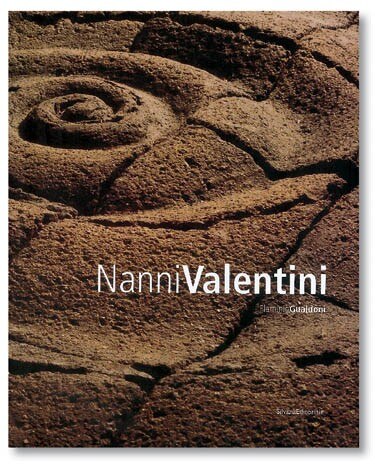
Nanni Valentini, Flaminio Gualdoni, Silvana Editoriale, Cinisello Balsamo 2005 (pp. 288)
An exhaustive monograph published 20 years after Nanni Valentini’s death (1932-1985), when at the peak of his creative maturity, attempts to redress his unjust condemnation to blank oblivion. The case of Valentini, a retiring artist manifestly alien to “posing” as an artist, is paradoxical given his rich intellect and the great quality of his internationally acclaimed work. Little or nothing was known about him if not within his small circle of friends: family members such as Tina Terenzi, niche admirers such as Marco Belpoliti, gallery owners such as Carla Pellegrini and scholars such as Flaminio Gualdoni. Yet those who, like me, had an opportunity to visit the PAC exhibition in 1984 were as if struck by lightning.
Today, this book edited by Gualdoni for Silvana Editoriale is a complete monograph, the first on the work of the Archivio Valentini, which has over the years ordered and catalogued the mass of material left by the artist, publishing adequate basic records, a vast selection of works, the artist’s numerous writings (collected for the first time) and a large selection of critical literature otherwise difficult to retrieve. In 1976, Valentini wrote: "I do not seek a way to mark the earth or the images offered by its plasticity, or the colours that evoke warmth; I seek those signs that can be detached, that will come out of it and that I am able to understand." With great humility but also aware of the "autre" requirements of Italian Art Informel, in the 1970s Valentini adopted an attitude of listening to matter, of minimum intervention to forge and mark the magma, in a dreamy lightness and refound warm space, seeking the extremes of nothing: transparent walls and earth floors. And reversing their sign, as if in a magic game, where the coloured stoneware became an atrocious blast of air and a gauze wall pierced the wall space.
As early as the mid-1950s, his work as a ceramic sculptor and painter had surprised masters of the earth such as Fontana and a young Sottsass, immediately winning the favour of Ponti and Domus, convinced that his efforts would shortly result in production, as was the case of many artists then. After winning prizes in Faenza and international recognition, his sculptures and ceramic vases, which combined magical form with a sublimely refined graffito and signs in the matter, he worked with the architect Massoni and moved towards possible mass production. But this was short-lived.
The 1960s principally brought a conscious rejection of the system, as Gualdoni said, "a total refounding of his desire for art " by steeping himself in nature, returning to drawing, far removed from all business logic and in mad and desperate reading. All this, accompanied by major financial difficulties, prepared the artist’s second mature period from the late 1960s to the mid 1980s; in rediscovered happiness, and backed by an iron will, the artist developed installations with ceramic and glazed stoneware pieces, showing a desire for eternal redress both over the maniac craft folly and over snobbish research. Within this narrow space, as if on a path on the edge of a stony landslide, the sphere of research was no longer the vase or the sculpture: it was an invented space on which evocative plastic "events" converged.
This need for a new spatiality closely linked to the original matter produced works such as Porta soglia (1979) and Finestra (1980), preludes to the great Lunetta (1982) presented at the Venice Biennale, in which Valentini understood the earth was as a design, as a thin, lacerated piece of paper marking architecture that opens the void, harking back to a fragment and returning to "ancient knowledge ". In this sense, as Gualdoni points out in the introductory essay, the last production, at the time of the great Milan exhibition, took some archetypal themes such as logos, omphalos and megaron to extreme consequences in earth installations with spiral references, shapeless white tiles surrounding a dreamt space, plus more environmental works such as Casa, with its strongly evocative references.
The artist wrote on the subject: "Se la terra è la "terra"/ la sua memoria è senza tempo/ E’ lei che ha ingoiato i muri di cera e di piume dell’oracolo/ è secca e fredda, gialla e muta/ Le si addicono i segni/ del seme, dell’asta dalla lunga ombra/ dell’acqua, del concavo/ Il suo ricordo è la tavoletta/ di Ebla che parla, come oltre l’orizzonte/ abita ancora l’insonnia (...)" Paolo Campiglio Art Critic
Valentini’s work