

di Andrea Daniele Signorelli
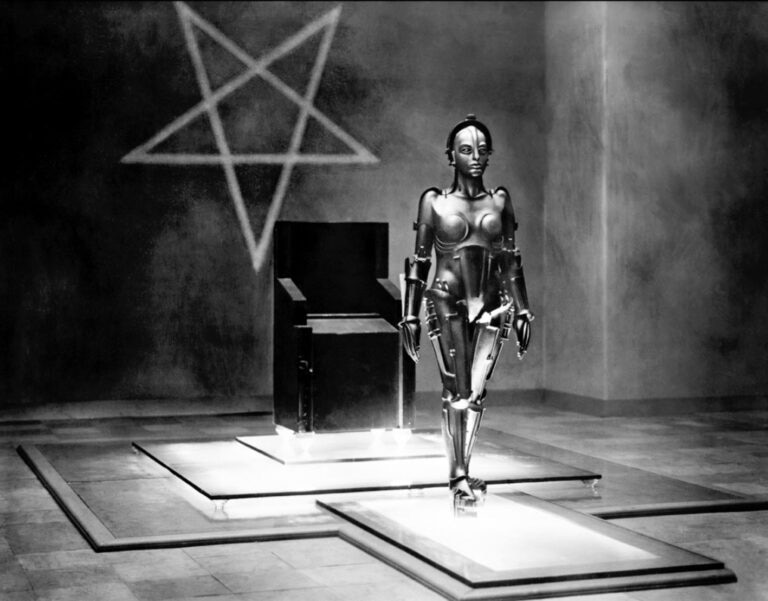
Ever since Fritz Lang’s masterpiece Metropolis was screened for the first time nearly a century ago, we have been unable to avoid imagining robots as metallic beings with a humanoid form.
This imagery has been reinforced by everything that followed over the subsequent decades: from Rosie, the housekeeper in the 1960s cartoon The Jetsons, to the extreme example of the replicants in Blade Runner, up to more recent literary cases like Ian McEwan’s Machines Like Me or Kazuo Ishiguro’s Klara and the Sun. And of course, there are countless others.

Considering how science fiction has shaped the world we live in today, it was perhaps inevitable that attempts to create actual androids would multiply within the robotics sector: robots featuring a human appearance, not to be confused with cyborgs, which are instead human beings equipped with electronic and mechanical prostheses.
A robotic carnival party
If we add to this the fact that when we think of a “useful” anthropomorphic robot, we imagine it specializing in very specific tasks, reviewing the various androids that have appeared across the four corners of the world feels above all like a robotic carnival party, where our metallic companions have disguised themselves “as humans.” To be precise, as police officers, waiters, nurses, priests, and much more.
For some strange reason, among the oldest anthropomorphic robots actually in use, we find those that—almost always in the Far East—perform the function of a priest or monk. In Kyoto, for example, the robot-priest Mindar has been operating at the Kōdai-ji Buddhist temple since 2019.
Do not imagine an android delivering elaborate sermons from the altar by leveraging artificial intelligence, though: in truth, poor Mindar is little more than a motorized bust—and a rather creepy one at that—which reads sacred texts stored in its memory and cannot interact with worshippers in any way.
However, the robot monk sector is a particularly thriving one. In China, back in 2016, Xian’er was introduced: a little robot with a cartoonish shape, standing just over 60 centimeters tall, active in the Longquan Buddhist temple on the outskirts of Beijing.
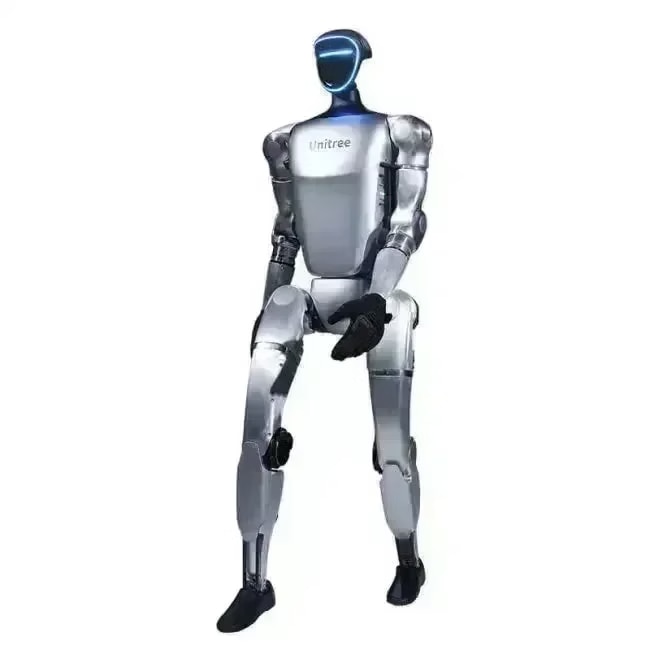
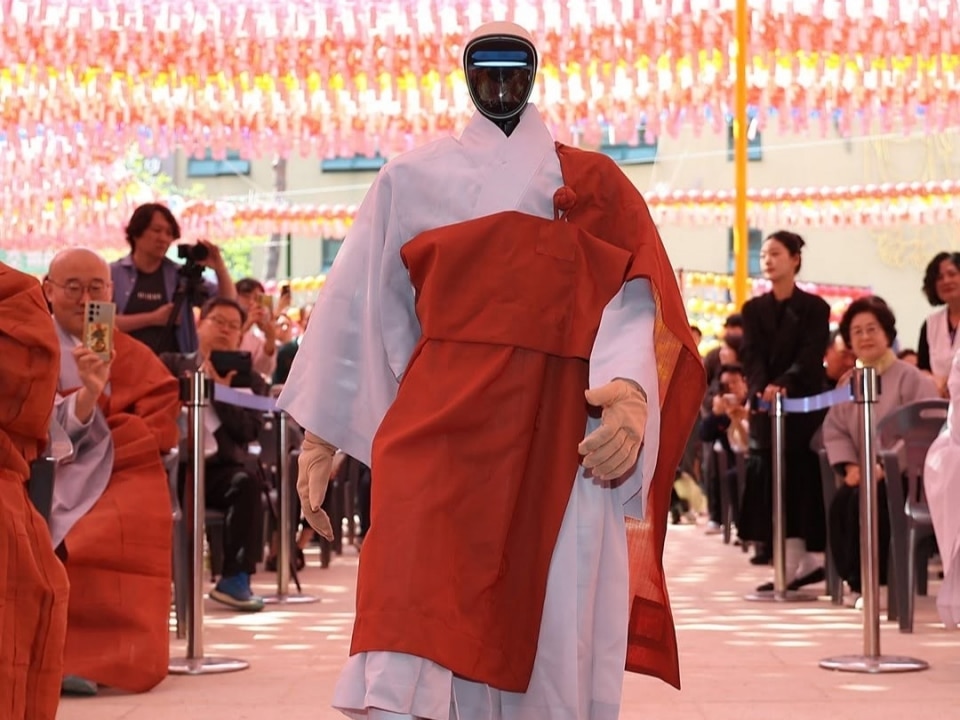
It can recite mantras and answer simple questions about Buddhism. In South Korea, on the other hand, there is Gabi, based on the G1 humanoid platform by China’s Unitree—likely one of the most advanced robotics companies in the world—which was ordained as a monk during a Buddhist initiation ceremony in May 2026.
There are several others, including the very ugly Lutheran robot operating in Germany, but focusing too much on priests would overshadow the other major category of this techno-carnival: robot police officers.
Since homes, offices, and warehouses have already been built for humans, humanoids would be better equipped to navigate the world than any other robot
The first was launched in Dubai in 2017 with the task of monitoring shopping malls and locations heavily frequented by tourists. Equipped with a police cap, a face, arms, and wheels, it is actually little more than a walking touchscreen that can be used to report crimes, pay fines, and obtain information. In short, all things we could do using a smartphone. In Dubai, in any case, they also have more serious robot-police projects, whose appearance is much less human and, above all, less reassuring.
In Kinshasa, Congo, for some incomprehensible reason, they thought of replacing real-life traffic wardens with a vaguely anthropomorphic tin tower—equipped with sunglasses (?)—tasked with directing traffic. It is hard to understand why they did not prefer to install surveillance cameras on a regular traffic light.
And since we are speaking of law enforcement, it is also worth pausing briefly on the advent—experimental and full of doubts regarding its actual utility—of robot soldiers. Mind you: we are not talking about drones or other autonomous weapons, but real Terminator-style killer robots. The most famous case is certainly the Phantom MK-1. In reality, it is not a model so different from the classic ones produced by Unitree or Boston Dynamics. Unlike the latter, however, the startup Foundation’s robot was explicitly designed for defense purposes and even tested in Ukraine.
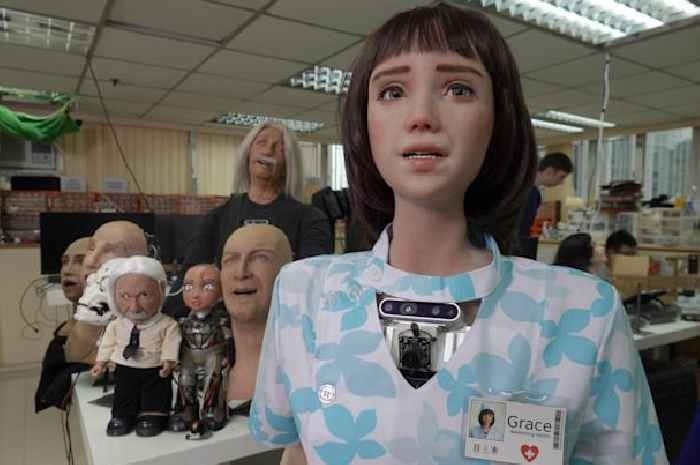
Another category where professional robots are not lacking is that of nurses. While this once meant simply providing hospitals with bulky beasts like Robear—effectively employed to lift elderly patients—the matter has now become more complicated.
Following the pandemic, for instance, Grace was launched: a fully anthropomorphic robot designed by Hanson Robotics, a company that has always specialized in androids with entirely human features. Grace’s job is to interact with patients and the elderly, offer companionship and emotional support, provide basic information, and assist healthcare staff.
Then there are robot baristas, robot chefs, receptionists, and even an astronaut robot. Reaching this point, however, it is necessary to make an observation: in most cases, these robots are totally useless except as an attraction and a curiosity.
After all, why should a robot police officer have arms it cannot use for any purpose? Why must a nurse android have a face that resembles a human being as much as possible, risking sliding into the uncanny valley—the unease generated within us by artificial beings that look too much like us?
Robots beyond marketing
The rather well-founded suspicion is that all of this is primarily aimed at sparking media interest and creating a bit of hype, while allowing the institutions adopting these solutions to appear innovative and forward-looking.
Indeed, if we look at the robots that are truly useful and widely employed worldwide, we discover that the humanoid form is almost always discarded: a large bin is more convenient than a pair of arms for transporting loads, there is no need for a face to communicate by voice, and to move around it is much more practical to have a compact shape that is less slender than ours.
From robot vacuum cleaners—starting obviously with the Roomba—to the delivery robots we occasionally cross paths with on the streets of China, Japan, or the United States; from robotic lawnmowers to those that clean the corridors of large hotels; from autonomous carts transporting medicines, linens, and samples in hospitals to robot-waiters carrying dishes and trays in restaurants; from the small tracked vehicles used by bomb squads to defuse explosive devices—the most famous being the TALON—to warehouse robots moving shelves, packages, and bins in logistics centers: in almost all cases, single-function robots, meaning those specialized in a specific task, move on wheels or tracks, are shaped like a large bin, are at most equipped with a mechanical arm, and have absolutely no need for an anthropomorphic form, which would actually get in their way.
They are therefore the heirs, endowed with greater autonomy of movement and sometimes decision-making, of old dishwashers and washing machines: appliances that are, to all intents and purposes, the robots that have revolutionized daily life more than any other.
However, this applies precisely to robots designed for a specific function. As research moves instead toward an all-rounder domestic assistant, it seems almost inevitable—at least judging by the various prototypes that have emerged in recent years—that it will take on a humanoid form, equipped with legs, arms, a torso, and a head.
Where do humanoid robots stand?
“Companies are betting that robots can tackle a broader range of tasks by mimicking the way people walk, bend, reach, grasp and otherwise go about their day,” reads the New York Times. “Because homes, offices and factory floors were built for humans, humanoids would be better equipped to navigate the world than any other robot.”










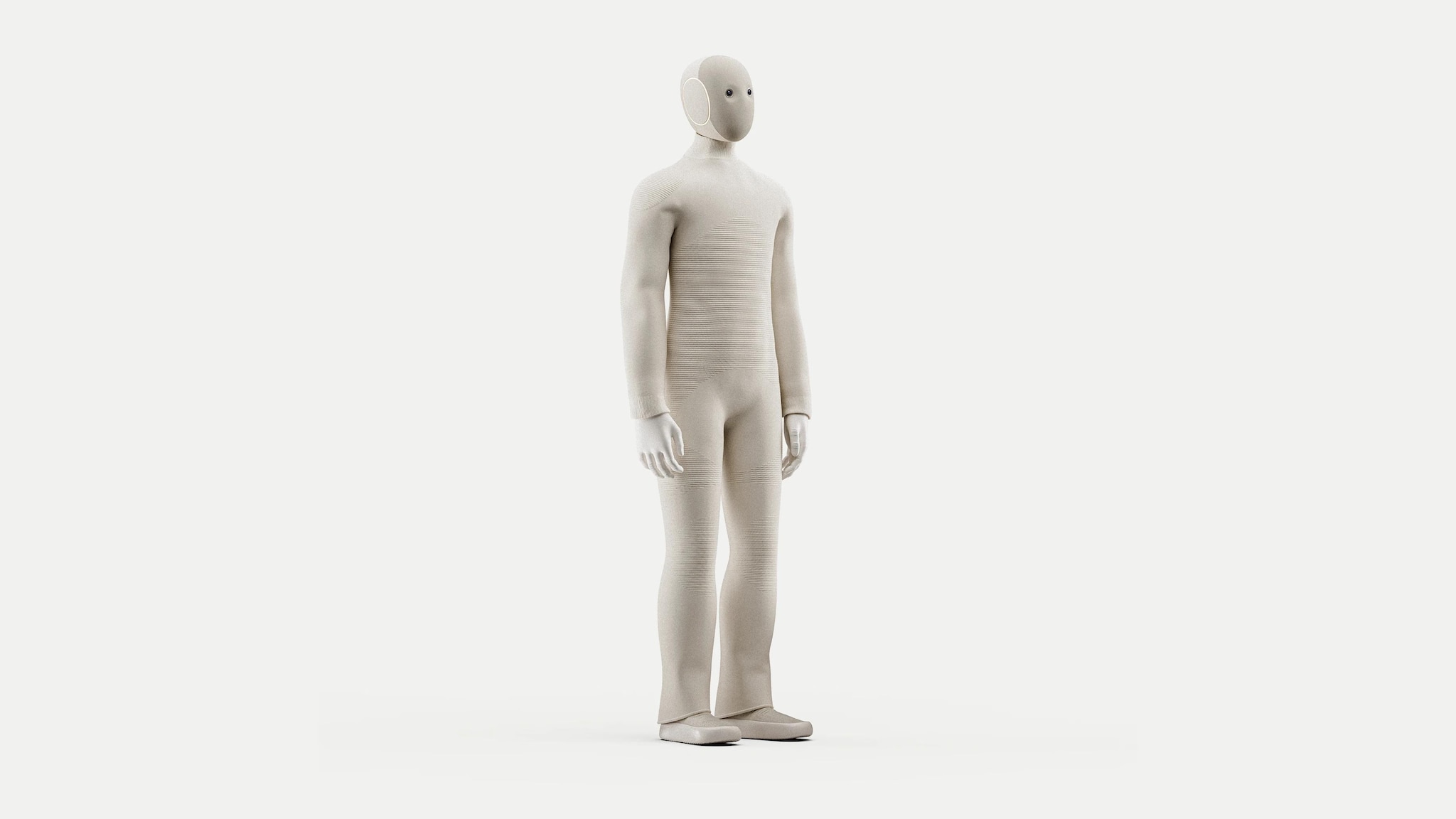
Examples are not lacking: Tesla’s Optimus, China’s Unitree H1 and G1, or the heavily discussed Neo from 1X, a Norwegian company. If we were to judge by the corporate videos uploaded to YouTube and TikTok—which show these humanoid robots moving nimbly around the house, ironing, grabbing a drink from the fridge and bringing it to the owner, taking the dog out, and even performing choreographed dances—we would think that the future of domestic robots has already become a reality.
The reality is very different. Even today, the vast majority of the surprising videos in which we see robots performing highly agile maneuvers, if not outright acrobatics or choreographed dances, actually consist of demonstrations staged in controlled environments, with tasks prepared in advance and often remotely controlled by human beings.
Between a promotional video of a robot capable of moving on its own in a real house—among rugs, stairs, pets, and children—and what these androids are actually capable of doing, also due to safety concerns, there is still an enormous distance.
How enormous? To understand, one only needs to think of the long-visoned Optimus, Tesla’s robot of which—according to Elon Musk’s usual unachievable promises—thousands of units should have already been produced. In reality, Optimus is nowhere near the production phase: in April 2025, videos were published showing it walking in a straight line, something that had already been achieved by the Wabot-1 robot in 1973, but at the moment nothing more is known about its commercial destiny. Musk announced the start of production by 2026: we shall see.
Tesla’s case is a peculiar one, however, given that Unitree and other companies, particularly Chinese ones, are already quite far ahead, and their humanoid robots are effectively employed in universities or laboratories, or for welcoming activities, interactive guides, inspections, and early testing in manufacturing environments.
Even here, though, the leap from demonstration to daily use remains massive: in most cases, these are still research platforms, promotional tools, or robots employed in highly controlled environments, not autonomous workers capable of managing on their own in a factory, a hospital, or a real home.
In the future, then, these all-rounder humanoid robots might truly prove useful and turn the science fiction dreams we grew up with into reality. Until that moment, however, we will have to make do with the classic—and functional—boxes on wheels.
Featured image: Monk ‘Gabi’. Courtesy of YouTube