

The clip has stopped being a preview of the content. It has become the content itself.
For years, short-form content had a specific purpose: to introduce something larger. A trailer promised a film, a preview announced a show, an excerpt encouraged us to listen to the podcast or watch the game. It was a gateway, a tool in service of the main work, designed to leave us wanting to explore further. The promise was clear: this is only a taste.
That promise no longer holds.
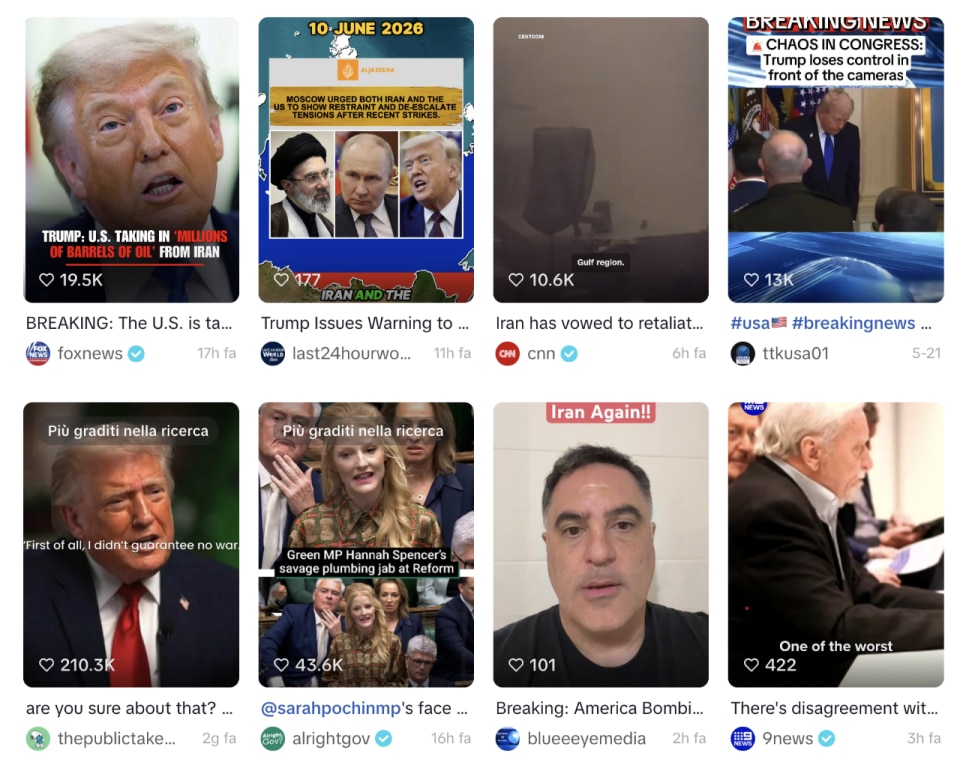
The clip introduces nothing: it has become the destination, the only thing most of us will actually consume. And the content from which it comes—the full episode, the complete fashion show, the ninety minutes of gameplay—has been transformed into something resembling a production cost: necessary for generating fragments, yet increasingly irrelevant in its own right.
The point, however, is no longer even choosing what to watch. The action we perform most often is not deciding, after seeing a clip, whether the rest is worth our time. It is continuing to scroll.
We spend hours inside fragments of things we will never truly experience: a podcast we will never listen to in full, an audition from a talent show we do not follow, thirty seconds of a stand-up comedy performance.
The clip has become the destination, the only thing most of us will really consume.
Platforms learned the lesson quickly. More and more often, the complete piece of content exists primarily to feed a chain of excerpts, highlights, and shareable moments. Scrolling has become a state rather than an action with a specific goal: staying inside the flow of clips is how we remain tuned into a collective conversation too vast to ever be fully consumed.
@neilcousins 6 things to do instead of doom scroll (part 1)
♬ original sound - remy
Faced with an endless supply of content that no one could ever exhaust, the fragment is the rational choice: the densest format, the one that gives us the illusion of being everywhere at once, up to date on everything, present in every conversation. We know everything about everything, and we have seen almost nothing in full.
The economy of the fragment
Behind this habit lies a very specific—and rather simple—market.
There are agencies whose sole job is to extract as many clips as possible from original content and distribute them through profiles that appear to have no connection to that content whatsoever. Payment is tied to a single metric—views, typically at a rate of around one dollar per thousand—and the objective is therefore equally singular: virality.
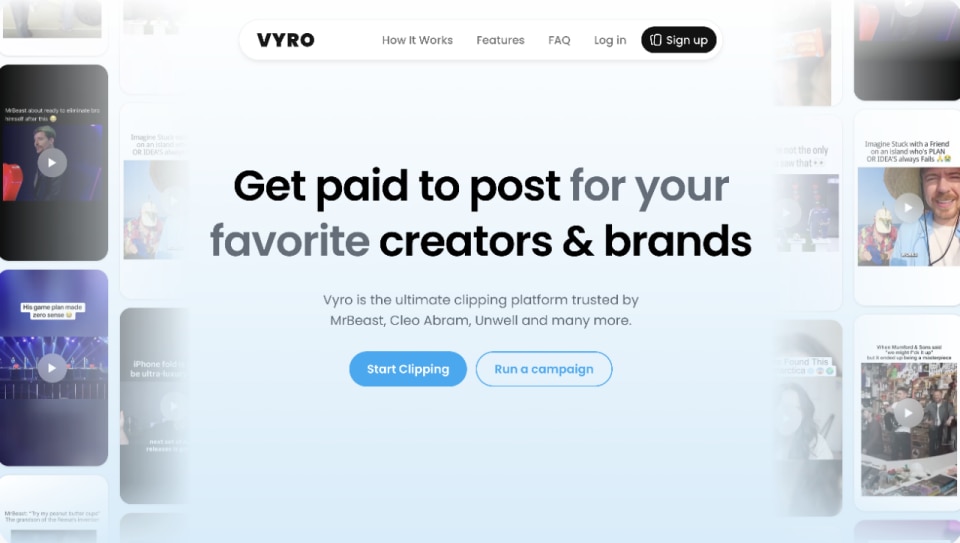
MrBeast has turned this into an infrastructure through Vyro, a platform that pays freelance editors to cut long-form content into short clips. The best performers reportedly earn six-figure incomes; the company overseeing his media ecosystem has been valued at five billion dollars, and clipping is a central part of that operation.
The value of the fragment compared with the work itself is well illustrated by a recent acquisition.
When OpenAI acquired the tech podcast TBPN for roughly two hundred million dollars, it did so despite knowing that each episode was listened to by only a few thousand people on average. The clips extracted from those same episodes, however, generated hundreds of thousands of views each. The value did not lie in the work itself, but in what could be cut from it.
At this point, the discussion stops being economic and becomes a matter of trust.
Most of the clips we encounter do not come from official accounts, but from fan pages, anonymous profiles, and ordinary users with no apparent financial interest. And that is precisely what makes them valuable. When the amount of information exceeds our ability to process it, we rely on social signals: we tend to appreciate what appears to be appreciated by others, what others have chosen to share.
The clip thus becomes proof that something deserves our attention. And we end up believing it.
The problem is that those signals can be bought.
We know everything about everything, and we have seen almost nothing in full.
For an artist, a creator, or a company, having clips circulate through third-party profiles provides a form of validation that explicit advertising can never offer: the appearance that the material is spreading on its own, organically, because people genuinely like it, not because someone paid for it.
A post labelled “sponsored” starts at a disadvantage. The viewer knows they are looking at an advertisement. The seemingly spontaneous clip, by contrast, does not identify itself as such: it is advertising that no longer looks like advertising.
And this is where the issue becomes more unsettling. A clip produced by an agency is, in every practical sense, indistinguishable from one that genuinely emerged by chance. It carries no marker, no label, no readable origin. Every signal that online culture appears to produce could be authentic—or it could be the result of a carefully orchestrated strategy designed to look spontaneous, and we have no way of knowing which it is.
Living among fragments
Ultimately, the clip is neither the beginning nor the end of this story. It is simply the form the phenomenon has taken today, one that will eventually transform into something else.
Yet it is a form that tells us something precise about our relationship with culture.
We have stopped inhabiting works and begun inhabiting fragments: temporary spaces designed to be shared more than experienced. A fluid culture made up of detachable pieces that can be disassembled and reassembled elsewhere, where value no longer lies in what a work is, but in how far it can circulate.
And we keep scrolling, suspended between the desire to be there and the impossibility of ever truly arriving. Convinced that we are looking at the world, when often we are only looking at what someone has decided—and perhaps paid for us—to see.
Opening image: Photo Anastasiya via Adobe Stock