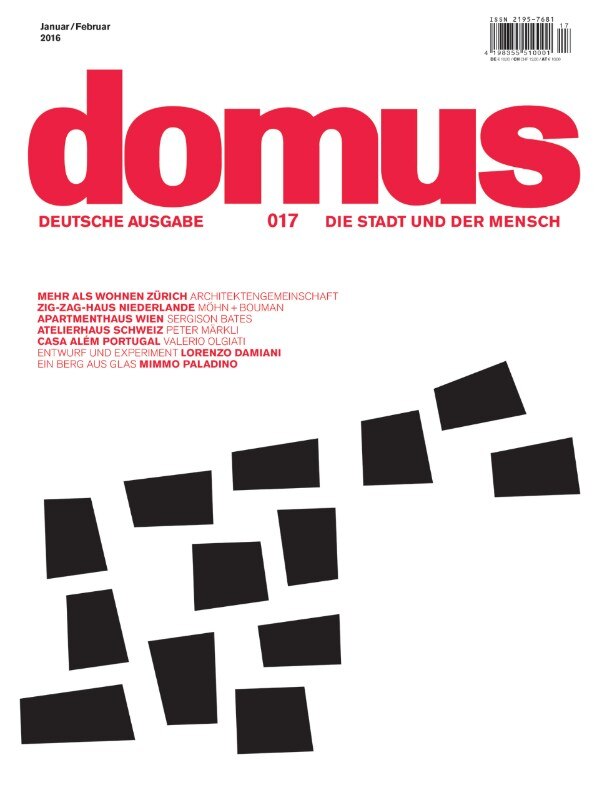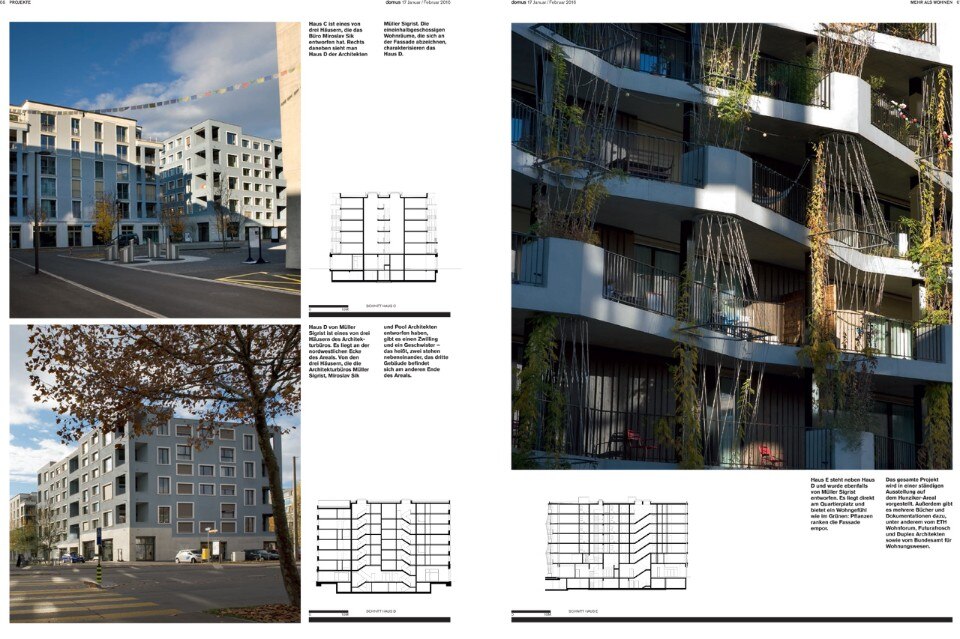
In this edition of the German Domus we present the project “Mehr als Wohnen” (More than Living), an innovative quarter for communal living in Zurich. This large-scale participative experiment, which arose from the exchange of views of all those involved, is being monitored by researchers. The users’ behaviour is being investigated and the results will be published. The collective model for living of the Dutch architects Möhn + Bouman, for its part, is devoted to a marginal social group. This residential building provides a new home for 62 persons with mental handicaps, but does not have the usual character of an institution. According to the motto “intercultural living”, a further interesting and highly urban form of communal life was created on one of the largest and most important inner-city redevelopment areas in Vienna: an ensemble of buildings designed by three different architects that opens up to the community at ground-floor level. In contrast to these forms of collective living, we present houses by Peter Märkli and Valerio Olgiati, two projects that were conceived for individual living requirements yet are far from being conventional single-family homes. Both are notable for a strong ground plan that lends a closed yet at the same time extremely open character to living there. In addition, they are a visible demonstration of the love of pure materiality.
Love of nature and the mountains, on the other hand, was what motivated the photographer Kaspar Thalmann to document the avalanche structures of the Swiss mountain village St. Antönien. A mountain in Italy, which is the conclusion of our thematic section, was also subjected to human intervention: with his installation on Monte Pizzuto, the artist Mimmo Paladino used countless shards of blue glass to close a wound caused by the construction of a water reservoir on the slope.