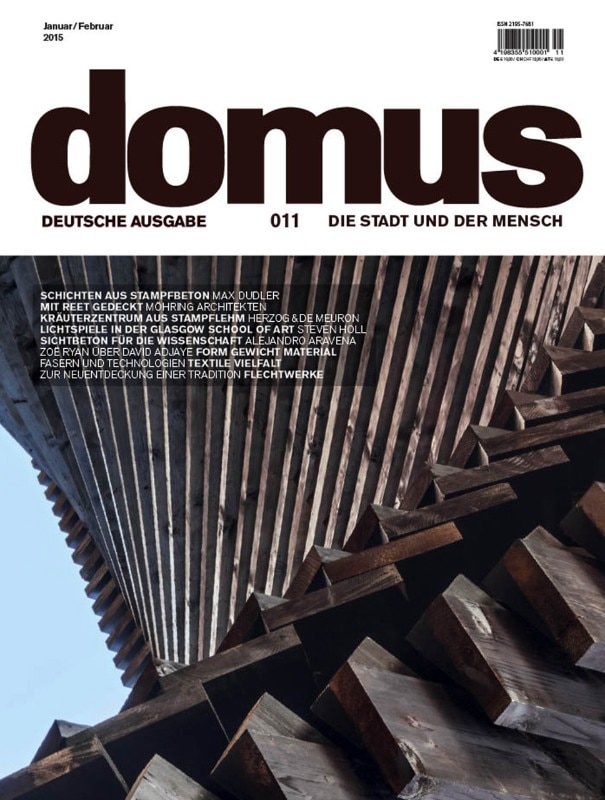
Some hadn’t existed until recently, while others have a long history that is now being rediscovered and re-interpreted.
As far as the Sparrenburg fortress in Bielefeld was concerned, there was no mistaking the context for the choice of material: Swiss architect Max Dudler complemented the historical weir system by adding a Visitors Centre made of rammed concrete. The facades of the small new building stand out for their multi-tonal layers. The material as such recalls the fortress' old quarry stone masonry, while the architectural language of the new flat roofed structure is autonomous and strictly contemporary. It neither shows off nor bows to the historical buildings. Three cottages on the Darss peninsula also deliberately draw on a tradition while breaking away from it, as architect Norbert Möhring has covered both the gable roofs as well as the side walls with reeds.
Starting from his first projects in London, British-Ghanaian architect David Adjaye has consistently showed the courage to make radical material choices. Zoë Ryan, co-curator (with Okwui Enwezor) of the large David Adjaye show at Munich’s Haus der Kunst, explains to what extent Adjaye’s projects always respond to location-based imperatives while simultaneously taking social parameters into account. Ryan is a Professor and Curator at The Art Institute of Chicago; her essay gives an idea of what is to come when “David Adjaye. Form, Heft, Material” opens in Munich at the end of January before moving on to Chicago.
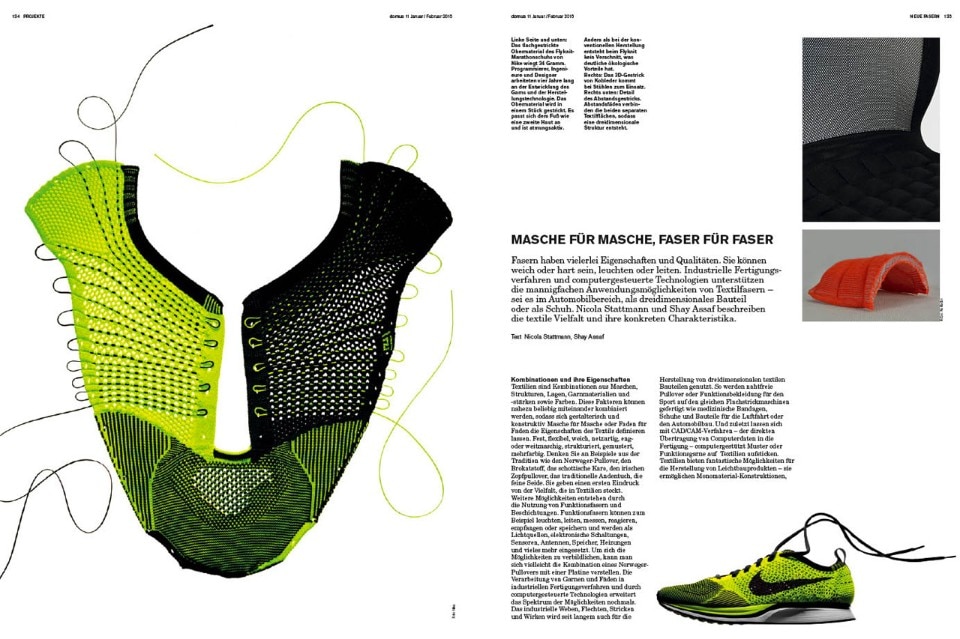
In the design section, Volker Albus investigates the revival of wickerwork and probes into the potential of this traditional technique by examining contemporary designs. Nicola Stattmann and Shay Assaf discuss the qualities of textile fibres. Featuring exemplary objects, their overview reveals a surprising variety that ranges from three-dimensional knitted fabrics to efficient composite fibre structures. The fact that fibres can glow or conduct electricity, that they can be hard or soft and that they can be processed by computerized machines has proven to be a decisive asset in several fields of application.