

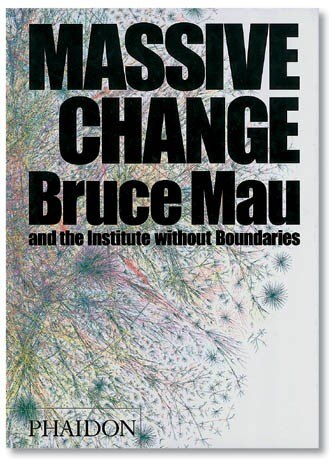
Massive Change. Bruce Mau and the Institute without Boundaries, Phaidon, London 2004, (pp. 242, € 29,95)
What do microcredit, carbon nanotubes and the “reformist” activism programmes that are introducing eco-sustainability into McDonald’s policies have in common? Not much at first glance, except that they are relatively recent inventions and they attract the distrust reserved for naïve, partial and irremediably inconsistent solutions.
These ideas reveal few common traits but what actually links them has even fewer: experts and advocates of innovation in different fields find it difficult to engage in productive conversation. From the first pages, Mau reminds us that the best designs are always invisible (and so it remains, at least until something goes wrong). The importance of this maxim is clear to those who are involved in design in the strict sense and the disciplines that explicitly identify with a design model; it becomes particularly interesting when applied to broader systems, not traditionally associated with the concept of design.
Massive Change even adopts the design approach for huge-scale phenomena, such as the military system and world poverty. This “design” takes shape within perspectives of interconnection and conversation, designs in which each designer participates adhering to protocols of distributed action and not a master plan.
Paraphrasing the concept of “Renaissance man”, endowed with 360°-abilities, the authors exalt the Renaissance team: the members can be hyper-specialised individually as long as they work well with specialists in other areas.
Massive Change is a book about interdisciplinary design decisions that, whether their immediate significance is local or global, end up affecting processes on a planetary scale. The numerous and fairly concise interviews avail of editing (by Jennifer Leonard) that is as effective as the visual impact and layout (Bruce Mau Design). The choice of those consulted does not smack of the obvious: there are the Nobel prize winners and emeritus experts, but the gallery of post-hippy entrepreneurs, activists, visionaries and academics is heterogeneous, also anthropologically speaking. It would be hard to contest a single choice or suggest other more expert figures for any province, whether scientific photography or sustainable architecture, drinking water or megalopolis-scale buses; or the decision to consult the populariser Matt Ridley on the subject of the genome, Jeffrey Sachs on poverty reduction or the novelist and writer Bruce Sterling for an overall view of the next 50 years. Massive Change does not offer a simple educational panorama of fashionable concepts. Nor is it the adult equivalent of an exciting illustrated book on “the world we will live in”. Many of the innovations put forward rest on discoveries that go against intuition, that have had (will have?) to gain ground against imbedded prejudices and traditional thought processes: the economist Hernando De Soto’s idea that in contexts of urban poverty the judicial system is not just decoration but has a crucial role to play, and that the legal recognition of copyright is more important for the very poor than for large companies (while highly praised by Noam Chomsky, De Soto’s theories are also inspiring the reforms of the Brazilian President Lula); the notion that the move to alternative energy is more pressing and plausible in Africa than in rich countries; and the vision of single-seater vehicles such as the Segway electrical “handlebars on wheels” as the crux of an intermodal system of sustainable transport instead of ridiculous gadgets for late-yuppies.
The military is analysed for the exchange of knowledge between military and civil research, as well as the prospects of turning the war economy into one of peace. The chapter on “visualising the invisible” investigates modern (and future) imaging techniques, but also the social role of images and how they change the way we see ourselves and the world (the double helix of DNA; the first pictures of the hole in the ozone layer from 1983). An attentive eye focusing on the collaboration paradigm and the protocols distributed will see that they do not only affect the obvious example of open-source software (and that the distributed model is nothing new: the Oxford English Dictionary was born out of the voluntary and atomised cooperation of thousands of readers, just like Wikipedia today). Mau believes that the professional culture of each discipline must develop design approaches open to models of collaboration - which are not anti-design but a specific way of producing design.
Perhaps the weakest section of the book deals with market economies. One could probably make a more stimulating case study of the area of human activity in which phenomena of auto-poiesis and self-regulation appear most clearly. This might counter the banal opposition of those on one hand who consider the market mechanism perfect and imperfectible, and those on the other who want to restrict it with what are sometimes naïve solutions.
It comes naturally to index the view of Massive Change as being scarcely cutting utopism. Little more than a year after its publication (today it is also a social intervention programme, an exhibition and a website) its detractors seem firmly convinced and numerous: the accusation is less that of over simplification and more of the unforgivable sin: “19th-century” progressivism. For some, Massive Change is no more than a celebration of the consumer culture. Many have compared it with the previous S, M, L, XL (with Rem Koolhaas) and Life Style: that Massive Change emerges as the least successful product goes without saying.
It is true that the book often resembles a special issue of Wired in its heyday. The Canadian Mau sells the same “Californian” ideology of idealism, activism and technophilia: a visionary optimism far removed from mere celebration of the existing, but easily mistaken for it. Massive Change is neither fatalistic nor cynical, and this makes it an easy target. It would be even easier to ignore the issues it raises and refrain from all contributions to the multidisciplinary and global outlook it promotes, but that would not necessarily be a good idea.
Giuliano Tedesco, Journalist