

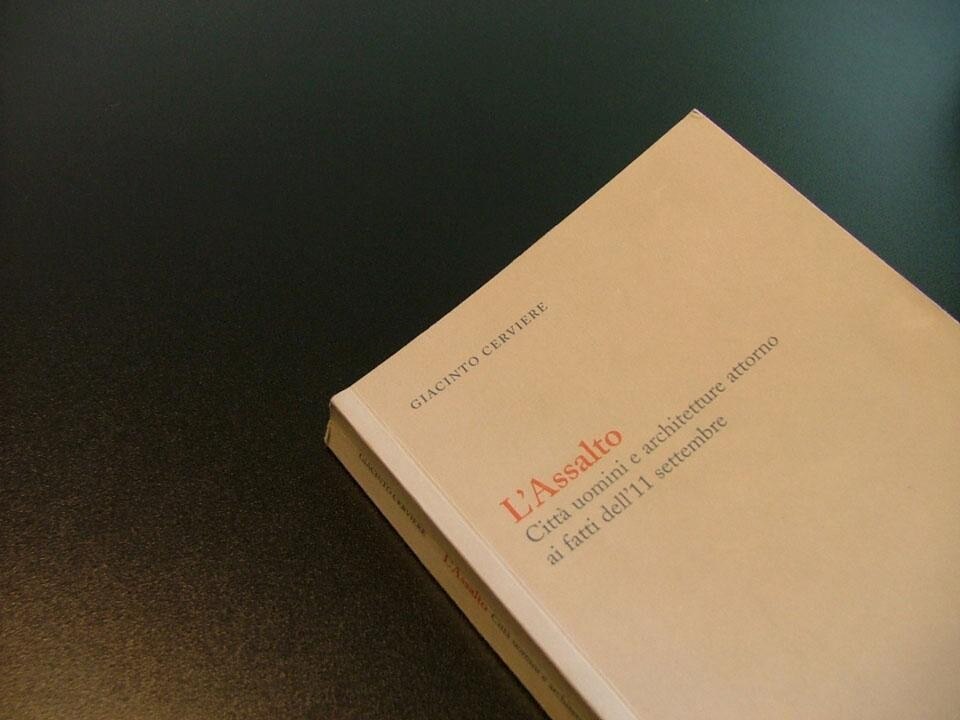
Most people will still remember what they were doing on September 11 at the time of the attack, which has sadly passed into history as the day of the collapse of the twin towers and as the largest terrorist attack in American history.
This writer was in the library studying a text on architecture without imagining how this dreadful blow to humanity was linked to, and partially dependent upon, the subject of his investigation. Like many, he always remembered this day as yet another episode in the history of the hatred between populations. We later learned to remember the tragedy with the famous cartoons of Art Spiegelman (author of Maus), who had already used the comic-book art to express sad human folly. But this book by Giacinto Cerviere helps read, in a different way, what was not only a simple story of people but also of cities and architecture as the book's subtitle explains with simplicity. September 11, beyond the mass murder, was an attack on architecture.
The book can be read with interest and curiosity because it speaks of facts that we experienced and because it clearly reveals some connections between events that have been overlooked thus far. The author tries to unravel, in what Franco Purini defines in the preface as a conceptual labyrinth, the set of religious, social, urban, human and political questions concentrated in the World Trade Center attack.
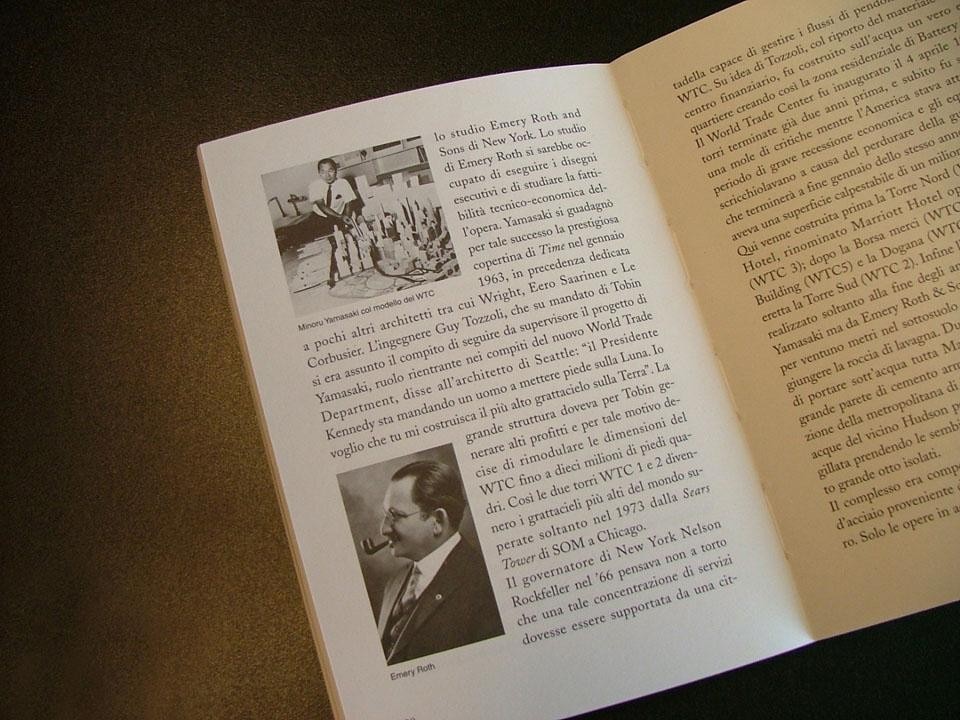
The fourth part is entitled "From the Moon to the Earth," and examines the genesis of the Twin Towers, how they were designed by Minoru Yamasaki and how they were built.