

The architecture of Stanley Tigerman

The architecture of Stanley Tigerman

An exhibition at the Graham Foundation reexamines the work of the legendary Chicago architect A news report from Chicago

Ceci n'est pas une rêverie (This is not a dream) is a retrospective and a reexamination of the architectural concepts of Stanley Tigerman which recently opened at the Graham Foundation. Curated by Emmanuel Petit, Associate Professor in the Yale School of Architecture, the exhibition organizes Tigerman's texts, sketches, cartoons, object designs, architectural drawings, and models in relation to nine themes that single out certain leitmotifs of his thought since 1960: Utopia, Allegory, Humor, Death, Division, (Dis)Order, Identity, Yaleiana, and Drift. Evident in this work is Tigerman's insistence on the transitory nature of architectural interpretations and on the spiritual and ethical value of ambivalence. The installation spreads through all three floors of the Graham Foundation's Madlener House, building on the playful, oneiric, and surrealist undercurrent of Tigerman's work.

"Tigerman combines the nonchalant imaginativeness of a dreamer with the pragmatic focus of a realist," says exhibition curator Emmanuel Petit. "His belief in the pedagogical dimension of the 'project' of architecture accounts for the versatility of his work, which by far exceeds that of routine professional production."

A Chicago native and principal in the architectural and design firm of Tigerman McCurry, Stanley Tigerman has undertaken nearly 400 projects, resulting in more than 175 built works. Tigerman trained in some of Chicago's top firms from 1949 until 1959 including the office of Keck & Keck, Milton Schwartz, Skidmore, Owings & Merrill, and Harry Weese. Following his graduation from Yale University, where he received both his Barch (1960) and March (1961) under the leadership of Paul Rudolph, Tigerman established his own firm, working with several partners, before founding Tigerman McCurry Architects in 1986 with his wife Margaret McCurry. Tigerman is a prolific author and was chosen as was one of the architects to represent the United States at the 1976 and 1980 Venice Biennales.

Ceci n'est pas une rêverie: The architecture of Stanley Tigerman
Graham Foundation
Through May 19.

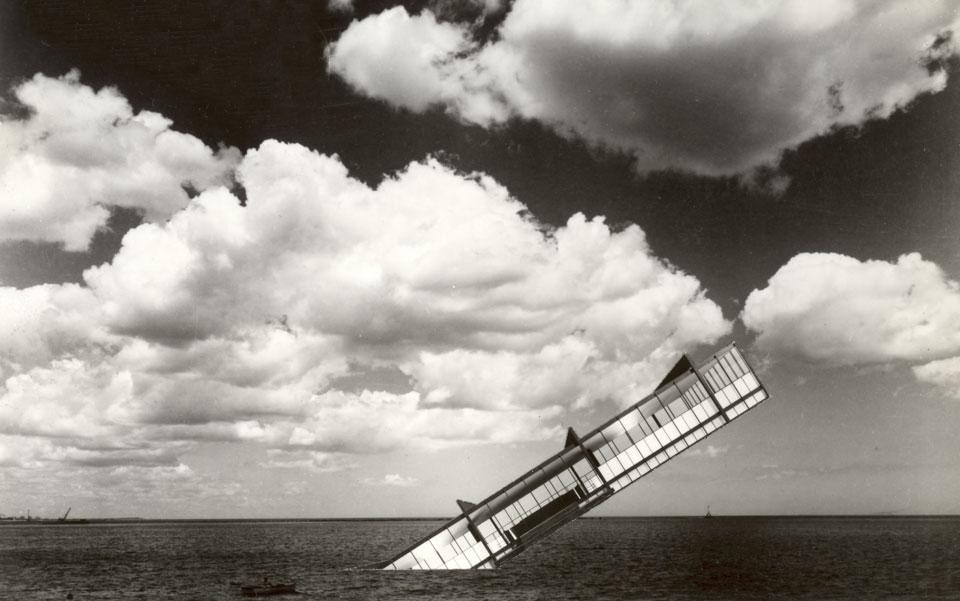
Image credit: The Titanic, 1978, Photomontage on paper, Approx. 28 x 35.7 cm, Gift of Stanley Tigerman, 1984.802, The Art Institute of Chicago. Photography © The Art Institute of Chicago.

Section
Architecture, News
Published
06 Feb 2012
Location
Chicago

The Outdoor Office

Jonathan Olivares presents three distinct scenarios for working and studying outdoors, and launches an utopian, modernist idea: fifty years from now, an outdoor workspace may become something as common as a gazebo or a patio. A design report from Chicago by Tim Parsons

Open Outcry

Conceptual artist Mary Ellen Carroll and architect Simon Dance join forces for a site-specific lunch at famous derivatives exchange, CME Group. An art report from Chicago by Lucy Bullivant

Balloon Factory

Object Design League operated a balloon factory at the MCA to produce a small run of latex balloons from scratch A design report from Chicago

Add your annotation here
Testo alternativo Immagine
Testo alternativo Immagine Close
Testo alternativo Immagine