This article was originally published in Domus 948/June 2011
An architecture with its own political statement
A surprising playground just opened in Mérida: a place where
youths can access computers, where they can meet, learn to
dance or simply skateboard. As I meandered through this latest
project by Spanish practice Selgascano, I couldn't help thinking
we have come a long way since Rafael Moneo's Museum of
Roman Art instigated architectural pilgrimages to this ancient
outpost of Imperial Rome. The old capital of Lusitania, home to a
unique UNESCO World Heritage Site, was then a city that made
you ponder the permanence of architecture and its cultural
contents. Conversely, when I mention that we—and indeed
Spanish architecture—have come a long way since Moneo's
building opened 25 years ago, I'm humming to Fat Boy Slim and
musing on how the circumstances for architectural production in
Europe are radically changing.
Given that the architecture media hadn't yet preyed on the
images of this fresh, destabilising ensemble when I visited
it, I enjoyed the rare experience of coming across the Factoría
Joven with no more than my own reception apparatus and
the popular, initial gut reactions to it. Post-occupancy disquiet
meshed insidiously with my first appreciation of the built object.
And curiously, concerns about this building's nature mostly
revolved around issues of durability and how current investment
responds to today's socio-cultural and urban demands. While
media duly appraised the participation of urban collectives in the
design process or the authorities' political commitment to offer
the restless, unemployed local youth an engaging architecture,
the digital vox populi protested against the building's fleeting
materiality or abhorred its final architectural expression.
We know that one man's dream of popular participation is
another's nightmare.
Critical Playground—
The Factoría Joven by selgascano is a striking Chinese dragon that injects life into the city's outskirts and counters urban desertification An architecture report from Mérida by Pedro Gadanho
Network

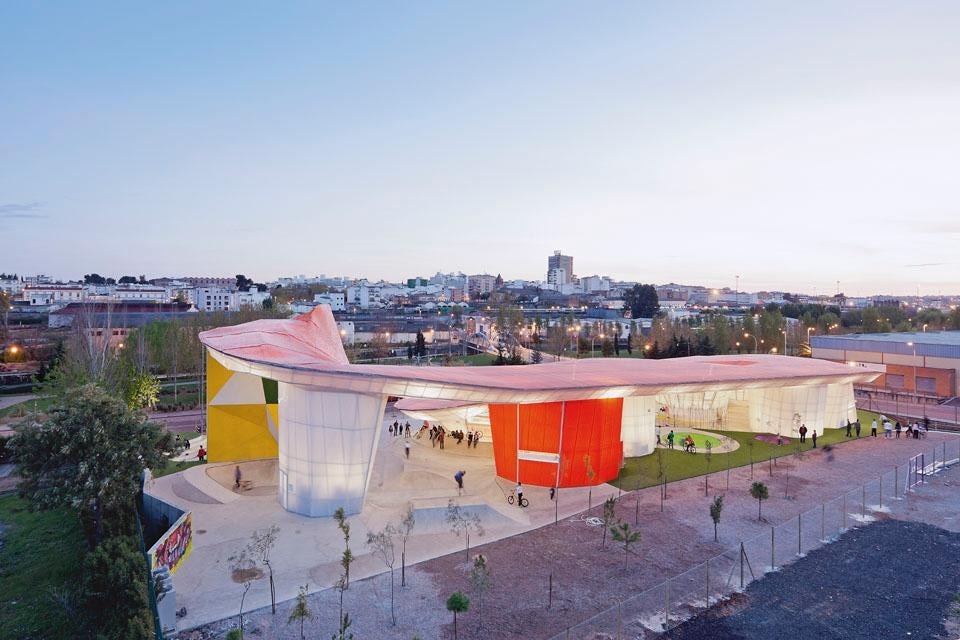
Inaugurated last March,
the Factoría Joven
is a large
canopy structure completely
open onto the city.
Nevertheless, the very contradictions that
the building raised within the realm of popular opinion also
insinuated an auspicious critical potential. The architecture
suggested a debate on what our conceptions of public space should be today—and for whom it should be built. However,
popular feedback mostly overlooked that our current spatial
conceptions may have to be much more transitory and nicheoriented
than some years ago. Alas, this is why the apparently
incomparable must now be put side by side.
The seemingly inane exercise of comparing this recent
accomplishment with Moneo's institutional feat suddenly gains a
strange raison d'être. Indeed it clarifies some essential alterations
in the way European architecture is to be commissioned and
put forward in the near future. The Museum of Roman Art was
made for tourists and visitors, offering ruins to interpretation
in an adequately contextual environment; the Factoría Joven
caters for local, disenchanted populations in the semi-industrial
periferia, in an effort to prevent the city's desertification. Rafael
Moneo aspired to perpetuity, and dialogued with ancient,
enduring construction techniques; José Selgas and Lucía Cano
are interested in ordinariness, and engage with a built landscape
that is determined by low-budget, off-the-shelf materials and
practices like graffiti, skating, cycling or wall climbing.
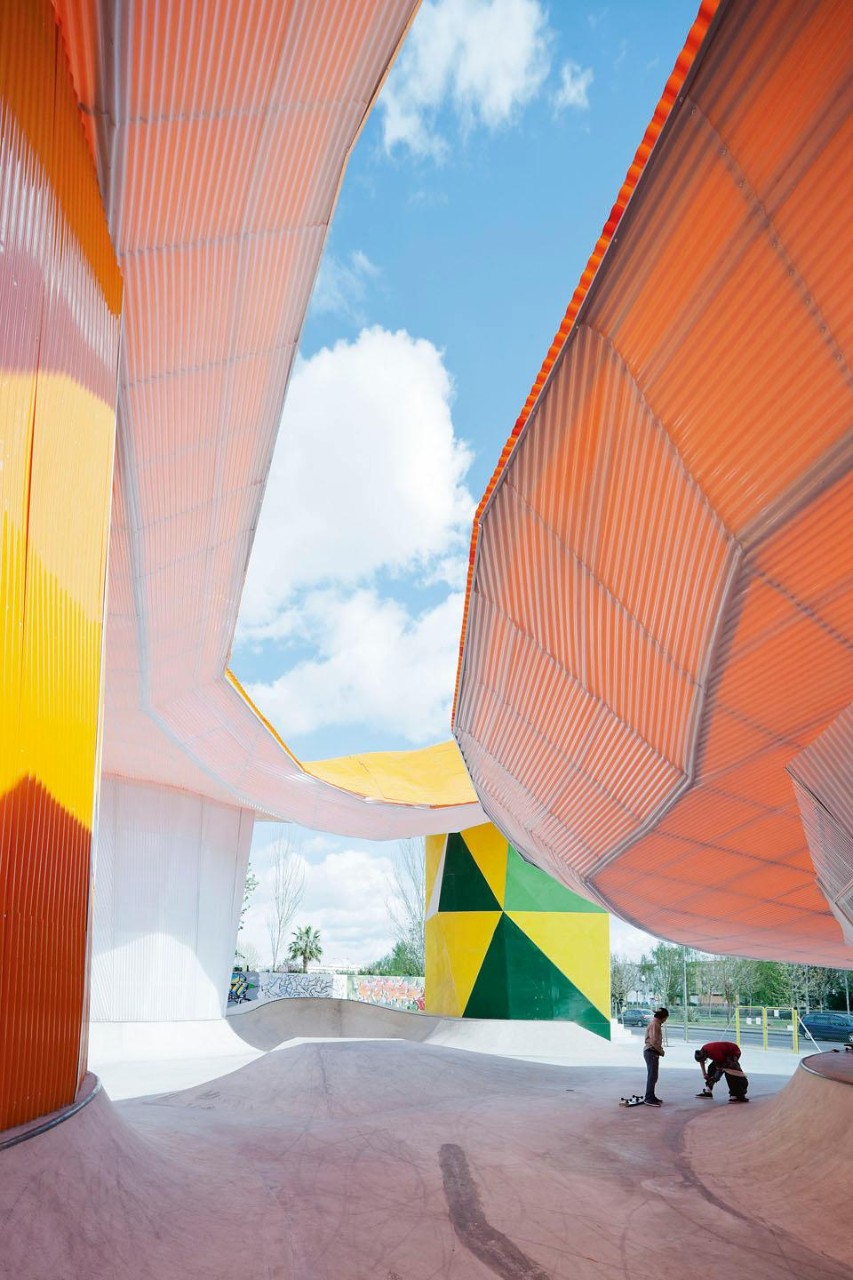
The structure of the
Factoría Joven consists
of a three-dimensional metal
grid that was also used to
form the supporting columns
set along the perimeter
of the complex, as well as
the roof which, according
to José Selgas and Lucía
Cano, “spreads out like
a light cloud”.
One stood for the economic sustainability of lasting constructions—when funding was abundant; the others defend an economy of means that fits an ephemeral purpose—while affluence is temporarily placed on hold. One proposed an austere spatial experience around a specific cultural identity; the others welcome a handson approach to subtler notions of cultural diversity. One claimed an architectural autonomy that is now hard to sustain; the others embrace architectural expressions that are gleefully immersed in pop(ular) culture. One went for Vitruvian firmitas; the others for Venturian revenge.[1]
"Selgas and Cano are interested in ordinariness, and engage with a built landscape that is determined by low-budget, off-the-shelf materials and practices like graffiti, skating, cycling or wall climbing."

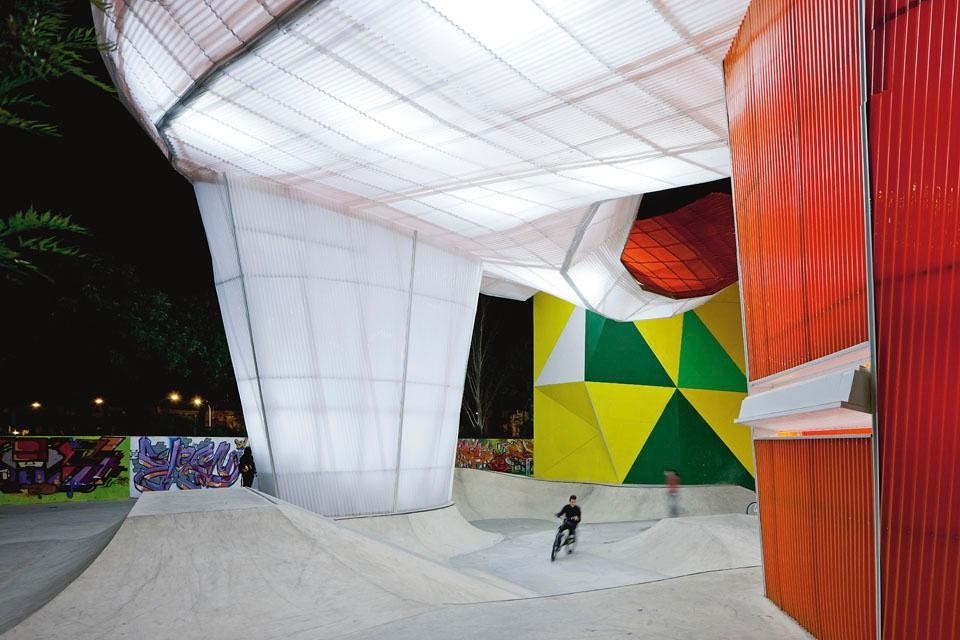
Factoría Joven includes
facilities for many activities
such as skateboarding,
Internet access, funk and
hip hop dance, graffiti,
street theatre, video, rock
and electronic music,
manga comics and artistic
performances.
Given the contrasting options and conditions, it is highly significant that architects emerging from the same disciplinary context now assume that they are no longer building for permanence. On the contrary, they just fight to deliver apt receptacles for temporary spatial appropriations, in as stimulating a way as possible within a given budget and for a given social circumstance.

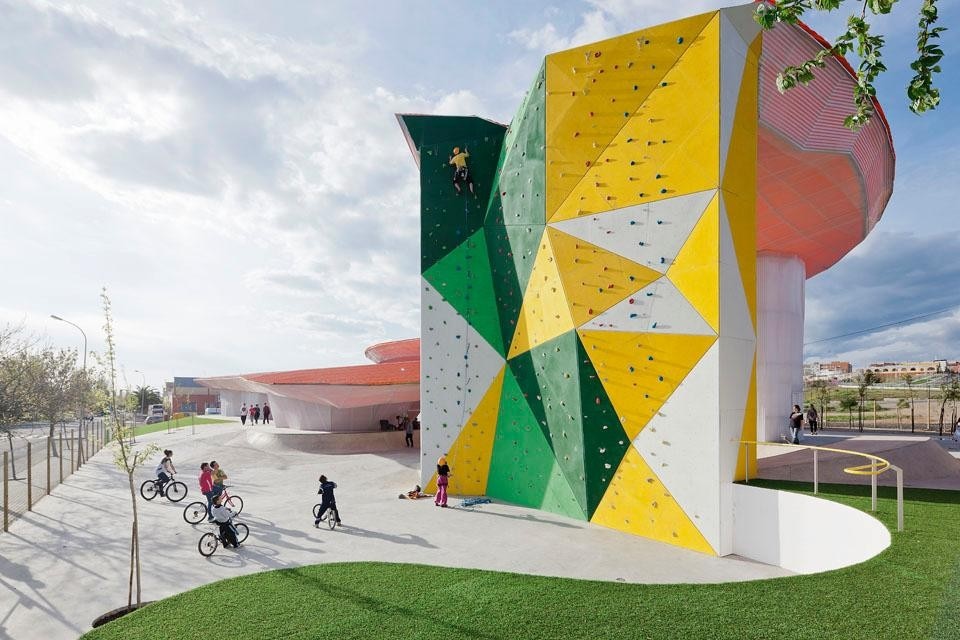
Kids can practise free
climbing at the south end of
the youth centre. The building
was erected in 13 months, at a
cost of about 1.2 million euros.
If one touches this building's surface, previous notions of architecture's desirable tectonics may be challenged. The plastic skin recedes and defies the preconception that construction should be solid and sturdy—while it better cushions a high-speed fall. And if polycarbonate is resilient—and soon also luxurious— its apparent physical fragility only heightens the tactile quality of the ensemble. And since Benjamin suggested that architecture's mode of reception is tactile,[2] finally this extravagant Chinese dragon is best appreciated not for its shape or plastic quality, but in that state of distraction that a youngster enjoys while videogaming or skateboarding.

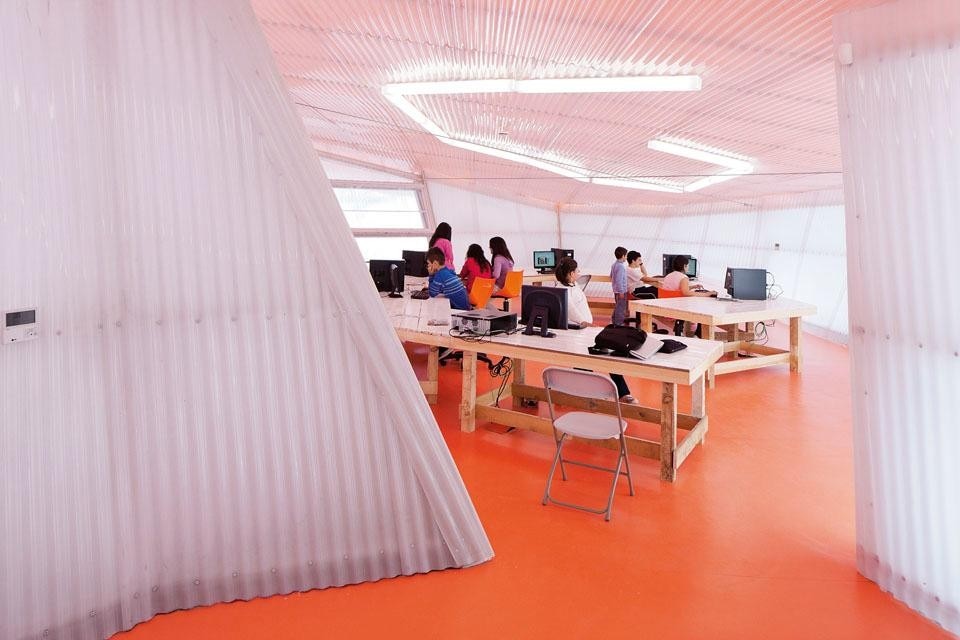
The roof-bearing supports
are actually oval forms
containing spaces allocated
to Internet access and to
the organisation of other
activities. To minimise costs,
the interiors are furnished
with recycled furniture.
Long after Henri Lefebvre advanced the social nature of spatial
production[3]—or Michel de Certeau anticipated that urban
space would be taken over by the "dominated others"[4]—this
critical playground becomes a peep into the self-redeeming,
political future of architecture. And while Bob Dylan's The
Times They Are a-Changin' still reverberates around it, one must
again acknowledge that, particularly in our mediated world,
architecture will be political also if it is read as such.
Pedro Gadanho, architect and writer
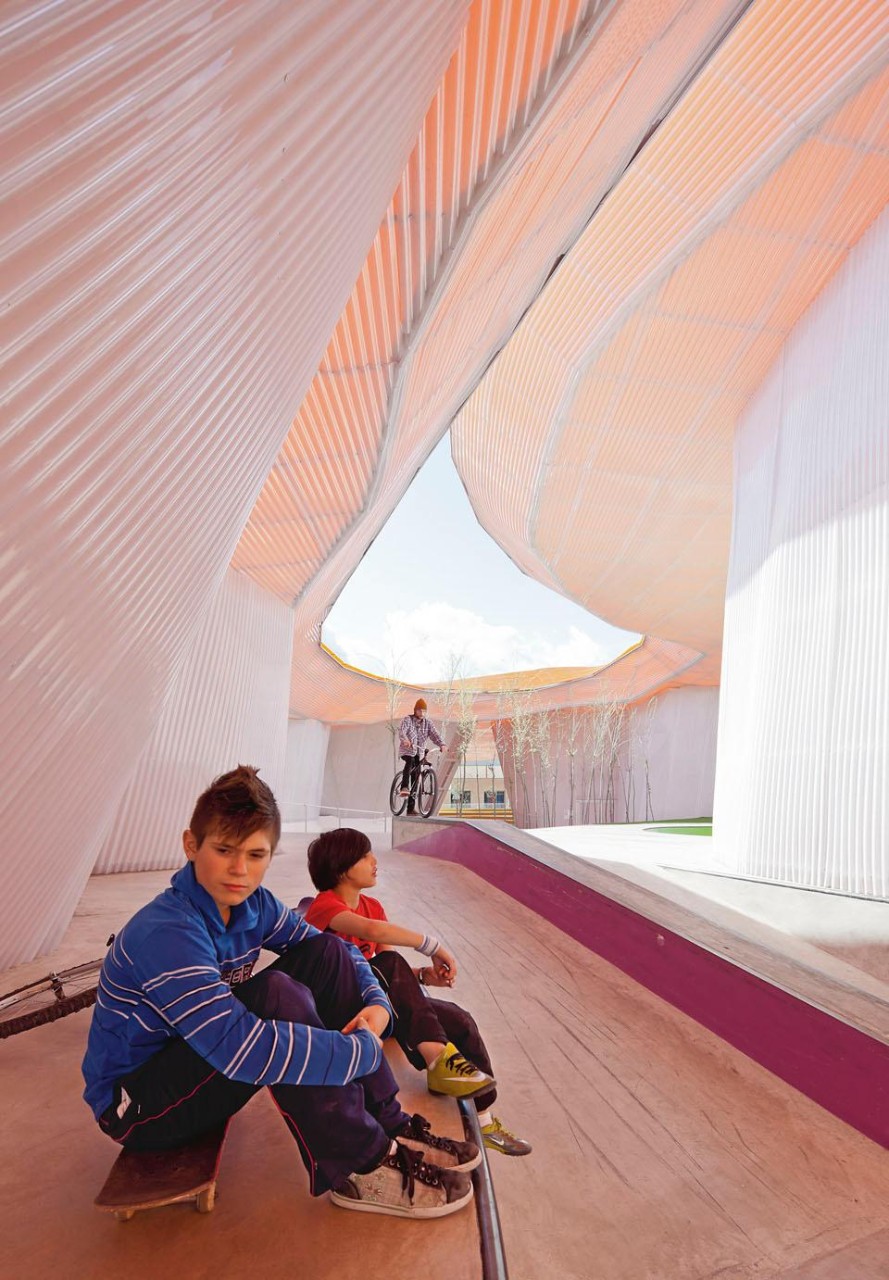
The canopy is a large,
one-metre-thick “thermal
cushion” that offers shelter
from soaring summer
temperatures. The metal
frame was fully clad with
polycarbonate panels.
NOTES
[1] Pedro Gadanho, "Venturi's
Revenge, or How Architecture
Went POP!" in Daniela
Konrad, Interrogating Pop in
Architecture, Wasmuth Verlag/ADIP-TU, Berlin 2008.
[2] Walter Benjamin (1936),
Das Kunstwerk im Zeitalter
seiner technischen
Reproduzierbarkeit,
Suhrkamp Verlag, Frankfurt
am Main 1980.
[3] Henri Lefebvre, La production
de l'espace, Anthropos, Paris
1974 (The Production of
Space, Blackwell Publishers,
Oxford 1995).
[4] Michel de Certeau, La Culture
au Pluriel, 1974
(Culture in the plural,
University of Minnesota
Press, Minneapolis 1997).
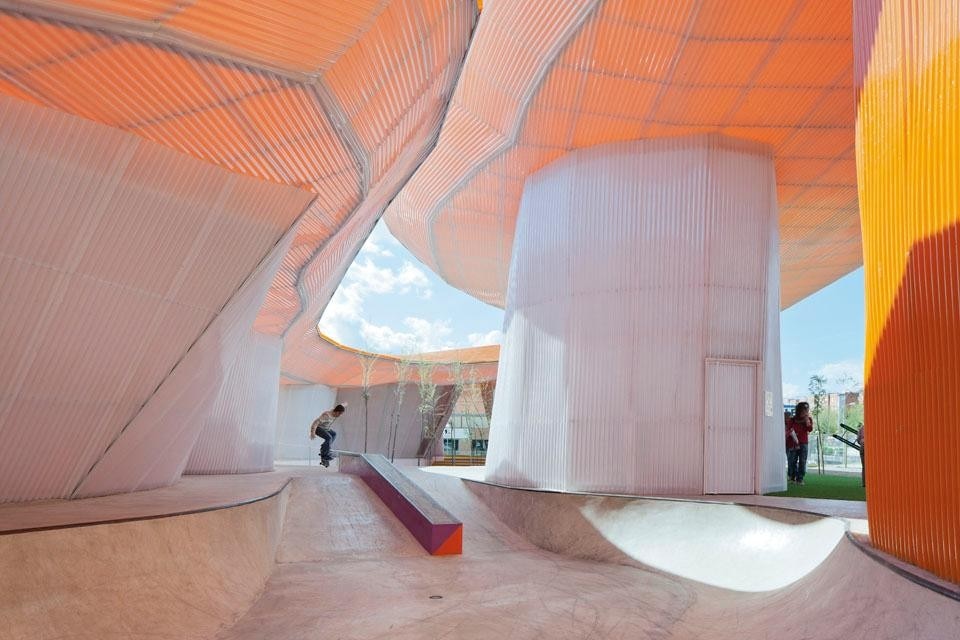
Built by the Extremadura
Regional Council by
arrangement with the Ley
de Convivencia y Ocio, the
project was developed in
collaboration with the local
population.
Design Architect: José Selgas e Lucía Cano
Project Team: Diego Cano, Lara Lesmes, Andrea Carbajo, Lorena del Río
Client: Junta de Extremadura
Structural engineer: Boma, Lanik
Mechanical engineering: Carlos Rubio
Floors manufacturer: Forbo
Lighting manufacturer: Talleres Zamora
General contractor: Procondal
Wall manufacturer: ATA
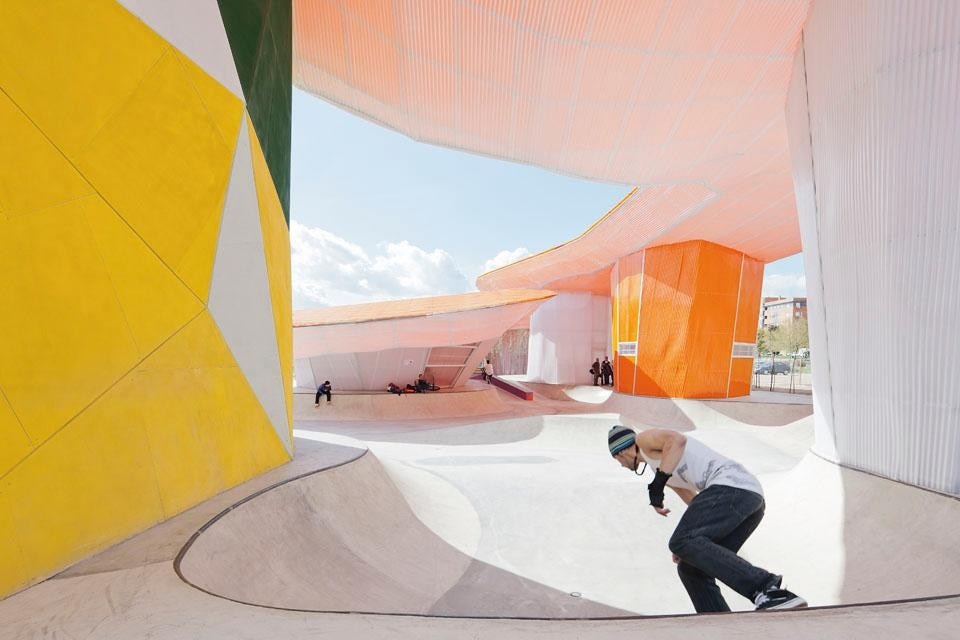
The complex was built over
a base about 1.5 metres
high, so as to protect the
archaeological remains
beneath it. It occupies a
surface of about 1,550 m2,
700 of which are allocated to skateboarding.


Architecture