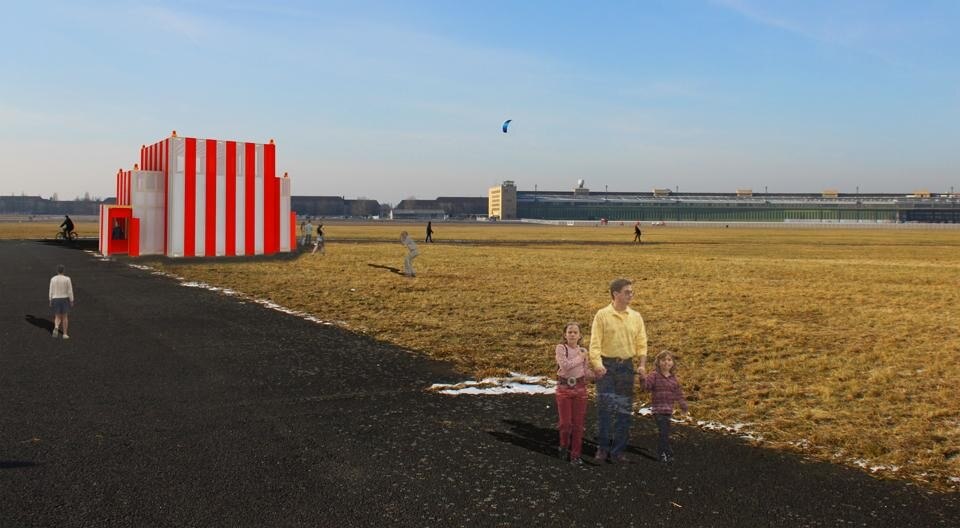
The Great World's Fair 2012

Following the unexpected, early demise of raumlaborberlin member and co-founder Matthias Rick, we publish a news report on the collective's latest project — in which Matthias was currently working — as a way to remember him.

Following the unexpected, early demise of raumlaborberlin co-founder Matthias Rick this past 28 April, we publish a news report on the collective's latest project, in which Matthias was actively working at the moment, as a way to remember him. Across the web, others have had similar initiatives, such as ROSY (the ballerina), a Kickstarter project to remember Matthias.

Over the last few years, debates about cultural politics have shown local policy makers to be completely focused on "competitive exhibitions," with which the city can bolster its image as an international cultural metropolis. Cultural politics in Berlin, it seems, have increasingly become a synonym for local marketing and an instrument of a neoliberal model of urban development. Politicians approvingly sell out urban space, putting up with the depletion of social and creative possibilities that goes along with this, in order to bring tourists and their money to Berlin, which the city needs in times of scarce public funds and paltry economic perspectives.

In this attempt to push Berlin far ahead in the competition between cities, it could only be a matter of time before politics would start pulling old plans out of the drawer, breathing new life into an event format with a dubious history. Why not simply put on a world's fair? Such is the concept behind The World is Not Fair–The Great World's Fair 2012, a new project by the architectural collective raumlaborberlin, in cooperation with Hebbel am Ufer, which seeks to create a counter proposal to the format of the "Expo," on the Tempelhof grounds from June 1-24, 2012.

This has been considered since the 19th century. It led, in 1897, at the highpoint of European colonialism, to the Great Industrial Exhibition of Berlin, which took place beyond the gateway to the city on the grounds of what is now called Treptower Park.
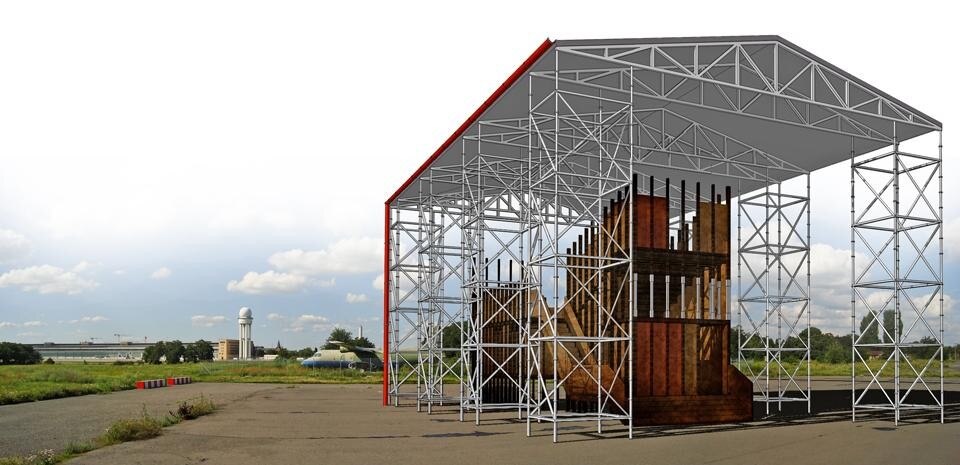
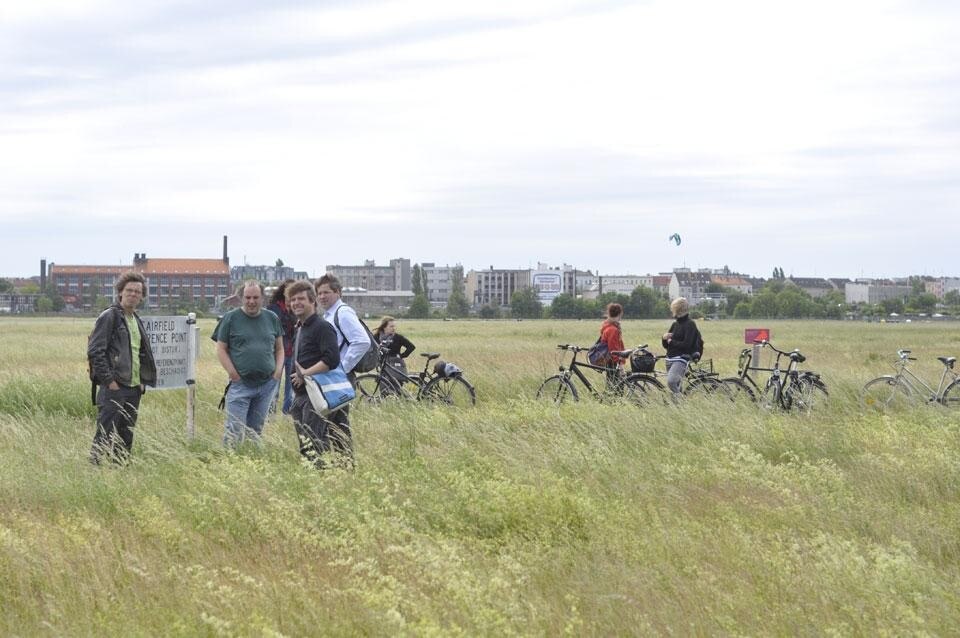
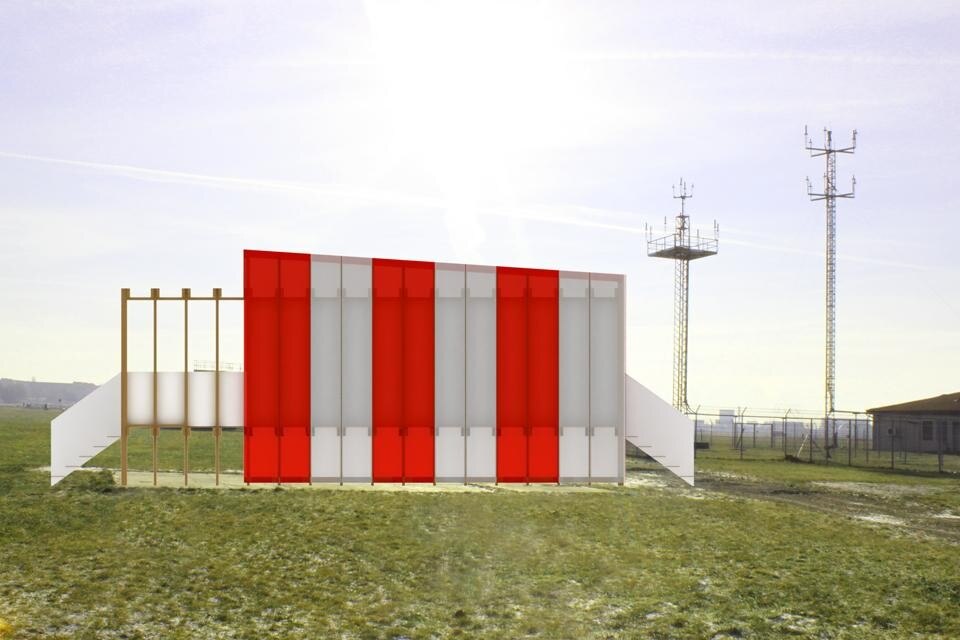
Top: Matthias Rick, third from left, and raumlaborberlin on the Tempelhof grounds. Above: <em>The Great World's Fair 2012</em> pavilion by director Toshiki Okada
Top: Matthias Rick, third from left, and raumlaborberlin on the Tempelhof grounds. Above: The Great World's Fair 2012 pavilion by director Toshiki Okada
The tradition of the so-called human zoos, which had already been established for 20 years through the activities of the Hamburg businessman and zoo founder Carl Hagenbeck, was carried on here. More than a hundred inhabitants of German colonies, including five hereros and four nama from present-day Namibia, were revealed to the exoticizing gaze of a curious audience in a so-called Negro Village. After these living exhibition objects had spent seven months in light tribal costumes practicing their traditional handicrafts, some of them even died due to the adverse weather conditions.

In the history of the world's fairs, which stretches over 160 years, degrading presentations of colonized cultures were a regular part of the agenda. Even the Brussels Industrial Fair in 1958 continued the tradition of these human zoos. The intrusions into the urban infrastructure of the host cities and their effects on the life of the people living there were hardly less destructive. We are reminded of the Vienna World's Fair of 1873. Then, at the time of the Austro-Hungarian Empire, the course of the Danube was even altered in order to make place for the expansive exhibition architecture.
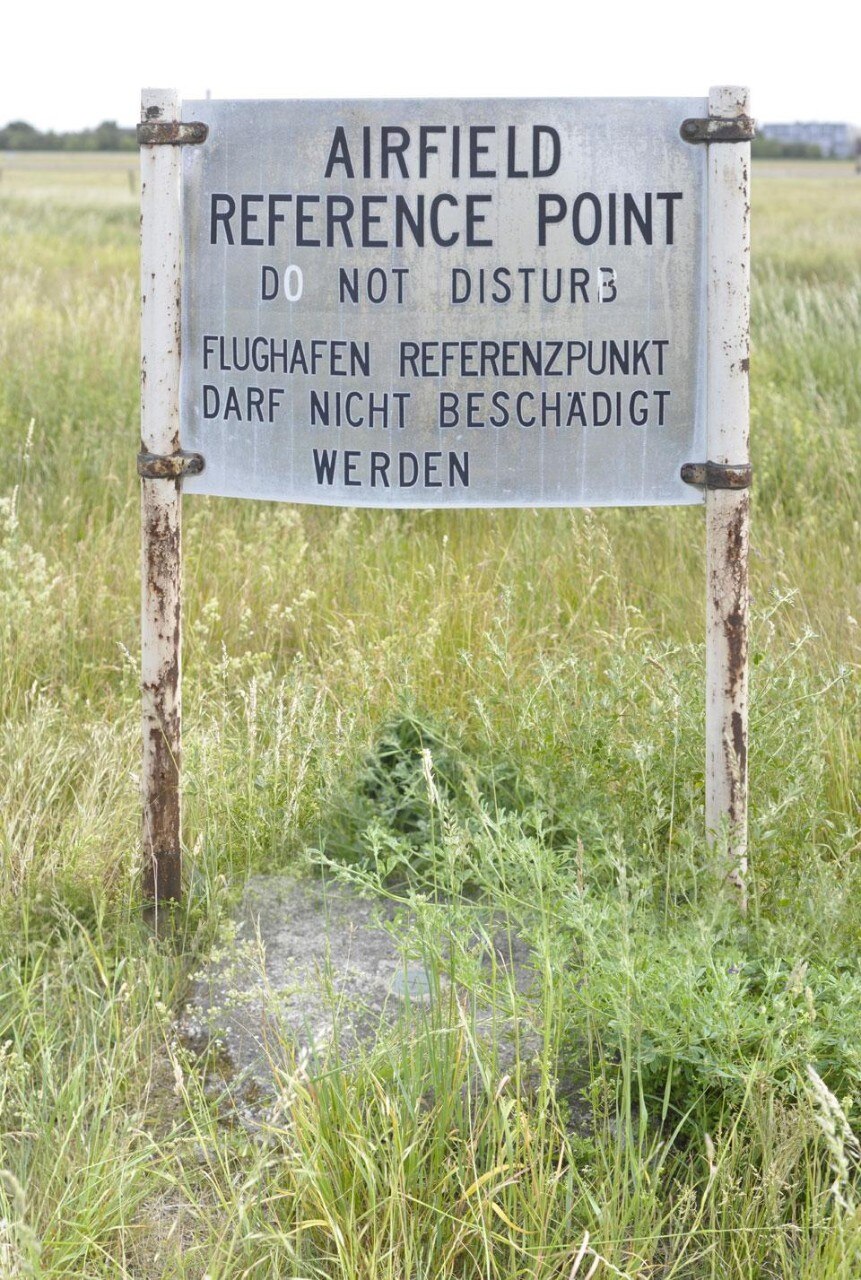
A detail of the grounds of the former Tempelhof airport
There is only a very limited sense in which the concept of sustainability can be associated with this when, even to the present day, if now under the brand name "Expo," whole neighborhoods emerge in metropolises all over the planet, in which nations enter a race of ideas to provide humanity with an idea of the world of tomorrow. Recently, for instance, in Shanghai, in order to make room for the construction needs of the large-scale exhibition with the revealing title, Better City, Better Life, around 8,000 families were forcibly evacuated–and then, as paying guests, were loaded onto tour busses and carted back in to their former and now radically restructured living quarters.

Often enough, this has given rise to some visionary architectural designs of unquestionable fascination. The Crystal Palace, conceived in Victorian style by Joseph Paxton, remains well-known to the present day. It was created for London's Great Exhibition in 1851, the first World's Fair ever. The technological breakthroughs of the industrial revolution made it possible, for the first time, to erect a monument out of steel supports and glass, completely doing without any structural masonry.
Before Berlin becomes the locale for such urban planning excesses and the collateral damage wreaked by them, The World is Not Fair–The Great World's Fair 2012, would like to create a counter proposal to the format of the Expo
Berlin-based filmmaker Harun Farocki will show the first part of a long research project with the title <em>Vorbild/Nachbild,</em> which examines the role of computer animation for simulation systems and prognostic services
Berlin-based filmmaker Harun Farocki will show the first part of a long research project with the title Vorbild/Nachbild, which examines the role of computer animation for simulation systems and prognostic services
Buildings such as the Crystal Palace set the perfect stage on which to present the most advanced developments of the burgeoning commodity capitalism to a mass audience, recruited both from members of the working class and the middle class. "World exhibitions," wrote Walter Benjamin in his Arcades Project, "glorify the exchange value of the commodity. They create a framework in which its use value recedes in the background. They open a phantasmagoria which a person enters in order to be distracted. The entertainment industry makes this easier by elevating the person to the level of the commodity."

Not even a hundred years later, at the Expo 67 in Montreal, the idea of transparent architecture that had been inaugurated by the Crystal Palace was brought to perfection when Buckminster Fuller designed the American Pavilion. An imposing steel structure was made out of pre-fabricated pieces. This was provided with a honeycomb of acrylic material and reached a diameter of 76 meters and a height of 62 meters. A 36-meter-long escalator in the middle of a theatrical exposition tour created an efficient transport system that provided access to the four great thematic worlds at seven levels.
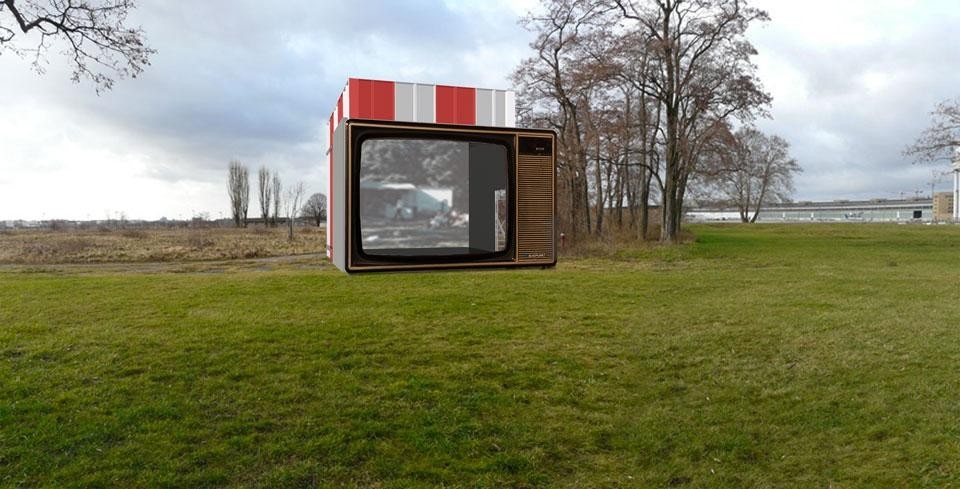
The video artists, performer, and activist Tracey Rose, with the help of non-professional actors, will put on a soap opera stretched out over the whole span of the exhibition
After a turbulent history of destruction and reconstruction, the building now houses the Montreal Biosphere, an interactive environmental museum for constructions of this sort. Much more frequently, however, the ambitious construction projects have landed on the rubbish heaps of history. The grounds of the New York World's Fairs in 1939/1940 and 1964/1965, the tour of the Exposición Universal, which was erected in Sevilla in 1992, or the exposition area of the Expo 2000 in Hannover — today they are abandoned or half-heartedly dismantled wastelands, eloquent witnesses of the past of a dream of the future, in the signs of an almost categorical belief in economic expansion and technological progress.
Ducth artist Willem de Rooij proposes a concert hall  presenting a composition composed of camel noises, seeing as the camel is one of the most popular world fair icons
Ducth artist Willem de Rooij proposes a concert hall presenting a composition composed of camel noises, seeing as the camel is one of the most popular world fair icons
Before Berlin becomes the locale for such urban planning excesses and the collateral damage wreaked by them, The World is Not Fair–The Great World's Fair 2012, would like to create a counter proposal to the format of the Expo, offering a tour with 15 pavilions set up for exploration on the grounds of the former airport in Tempelhof.

These pavilions are not to be understood as state agents for national branding, but instead as places of highly subjective artistic and political reflection. Beyond the boundaries of cultural disciplines, architects, theater artists, performers, and visual artists will seek to examine ideas, systems, and phenomena by which even the most outlying cultures are now globally connected with each other. What will be exhibited is not the world as it is or should be, but how we perceive, understand, and interpret it. Can it still be represented and negotiated as a totality at all?

Five projects that will be seen in the framework of The World is Not Fair – The Great World's Fair 2012 should be named here:
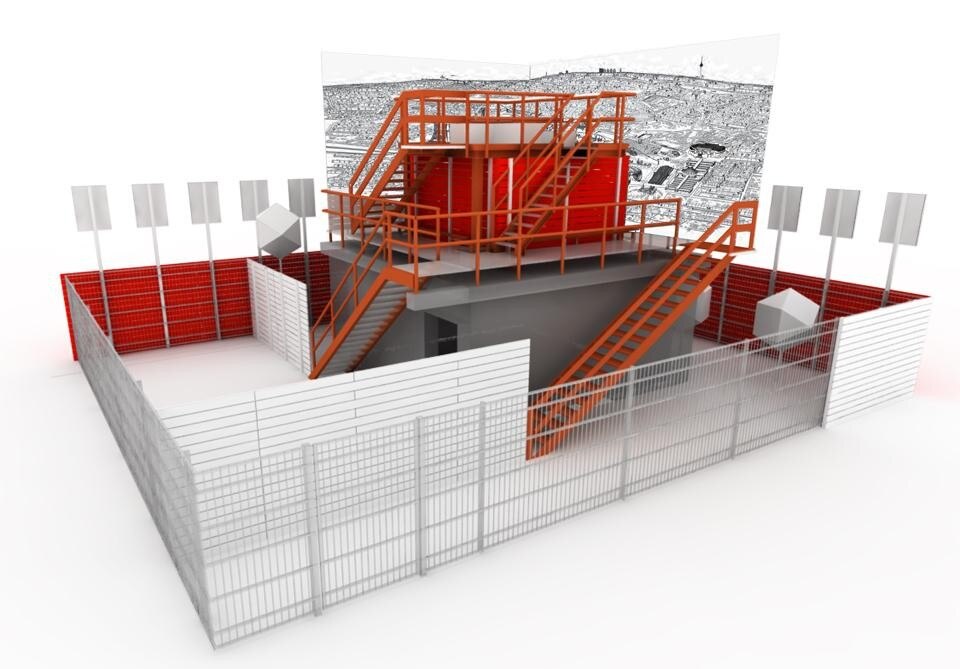
Berlin-based artist Erik Göngrich proposes a critical view on 160 years of world fairs. "Is there a way to create a world fair today that makes sense? Is there a way to create a world fair today in Berlin that makes sense?"
In an architectural structure reminiscent of the damaged reactor blocks in Fukushima, the director Toshiki Okada, who comes from Yokohama, together with his theater troupe chelfitsch, will examine the abstraction and immeasurability of the catastrophic events in a language of reduced gestures and limited words.

Hans-Werner Krösinger, one of the earliest representatives of contemporary documentary theater, is conceiving a living sound installation in an antenna building, focused on the military use and history of forced labor at the former Tempelhof Airport.
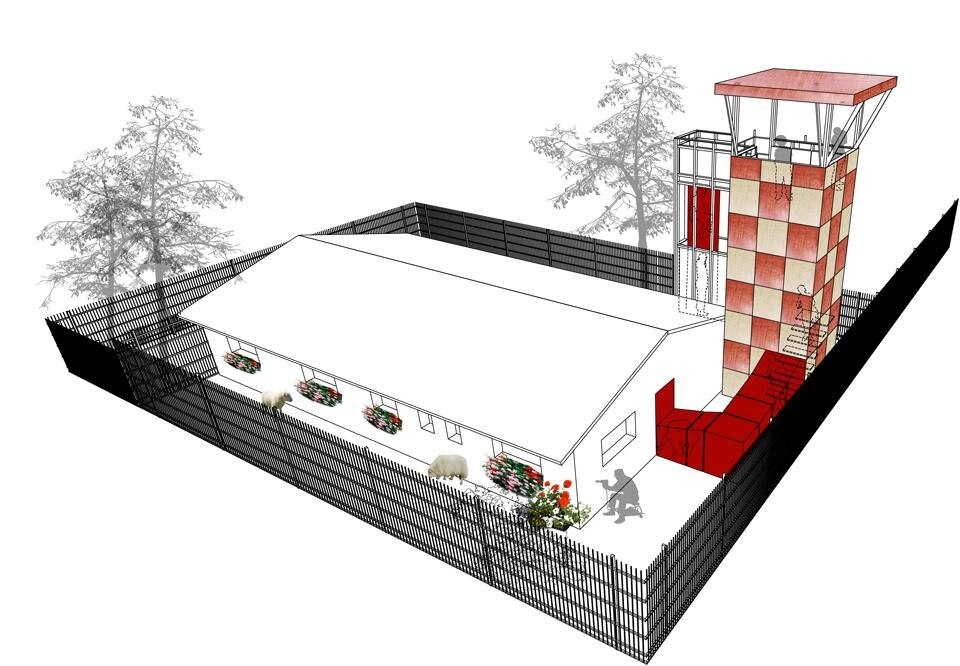
Gießen-based theatre collective Machina X proposes a theatrical installation in between virtuality and reality, where a hermit "living in the postapocalypse still has the illusion of the perfect world", while fixing it and caging conspiracy theorists
The video artists, performer, and activist Tracey Rose, with the help of non-professional actors, will put on a soap opera stretched out over the whole span of the exhibition. As a stage, she will use an oversized reconstruction of a black-and-white Blaupunkt television, which had provided her family in South Africa with access to world events during the Apartheid period.

Berlin-based filmmaker Harun Farocki will show the first part of a long research project with the title Vorbild/Nachbild, which examines the role of computer animation for simulation systems and prognostic services. It concerns the global circulation of air, fire, and water — and the demand to control a world that is marked by a growing instability in relation to the predictability of systematically defined events.
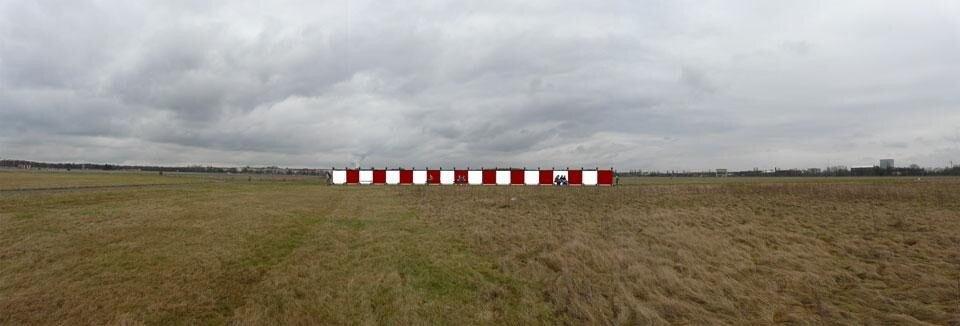
Beirut-based artist Rabih Mroue proposes a 40m long tunnel which is like a walkable thumb cinema, showing in 72 pictures the short moment of a Syrian demonstrator filming his own assassination by a sniper
The Stuttgart architecture collective Umschichten will build a festival center from found materials. For three weeks, a hybrid cultural space will emerge. It is meant to serve as a place of meeting and exchange for the visitors to The World Is Not Fair–The Great World's Fair 2012, but also as a venue for events. A comprehensive program of lectures, discussions, film screenings, and concerts will be presented here.

The architecture of the 15 pavilions can be understood as a contribution to a discussion about sensibly managing resources. A third of the exhibition spaces involve reformations of structures that already belong to the existing facilities of the former airport field. Other structures will be erected from modules that were used in the summer of 2011 at the festival Über Lebenskunst at the Haus der Kulturen der Welt. Only three pavilions are new structures, and these only to a limited degree.
Tempelhof Field, with its changing history as a former drill ground, as the stage for early aviation experiments, and thus as one of the prominent locations from which globalization took off, as the base for Nazi aerial warfare and as the key site for the arms industry of the Hitler regime, as the historic stage of the airlift between Berlin and West Germany and thus as a symbol of the Cold War and the politics of Western alignment, is the ideal location for this exhibition project.

The size of the grounds at Tempelhof Field matches the extent of Prague's old city. This extent shoots down any efforts that might be made to enter into a competition at the level of designing with monumental stagings, which we are familiar with from the world's fairs and "expos."

This need not be any disadvantage. Since these grounds cause any architectural gesture that would aim at overwhelming through supersizing to appear as merely marginal, they open up unfamiliar perspectives on our perception of near and far–forcing us to reflect on the proportions of cultural plans in relation to the normative and topographic frameworks that they are designed for. We therefore get the chance for a project to apply a poetry of failure into the work against this claim, to make the contradictions that arise because of it productive.

Latest on News

Latest on Domus

China Germany India Mexico, Central America and Caribbean Sri Lanka Korea icon-camera close icon-comments icon-down-sm icon-download icon-facebook icon-heart icon-heart icon-next-sm icon-next icon-pinterest icon-play icon-plus icon-prev-sm icon-prev Search icon-twitter icon-views icon-instagram